
On the evening of 1 December 1936, a 67-year-old man with a thick moustache and a pocketful of patents won the skipping contest in the first-class lounge of the P&O liner SS Mongolia. The ship was carrying him home from New York to Invercargill. He had been away, on and off, for the better part of twenty years. The skipping contest was the kind of foolish onboard entertainment Edwardian shipping companies still ran in the 1930s to keep the long sea legs amused, and Ernest Godward, who at seventeen had jumped ship at Port Chalmers and at fifty had relocated himself permanently to Manhattan, was good at this kind of thing. He was an old amateur boxer, an old amateur rower, an old amateur cyclist, and a man who never quite stopped moving. He was photographed with his trophy.
The next day he had a heart attack in his cabin. He was buried at sea. The trophy, the patents and the trunk full of correspondence went the rest of the way to Invercargill without him.

That is the story New Zealand has on file about Ernest Godward, when it has any story at all, which is rarely. There is a brief Te Ara entry. There is an Otago Daily Times feature his great-granddaughter wrote when she put a book together for the family. There is a Wikipedia article. There is a slightly fervent NZEDGE profile which keeps trying to call him a legend and not entirely succeeding. There is a 16-room Queen Anne villa called Rockhaven sitting on Queens Drive in Invercargill, behind a hedge, on the New Zealand Heritage List. There is a heritage marker. There are a small number of his patent specifications in the United States Patent Office archive, viewable online, in his own dry careful technical English.
And then there is the actual life. Godward was, by an honest count, one of the most prolific Antipodean inventors of his generation. He patented somewhere north of thirty separate devices over a working career of forty years. The two that made him serious money were a hairpin that sat still on the head and a small brass-and-steel device that improved the fuel economy of the early internal-combustion engine by something like a third. He invented an eggbeater that did not skid across the kitchen bench, a hedge clipper made from old bicycle parts, a kerosene-pump siphon, a tank filter, a tin can lid, and an animal trap that nobody seems to have a clear description of. He helped run Invercargill’s first hot-air balloon launch. He won the first proper Invercargill-to-Dunedin motor race. He served three years on the North Invercargill Borough Council. He sang in local productions. He was, by every contemporary description, exhausting.
He was also more or less an absentee husband. He married Marguerita Treweek in 1896. They had ten children in twenty years. From 1916, when Ernest was 47, he lived in New York. Madge Godward and the children stayed in the 16-room villa on Queens Drive, and Madge ran the household for the rest of her life on remittances. After Ernest died, his widow and one of their daughters went through his diaries and his correspondence and burned everything they considered too personal. There was a story, kept quiet inside the family for decades, that an American woman had once turned up at Rockhaven asking after a Ming vase Ernest had supposedly promised her. The American woman was not invited inside.
None of this is a scandal. It is the texture of a real life, and it is the texture this country tends to airbrush out of its inventor stories, because we are more comfortable with men in workshops than with men who run two parallel households on opposite sides of the Pacific. Godward did the second thing, and he also did the workshop, and the workshop is the part this story is mainly about, because the workshop is the part that mattered.
The boy who ran away
Ernest Robert Godward was born on 7 April 1869 in Marylebone, London, the son of Henry Godward, a fireman, and Sarah Pattison. He was a sickly child. He did not attend any school until he was nine. There is a family story that he was eventually sent to a preparatory school at twelve, took one look at it, and absconded.
What happened next is unusual enough that historians have generally taken it on his word. He turned up at the London docks, found a berth on a steamer, and reached Japan. He worked, by his own account, on a cable-laying ship operating between Nagasaki and Vladivostok. He was eventually located by the British Consul in Japan, Sir Nicholas Hannen, who was responsible at that point for repatriating English children who appeared in the Treaty Ports without permission. Hannen put him on a P&O steamer and sent him home to his parents.
Back in London, Henry Godward apprenticed his runaway son to Shand, Mason & Co of Blackfriars. Shand Mason were one of the great names of Victorian engineering, a firm of hydraulic engineers who built steam-powered fire engines for the British municipal market. Ernest spent his early teens learning to fit pipework, machine brass, calibrate steam pressure gauges and read engineering drawings. Then he ran away again, this time as a P&O steward on a steamer bound around the world.
This time the ship reached New Zealand. On 31 December 1886, at the age of seventeen, Ernest Godward jumped ship at Port Chalmers. He never lived in England again.
Dunedin, and a banjo
His first New Zealand decade reads like an entire other person’s biography. He worked as a photographer’s assistant in Dunedin. He learned the banjo. He fell in with a touring vaudeville troupe called the Star Variety Company and sang on minor circuits. He won a row of athletic prizes — over a hundred medals across his life, by family count, in cycling, running, swimming, rowing and boxing. He drifted into the bicycle trade because in the early 1890s every fit, mechanically minded man in Britain and the colonies was drifting into the bicycle trade. The high-wheeled penny-farthing had given way to the chain-driven safety bicycle, and a generation that had never had personal transport before suddenly did.
By 1893 he was working in Dunedin for Sam Stedman, the cycle dealer. By 1894, at twenty-five, he had moved to Invercargill and bought into the Southland Cycle Works on Dee Street, eventually trading as Godward and McKenzie. The shop sold imported English and American bikes, repaired them, hired them out, and assembled their own house brand under the name Sparrowhawk. Godward, by every account, ran a competent business and rode competitively for the Invercargill Cycle Club at the same time.
On 28 January 1896 he married Marguerita Florence Celena Treweek, known to everyone as Madge. He was twenty-six. She was the daughter of a respected Invercargill family. They moved into a small house. Their first child arrived inside a year. By the turn of the century they had three.
This is the standard photograph of Edwardian success in provincial New Zealand. It is also the photograph Ernest was about to walk out of.
The hairpin that sat still
Sometime in 1899, in the back of the Dee Street workshop, Godward took a piece of fine springy steel wire and bent it into a tight helix, then opened the helix into the shape of a long-legged elongated U with a corkscrew along one shaft. It was a hairpin. The point of the spiral, which is impossible to describe usefully without a picture, was that the helical kink gripped the hair on one side. An ordinary hairpin in 1899 was a straight wire bent in a U; it slid out of fashionable hairstyles, particularly the bouffant arrangements of long hair on top of the head that were the dominant adult women’s hairstyle of the period, more or less continuously, and Edwardian women spent a quiet, unending portion of every day pushing hairpins back into place. Godward’s spiral version, once seated, stayed put.
He patented it in New Zealand in 1899. He went into local production through a new vehicle, Godward’s Spiral Pin and New Inventions Company, listed on the New Zealand stock exchange. The pin sold instantly. It sold in Australia, where one Melbourne distributor reportedly moved a quarter of a million units. It sold in South Africa. By 1900 Ernest Godward had decided that the way to make a real fortune out of the spiral hairpin was to take it to America.
He went. He filed United States patents through New York attorneys. One related design, his rubber hair-curler, survives in the USPTO archive as US Patent 672,506, filed on 31 July 1900 by "Ernest R. Godward, of Invercargill, New Zealand," and granted on 23 April 1901. It described a curler made wholly of pliable rubber, on the grounds that the metal-tipped curlers then in use, in his own dry phrase, came uncomfortably into contact with the head when the wearer was reclining. He was thinking about women trying to sleep in their curlers.
For the spiral hairpin itself he formed two American companies, the Merkham Trading Company and the Koy-Lo Hairpin Company, to handle manufacture and distribution. The NZEDGE profile claims that Mark Twain, then in his sixties and personally bankrupt after the Paige typesetter disaster, served briefly as the Koy-Lo company’s vice-president. The claim is unsourced and I have not been able to verify it in the Twain biographical literature, so it sits here as a family-flavoured anecdote rather than as fact.
What is fact is the price. In around 1901 Godward sold the American rights to the spiral hairpin for £20,000 sterling. In contemporary New Zealand pounds that was the price of fifteen or twenty Invercargill houses. In modern terms it was something on the order of three or four million New Zealand dollars. He kept the Australasian rights. He sold his interest in Southland Cycle Works in 1900. He came home to Invercargill rich, at thirty-two, and decided to spend the rest of his life inventing things.
Rockhaven
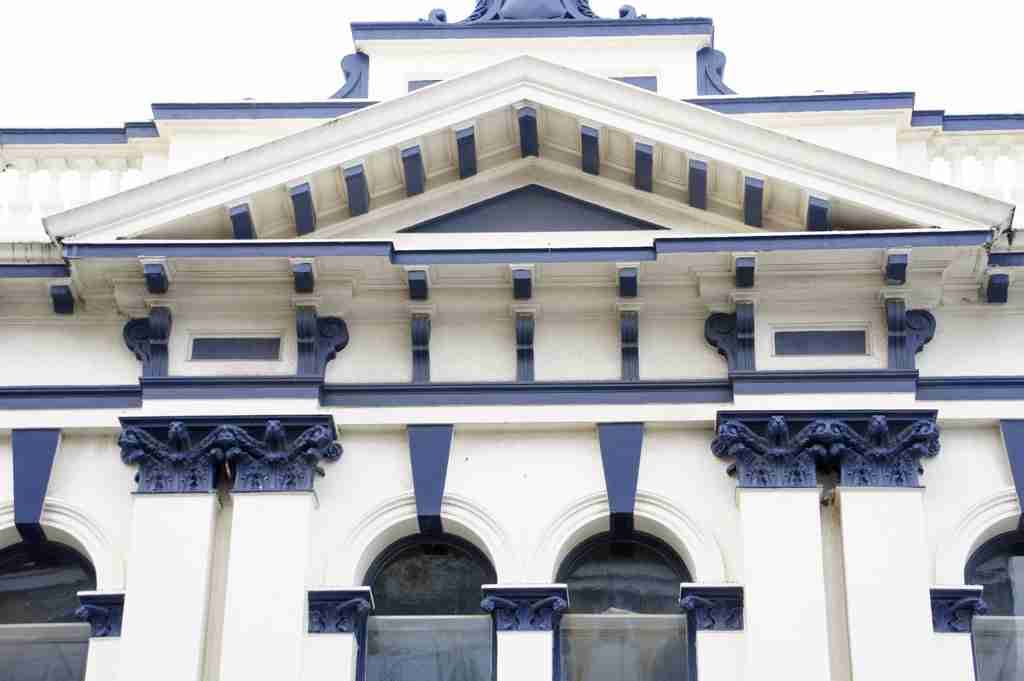
The first thing he did with the hairpin money was build a house. From 1905 to 1908, on a generous corner section of Queens Drive in north Invercargill, a local architect put up the kind of sixteen-room Queen Anne villa that Edwardian colonials built when they wanted everybody to know they had returned from America. It had a turret. It had a wraparound veranda. It had a billiard room, a dedicated music room, decorative fretwork that Godward partly carved himself, and a stained-glass front door. Ernest called it Rockhaven and gave the design language an explicit American flavour borrowed from houses he had seen on his patent trips in California and on the East Coast.
Rockhaven still stands. It is listed by Heritage New Zealand as a Category 2 historic place. Madge lived there until 1946, when the house was sold to the Smith family of Invercargill, who held it until 1977. Successive private owners have kept the building largely intact.
Rockhaven is not a metaphor for anything. But it is the closest thing this country has to a physical record of Godward’s first fortune, and it sits, very quietly, behind a hedge in a southern provincial city, in the rough centre of his decade of greatest local visibility.
The Invercargill years
Between 1900 and his more or less permanent move to America in 1916, Godward was the most visible private engineer in Southland. He was elected to the North Invercargill Borough Council in 1903 and served until 1906. He helped found the Invercargill Amateur Swimming Club. He raced bicycles. He was on the committee of the Invercargill Cycle Club. He sang. He painted, in oils, with reasonable competence; some of his pictures are still in the family. He played a string of musical instruments. He was, in 1908, a passenger in the first hot-air balloon ascent ever attempted from Invercargill, which went up from the Showgrounds with his friend Robert Murie. The next year he and Murie won the first Invercargill-to-Dunedin-and-back motor race, in a Reo car fitted with one of Godward’s prototype carburettor improvements. The Southland Times reported the result with the slightly stunned admiration provincial papers reserve for men whose hobbies become news stories.
The eggbeater belongs to this period. He had been thinking, his children later said, about why his wife’s eggbeater always shot off across the kitchen bench halfway through a sponge cake. The fix was almost trivially simple. He fitted a rubber suction cup to the lower foot of the central spindle. The cup gripped the bowl when downward pressure was applied. It ungripped when the cook lifted the device clear. He filed for a US patent in April 1906. US Patent 846,661, "Egg-beater, whisk, &c.", was granted on 12 March 1907 to Ernest Robert Godward, described in the specification as "a subject of the King of Great Britain, residing at Invercargill, Southland, New Zealand". The first illustration in the specification is a small line drawing of the rubber sucker. The application time for the cake batter, the family said, dropped from fifteen minutes to about three and a half.
His son Bruce later remembered, drily, walking around as a boy in Invercargill knowing without quite understanding it that his family’s tools were not shaped like anybody else’s. Lawn rakes were the wrong shape. Hedge clippers were the wrong shape. Hairpin-making jigs were lying around the workshop. Pencil sharpeners had been modified. The egg whisks plainly worked better than other people’s egg whisks. The household ran on prototypes.
Other patents from this Invercargill period that turn up in records or contemporary newspaper coverage include a non-slip post-hole borer for fencing work; a hedge-trimming attachment built out of bicycle pedal cranks and a sharpened reciprocating bar; a burglar-proof window catch that locked when the sash was closed and could be opened only with a special key from the inside; a padded draught-protector for the bottom of doors; a kerosene-pump siphon for the home; a spring-loaded tank filter; a sealable lid for tinned-food cans for re-use after opening; and a telescopic hose nozzle for fire hydrants and garden taps. Several of these were filed in New Zealand only. A handful were marketed by the Spiral Pin and New Inventions Company and sold in domestic hardware stores. None of them made him as much money as the hairpin.
By the time of the 1908 Coldstream shooting case, in which a young Invercargill woman named Maud Buchanan fired a revolver at a love rival in a domestic dispute, Godward was prominent enough in the town that his witness statement was reported in the Southland Times. He had been driving past at the time.
The carburettor
Around 1908 — the precise date depends on which member of the Invercargill motoring set you ask, because the early carburettor was modified continuously over years — Godward built the prototype of the device that would consume the second half of his working life. Internal combustion engines of the period burned petrol very inefficiently. The standard carburettor of 1908 atomised raw petrol into a fine spray and fed it into the inlet manifold, where most of it never fully vaporised before combustion. The unvaporised droplets either burned poorly, soaking the cylinder walls and washing oil off them, or condensed inside the manifold and emerged from the exhaust unburned.
Godward’s idea was to insert a small device between the carburettor and the cylinder head. The device, in his early prototypes, used a small heated chamber and a series of internal baffles to break the fuel droplets up further and ensure that what reached the cylinder was true vapour, not droplet-laden air. He called it, at various times, the Eclipse Petrol Economiser, the Godward Vaporiser, and the Godward Gas Generator. The brand name moved with the market.
The central performance claim he and his demonstrators made was that the device added roughly fifteen per cent to the engine’s horsepower, cut petrol consumption by about a third, and allowed an engine to run on lower-grade fuels — kerosene, distillate, fuel oil, occasionally even bootlegged spirits during American Prohibition — that the standard carburettor could not handle without flooding. He demonstrated it on bicycles fitted with proprietary engines, then on imported Reo cars he sold through his Dee Street premises, and then on motor buses in the United Kingdom.
In 1913, age 44, he travelled to London and set up the Godward Carburettor Company in a small factory at Kingston-upon-Thames. He was hoping to win a contract with the London General Omnibus Company, which by then had a fleet running into the thousands. The London buses had been an obvious early target for fuel-economy claims because they covered enormous mileage on a fixed urban duty cycle. He patented the British version of the device in 1914. The contract did not come. The company did not work in Britain. He shut it down.
In 1916, at forty-seven, with the Great War raging and shipping perilous, he sailed for New York and opened an office at 280 Broadway in lower Manhattan, in the building stack just north of City Hall. He never lived in New Zealand again, except as a visitor.
Manhattan, twenty years
The American chapter of Godward’s life is the part the New Zealand record is hardest on, because the New Zealand record is mainly the record his children kept, and his children grew up at Rockhaven without him. He had ten children. In strict terms, they had nine plus a niece of Madge’s whom Madge raised; the household and his correspondence treated all ten as his. He paid for them. He visited them. He did not live with them. The New York apartment was understood, inside the family, as Father’s other house.
What he did inside that apartment, and inside the workshop he ran out of Manhattan, is documented in the United States patent record. Over the second half of his career he filed for and was granted a long string of refinements on the original 1908 vaporiser idea. The most significant of these for our purposes is US Patent 1,854,298, "Vaporizer", filed on 15 September 1930 by "Ernest R. Godward, of New York, N.Y.", assigned to The Eclipse Petrol Economiser System Company, Limited, of Christchurch, New Zealand, and granted on 19 April 1932. The opening sentences describe an apparatus for "bringing a plurality of fuel mixture streams into collision" in order to shatter remaining liquid droplets and recover unvaporised petrol back into the inlet stream. Total carburettor variants he developed over the New York decades, by the count of the No.8 Re-Wired aggregator, eventually reached 72 distinct models.
The device worked, demonstrably, in the field. In 1926 the United States Army’s Quartermaster Corps trialled it on a fleet of military trucks. The trial reports, summarised in the Wellington Evening Post at the time and quoted in the secondary literature, said the device increased horsepower at no fuel cost and allowed the engines to use cheaper fuel. The Army adopted it for selected applications. By 1929 the largest urban transit operator in Philadelphia, the Mitten Company, had fitted the Godward vaporiser to roughly 580 of its buses. New Zealand papers reported the Mitten contract that year as a significant Antipodean engineering victory.
It is at this point, the highest point of his second commercial life, that the rest of the world fell on him.
The crash
In late October 1929 the New York Stock Exchange collapsed. Godward, in common with most American small-business owners of the period, had been holding his liquid wealth in equities. He held a substantial position in the Eclipse Petrol Economiser System Company, in oil-related industrials, and in a number of small Manhattan promotions. He also held private debt to American distributors of his vaporiser. He took heavy losses. The Wellington Evening Post in early 1929 had been reporting his successes; by late 1929 it was reporting his setback, in the slightly euphemistic vocabulary of the period, as a partial reverse.
He did not stop. He filed the major 1930 vaporiser patent after the crash. He kept the Manhattan office open. He kept selling. He continued to be described, in trade journals, as one of the world’s leading practical authorities on the internal combustion engine. The phrase appears in industrial reports from the early 1930s.
What he did not do, more or less ever, was come home. The 1936 voyage on the SS Mongolia was his first attempt at a permanent return. He was sixty-seven. He was tired. The American economy had not recovered to anything like the level of late 1928. He had, at last, decided to leave the Manhattan office in the hands of a younger associate and live out his last years on Queens Drive. He was looking forward, his last letters home suggested, to walking around his own garden again.
He died at sea instead.
What Madge burned
His trunk, his trophy and a small parcel of papers went on without him and were forwarded to Invercargill. Madge Godward, by then in her sixties, opened them with one of her unmarried daughters. They read for some weeks. They then made a quiet decision that the diaries, the personal correspondence and a portion of the loose business letters were not material that would do anyone any good. They burned the lot in the Rockhaven incinerator.
What was burned has never been precisely known. It included, almost certainly, a long correspondence with a number of American business associates. It very probably included the documentation around any second household. It eliminated, almost completely, the means by which any biographer would ever reconstruct the New York years from the inside. The destruction was not malicious. It was Edwardian propriety doing what Edwardian propriety did, by a woman who had survived four decades of an absent husband and was not about to spend her widowhood archiving him. Shirley Walker, his great-granddaughter, wrote about the burning in her family-published 2013 book Ernest R. Godward, Inventor with the dry generosity of a descendant who has decided not to fight the dead.
What survives is the patent record, the public newspaper coverage in Papers Past, the Heritage New Zealand listing on Rockhaven, a few photographs, the eggbeater (still produced, in its modified form, into the late twentieth century), the trophies, an inscription on a 1932 presentation gift from his American business associates that called him simply "singer, musician, painter, inventor, traveller, adventurer, and all-round sport", and one Ming vase story.
The honest accounting
How prolific was he, really? The frequently repeated number is that he held over thirty patents. That is broadly accurate as a count of granted and lodged patents across New Zealand, the United Kingdom and the United States during his working life. The further claim, that he developed 72 different models of carburettor and vaporiser, refers to internal product variants rather than to 72 separate granted patents, and is best read as such; the United States patent corpus under his name is smaller than that, but consistent with active continuous improvement of a single device family across two decades.
How important was the carburettor? The honest answer, in the long sweep, is that fuel-vaporisation aftermarket devices were a serious and growing field in the 1910s, 1920s and early 1930s, before the major automotive carburettor manufacturers — Stromberg, Carter, Zenith — closed the gap by improving their stock designs and made the bolt-on aftermarket largely redundant. Godward’s device worked. It worked well enough for the United States Army to fit it. It worked well enough for the largest transit operator in Philadelphia to fit five hundred and eighty buses with it. It made him a second fortune in the late 1920s. It did not change the world, because by the late 1930s the problem it solved had been solved upstream, inside the carburettor itself. That is not a failure. That is what happens when a small inventor finds a real problem at a moment in technology when the problem is about to be designed out of the system.
How important was the hairpin? Within the genre of personal items invented in colonial New Zealand and sold worldwide, very. The spiral hairpin was, for roughly fifteen years between 1900 and the wartime shift to shorter women’s hair, a piece of standard hardware in millions of bedrooms. It made him the kind of money no other Invercargill businessman of his generation made on a single product. It was the basis of everything else he did.
The man who refused to be one thing
The standard New Zealand inventor story is meant to end with a moral. Godward’s does not, particularly. He was not a wronged genius. He was not a struggling visionary. He was a sharply intelligent, restlessly competitive, technically competent provincial man who decided in 1899 that he could do better than the standard hairpin, was right, sold the rights for a fortune, and then refused to spend the next thirty years sitting at home. He liked Manhattan. He liked the hum of business on Broadway. He liked patent attorneys and prototype shops and trade journals. He also liked Invercargill. He liked Rockhaven. He liked the children he barely lived with. He liked his wife, in the absent, financially reliable, somewhat 1890s sense in which an Edwardian husband of his class was permitted to like his wife. He kept skipping, somehow, into his late sixties. He won the contest. He died.
What he did not do was leave New Zealand a great institution. There is no Godward Foundation. There is no Godward chair. There is no Godward Museum, although there are Godward-attributed objects in the small Southland Museum archive. There is the eggbeater. There is the carburettor patent file in the USPTO. There is Rockhaven on Queens Drive, behind its hedge.
The reason he is less remembered than Bill Hamilton or Bill Pickering or John Britten is mostly geography and partly category. Godward’s biggest commercial successes happened either in colonial Melbourne or in New York, not at home. The carburettor patents are American. The Mitten Company buses ran in Philadelphia. The hairpin millions came out of an American holding company. The biographical centre of gravity of his career, looked at coldly, is not Invercargill. It is the Atlantic seaboard. New Zealand likes its inventors with a clearer hometown story.
And the inventions, in their second category, are domestic. They are eggbeaters and hedge clippers and door draught-protectors. Even the hairpin is, in the cultural unconscious, a mildly funny object. New Zealand prefers the jet boat, the bungy, the spiral guitar, the racing car. We do not really know what to do with a man whose biggest single hit was a piece of Edwardian women’s hair hardware.
Godward himself probably would not have minded. He was, on the surviving evidence, immune to status anxiety. He cared what worked. He cared what sold. He cared about patents and prototypes and athletic medals and his own physical fitness, well into late middle age. He cared, plainly, about the household at Rockhaven, even if he organised his life so that he was almost never inside it. The skipping contest on the SS Mongolia the night before he died is the most Godward sentence available about the man. He was sixty-seven, he had been at sea for weeks, he was on his way back to a country he had largely stopped living in, and there was a competition, so he won it.
Sources and further reading
- Allison Rudd, Truly a man of many talents, Otago Daily Times, 17 August 2013 (interview with Shirley Walker, great-granddaughter)
- Shirley Walker, Ernest R. Godward, Inventor (River Press, 2013)
- Te Ara Encyclopedia of New Zealand, Godward, Ernest Robert (Dictionary of New Zealand Biography)
- NZEDGE Legends, Ernest Godward, Inventor
- Wikipedia, Ernest Godward
- Heritage New Zealand, Rockhaven, 397 Queens Drive, Invercargill (List No. 2509)
- USPTO, Patent US672,506: Hair-crimper (filed 1900, granted 1901)
- USPTO, Patent US846,661: Egg-beater, whisk, &c. (filed 1906, granted 1907)
- USPTO, Patent US1,854,298: Vaporizer (filed 1930, granted 1932; assigned to The Eclipse Petrol Economiser System Company, Christchurch)
- National Library of New Zealand, Papers Past — contemporary Southland Times and Evening Post coverage 1899–1936
More from the Great New Zealanders series
This is part of Newswire's Great New Zealanders series, which profiles people whose lives shaped this country. Other recent profiles include Jean Batten, Roy Kerr and Bruce McLaren.
Have something to add
Did your family own a Sparrowhawk bicycle, a Godward eggbeater, or one of the spiral hairpins? Are you a descendant of one of Ernest and Madge Godward's ten children? Have you been inside Rockhaven on Queens Drive? We would love to hear from you in the comments below.
This article was written by AI, briefed to report the facts, hopefully without some of the bias people bring to the job 🙂
Leave a Reply