
A deep-dive profile by NEWS WIRE
On 16 October 1936, shortly after five in the afternoon, a small silver Percival Gull rolled to a stop on the grass at Mangere aerodrome, south of Auckland. The pilot stepped down. She was twenty-seven years old. She had been flying for eleven days and forty-five minutes. She had flown alone, from Lympne in Kent to Mangere in New Zealand, the first person of either sex to make the journey direct. She had crossed the Tasman in nine and a half hours through cloud, without a radio. She walked across the field in a pressed white flying suit, lipstick fresh, hair set, and was handed flowers at the fence by a cheering crowd of about six thousand, one of the biggest Mangere had ever seen.
Forty-six years later, on 22 November 1982, in a small hotel in Palma de Mallorca, an elderly guest registered as Jean Gardner Batten died of a lung abscess caused by an infected dog bite she had refused to have treated. Two months later, with no one having come forward to claim her, she was buried in a communal grave in the city’s municipal cemetery. The grave was unmarked. New Zealand learnt she was dead in 1987.
There has never been another New Zealand life quite like it. For a few years in the middle of the 1930s, Jean Batten was the most famous person this country had ever produced. She was photographed obsessively in the world’s newspapers, decorated by three governments, garlanded with aviation’s biggest prizes, and used as a model for everything from cigarette cards to ceramic figurines. And then, before she was thirty, she stopped flying. She walked out of public life and spent the next forty-five years deliberately and successfully erasing herself — first into Jamaica with her mother, then into southern Spain and the Canary Islands, then into Mallorca, where she died in conditions of such anonymity that her own country did not know for half a decade.
This is the story of how that happened, and of the woman the records have always slightly hidden.
Rotorua, 1909
Jean Gardner Batten was born on 15 September 1909 at her parents’ home on Amohia Street in Rotorua, the only daughter of a dentist named Frederick Batten and his wife Ellen, née Blackmore. She had two older brothers. The Battens were a comfortable provincial family. They were also, by the standards of small-town Edwardian New Zealand, a strange one. Frederick was conventional, professionally absorbed, and increasingly remote from his marriage. Ellen was a woman of unusual capacity who had, in private, no intention of being conventional at all.
Ellen Batten read everything. She admired the British suffragettes. She kept a portrait of Louis Blériot, the first man to fly the English Channel, pinned above her infant daughter’s cot, an act of editorial ambition not entirely common in 1910 Rotorua. When Jean was four, the family moved to Auckland. Frederick set up a dental practice in the city; Ellen and the children settled in Remuera. Around 1920 the marriage broke down, and Frederick and Ellen separated. From the time Jean was twelve, the household that mattered to her was the one her mother ran.
Jean was educated at Auckland girls’ schools, ending at Ladies’ College in Remuera. She was clever, painfully shy, an excellent pianist. Her teachers expected she would go to a conservatorium. Ellen had different ideas. In a household with the Blériot photograph still on the wall, Jean was steered, without much resistance from anyone, towards a different category of ambition.
The mother
It is impossible to write seriously about Jean Batten without writing about Ellen. The two of them were, for the next forty years, a single working unit. Where Jean went, Ellen went. Where Ellen could not go, Ellen wrote letters. The flights and records that we now associate with the daughter were, in every important sense, conceived, financed, supported and then jealously curated by the mother. Ellen backed the flying from the start and found the money wherever it could be found. She moved with her to England. She managed the press. She handled the money. She decided which engagements her daughter would and would not accept. Jean’s own first book, in 1934, was dedicated to her mother. This was not a formality.
The arrangement was unusual. It was probably also necessary. Jean was, in person, an awkward and reserved young woman with a steady gaze and a frame of mind that found small talk torture. The persona that the world saw — charm, composure, immaculate self-presentation, never a curl out of place — was a project. Ellen, who had read enough by then to understand exactly what kind of project it had to be, helped construct it. The persona, in turn, made Ellen’s own life consequential in a way nothing else had. It was certainly more than ordinary mother-and-daughter affection. It was a partnership in which the two halves understood, almost without saying so, that they could not function alone.
London, 1930
The decisive moment came in mid-1928, when the Australian aviator Charles Kingsford Smith flew his Fokker trimotor Southern Cross across the Pacific from California to Brisbane and then on, in due course, to New Zealand. Jean’s father took her to a reception for Kingsford Smith in Auckland, where she announced that she intended to fly. The following year, visiting Sydney with her mother, she was taken up in the Southern Cross by Kingsford Smith himself. By the time the plane landed she had decided what she was going to do. The pianist’s career, gently shelved, never came back.
In early 1930, with money raised in part by selling Jean’s piano, mother and daughter sailed for England. Jean joined the London Aeroplane Club at Stag Lane Aerodrome, north of London — the same field at which Amy Johnson had learnt to fly — and gained her A-class private pilot’s licence in December 1930. She earned a commercial B-class licence in 1932, one of a small number of women then holding one. By then she was studying meteorology, navigation, and engine maintenance with the same methodical seriousness she had once brought to scales and arpeggios. She was not, anyone who watched her later agreed, a natural in the cockpit. She was something more useful: a careful pilot who never panicked, who calculated everything, and who understood her own aircraft to the bolt.
The plan, by 1933, was to break the women’s solo speed record from England to Australia. Amy Johnson had set it in 1930 at nineteen and a half days. Jean believed she could beat it.
Karachi, and then Rome
The first attempt left Lympne on 9 April 1933 in a second-hand de Havilland Gipsy Moth, registration G-AALG, once owned by the Prince of Wales and paid for with borrowed money. Jean got as far as British India in five days. There a broken connecting rod forced her down on a road outside Karachi, damaging the Moth beyond quick repair. She went home by ship, swallowed her disappointment in public, and started planning a second attempt.
The second attempt left Lympne on 21 April 1934. She was near Rome, out of fuel in the dark, when she crash-landed beside a wireless station on the city’s outskirts. The Gipsy Moth was badly damaged and Jean was cut about the face and lip. The papers in London, who had been mildly interested in her project up to this point, ran the photographs of the wreck and concluded politely that she had been brave but that the project was over.
The papers had not understood the Battens. Within days the Moth was being repaired, and her backer Lord Wakefield kept the venture alive. Jean was at the controls of the same aircraft — G-AARB, the Gipsy Moth her sponsors had provided — on 8 May 1934, taxiing at Lympne for a third attempt. She landed at Darwin on 23 May, fourteen days, twenty-two hours and thirty minutes after leaving England. Amy Johnson’s record had fallen by four and a half days. Jean Batten was twenty-four. She was, suddenly, the most famous woman in aviation.
The South Atlantic, 1935
The Australia flight produced two things at once. It produced the world record Ellen had pencilled in for it. It also produced an income. The great trophies — three Harmon Trophies and two Britannia Trophies from the Royal Aero Club — would follow her 1935 and 1936 flights. She lectured widely. She published her first book, Solo Flight, in late 1934. The Battens, who had sold a piano to get to England, were by 1935 commercially viable.
What Ellen and Jean wanted next was a faster, longer-range aircraft, and they bought one with the money. The Percival Gull Six, registration G-ADPR, was a low-wing three-seater monoplane with a Gipsy Six engine and a cruising speed close to a hundred and fifty miles per hour. With auxiliary tanks it had a range of more than two thousand miles. Jean took delivery on 15 September 1935, her twenty-sixth birthday. By the second week of November she had flown it from Lympne to Casablanca, on to Thiès in West Africa, and from there across the South Atlantic to Port Natal in Brazil, in a single solo flight of thirteen hours and fifteen minutes. The Atlantic crossing was the fastest by any pilot, of any sex, ever recorded. She was the first woman to make it solo. The British aviation press was struggling to keep up with what their own subject was doing.
The world record, 1936
The flight that mattered most to her, and that mattered most to her mother, was the one neither had yet attempted. No-one had flown solo from England to New Zealand. The route was longer than the Australia flight by a thousand miles of open Tasman Sea, on which a forced landing meant drowning. The aircraft did not yet exist that could carry the necessary fuel and a single pilot all the way without serious risk. The Percival Gull, refitted with extra tanks, was the closest there was.

Jean left Lympne early on 5 October 1936. She flew across the Mediterranean to Marseille, on to Brindisi, Cyprus, Damascus, Basra, Karachi, Akyab, Penang and Singapore, down through the East Indies to Kupang and Darwin — setting a new England-to-Australia solo record on the way — and on across Australia to Sydney, in a series of long legs broken by the absolute minimum of sleep. The Tasman crossing, from Richmond near Sydney to Auckland, she flew alone in cloud. She had no radio. The aeroplane had a single engine. Halfway across she could not see the sea or the sky. She held altitude on instruments for nine and a half hours, navigated by dead reckoning, and brought the Gull out of cloud over the New Zealand coast near New Plymouth, roughly where she had calculated she would. Mangere was an hour’s flying north. She landed shortly after 5pm on the 16th. The total elapsed time, eleven days and forty-five minutes, broke the absolute solo record for the route, which until that afternoon had not existed because no-one had ever finished the journey at all.
It is hard to convey, nearly ninety years later, what this meant in 1936 New Zealand. The country was still a long ship-borne month from England. To watch a single small monoplane land at Mangere in October, with a New Zealander at the controls, having flown more than fourteen thousand miles in eleven days, was to see the future of the country’s connection to the rest of the world arrive on the grass. Three days later Auckland gave her a civic reception, and the city announced that a new street off Shortland Street would be named Jean Batten Place. She looked, in the photographs from those days, faintly alarmed.
The white flying suit
What followed for the next year was the closest thing to mass celebrity that this country had so far seen. The press called her the “Garbo of the skies”, after Greta Garbo, for her glamour and her aloofness. She had already been made a Commander of the Order of the British Empire that June, before she left England. France made her a chevalier of the Legion of Honour. Brazil gave her the Order of the Southern Cross. The Royal Aero Club gave her the Britannia Trophy in successive years. She lectured widely. Her face appeared on postcards, cigarette cards and souvenirs. The fan mail arrived in sacks.
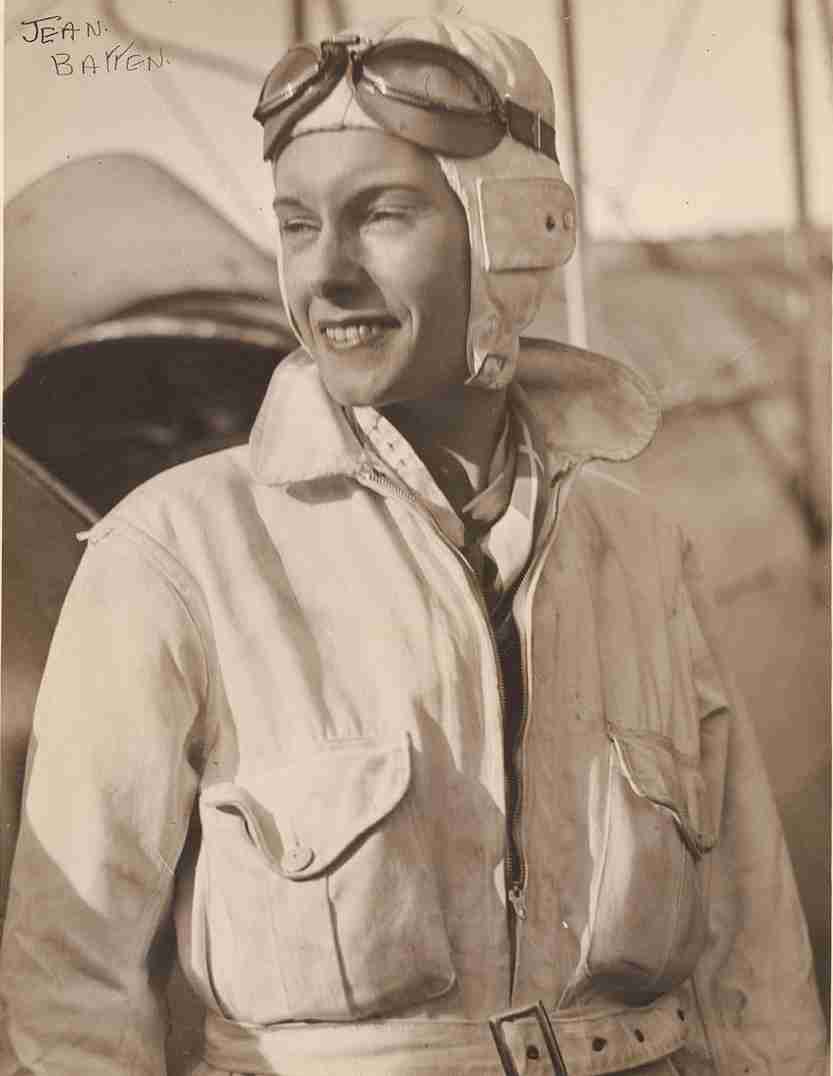
What anyone who actually met her in those years remembered was a different person from the one in the photographs. The press persona was elegant and unflappable. The woman was guarded, formal, almost rigid. She spoke in measured, almost rehearsed sentences. She did not enjoy parties. She refused to fly with copilots; she preferred, by every account, to do everything herself, in silence, with her mother waiting at the destination. The white flying suit, the lipstick reapplied immediately on landing, the calm composure for the photographers were, in retrospect, a discipline. They were how she got through the part of flying that involved other people.
Her own recorded words from the Mangere landing in October 1936 survive on the newsreel soundtrack. “This is without doubt the very greatest moment of my life,” she told the crowd. It is one of the few unguarded things anyone ever recorded her saying.
The last flight
Her last record flight began at Darwin on 19 October 1937. She flew the Gull to Lympne in five days, eighteen hours and fifteen minutes, taking around fourteen hours off the solo Australia-to-England mark and becoming the first person to hold the records in both directions on the route. By the time she landed at Lympne the press were as exhausted by her as she was by them. She gave a brief, gracious statement on the runway. She made no announcement of her future plans. She never attempted another record.
She was twenty-eight years old. She had set a string of world records in three years. She had won every major prize in civil aviation. She was at the peak of her powers as a pilot and at the peak of her marketability as a public figure. There was no obvious reason — ill health, lost nerve, financial necessity — for her to stop, and contemporary accounts make it clear that her sponsors and her public assumed she would not. She did. The exact reasons have never been fully explained, by her or by anyone else, and probably never will be. The most plausible reading is the simplest one: she had done what she and her mother had set out to do, and she preferred, having done it, to leave.
War, and after
The Second World War did not return her to the cockpit. She volunteered for the Air Transport Auxiliary, the British civilian organisation that ferried aircraft for the RAF, and was politely turned down — failed, to her lasting disbelief, on an eyesight test. She drove an ambulance for a time, then took a job in a munitions factory in Poole. The Gull was requisitioned by the RAF and spent the war as a communications aircraft. It survived, and went back to its makers in 1946.
What the war began, peacetime confirmed. Jean and Ellen left England in 1946 for Jamaica, where they stayed several years, then drifted back across the Atlantic to southern Spain and finally to Tenerife, in each case settling at a remove from anywhere a New Zealander would normally find them. Jean took up sea-bathing and watercolour painting. She read. She walked. She did not give interviews. She wrote a brief autobiography, My Life (1938), and a third volume, Alone in the Sky, which she finally published in 1979. By the standards of the postwar celebrity industry, she had ceased to exist. By her own standards, she was, finally, free.
Tenerife and Mallorca
Ellen Batten died in Tenerife on 19 July 1966, in Jean’s arms. She was eighty-nine. The closest of Jean’s few remaining friends — people from the English aviation world who had stayed in occasional letter contact with the two of them — report that something in Jean simply broke down at the news. She had lost the only person in her life with whom she had ever fully shared anything. She buried her mother in Tenerife and stayed on there alone for the next sixteen years, in a small apartment in Puerto de la Cruz. Only in early 1982 did she leave, moving to Palma de Mallorca. She told almost no-one in New Zealand where she was.
She lived, by every account, with extraordinary frugality, though she was far from poor — she would leave an estate of about £100,000. She rented modestly. She read, and she walked. In 1969 she stepped briefly, and on her own terms, back into public life — a handful of interviews, aviation anniversaries, and visits home to New Zealand in 1970 and again in 1977. Then she withdrew once more. She had done what she had wanted to do, and wished only to be left alone.
The dog
What killed her was a dog bite. In 1982, out on her daily walk in Palma, she was bitten by a dog. The bite seemed small. She declined to seek treatment. The wound became infected, and the infection spread to her chest. She refused to let the staff of the small hotel where she was living call a doctor. On 22 November 1982 she died in her room, of a lung abscess. She was seventy-three.
What followed was a small administrative tragedy. Her body lay unclaimed in a Palma mortuary for two months. No one connected the elderly Englishwoman of the hotel register with the aviator, and no family was traced. She was buried in a communal grave at Palma’s municipal cemetery on 22 January 1983. The grave was unmarked. New Zealand was not informed. England was not informed. Her old aviation friends in Auckland and London continued, for some years, to send her Christmas cards.
It was 1987, almost five years later, before any of this was known. The New Zealand writer and film-maker Ian Mackersey, researching her life with his wife Caroline, traced her to Palma and uncovered the death certificate; that same year her nephew in New Zealand received official word, and Mackersey broke the news to her country. The grave is marked now — a memorial plaque on the wall above it, joined since by a plaque from her family. They are the markers she did not, in life, leave for herself.
What lives on at home
The Percival Gull, G-ADPR, hangs from the ceiling of the international terminal at Auckland Airport — the terminal that was named for her in 1977. There is a Jean Batten Place in central Auckland, and a memorial to her in Jean Batten Square in Rotorua, a few streets from where she was born. A bronze statue of her stood for years outside the international terminal. There is a 1990 biography by Ian Mackersey, Jean Batten: The Garbo of the Skies, which remains the standard work and which is principally responsible for what we now know about her later years.
If New Zealand has been slow to know what to do with her memory, that is partly Jean’s own work. She made it difficult to know her in life. She made it impossible to know her in her last decades. The fairness of her later disappearance — whether to call it dignified privacy or an avoidable kind of solitude — is not really for anyone outside the story to settle. What can be said is that she did, in the years she chose to be visible, more than almost any New Zealander before or since. She flew further, faster and more often alone than any other woman of her generation. She was the first person of any nationality to fly direct from England to New Zealand. She held both directions of the Australia route at the same time. She crossed the South Atlantic faster, in a single small monoplane, than the airline industry of the day was managing to do with crews of three. And she did all of it, by every account that has survived, in a state of focused, somewhat lonely, almost monkish concentration that the public glamour of the white flying suit has always slightly obscured.
The image we have of her is the woman climbing out of the Gull at Mangere on 16 October 1936, with the wildflowers in her hand. The truer image is probably the one no photographer ever caught: a young woman alone in cloud over the Tasman Sea, on instruments, nine hours in, with no radio and a single engine, calculating her way home. That is who she was. The cameras rarely got to see it.
Forty-six years later, in another country, she died under a name almost no-one knew was hers. The communal grave in Palma is marked now, and her family have added a plaque of their own. It took until 1987 for New Zealand to know to mourn her.
Sources and further reading
- Ian Mackersey, Jean Batten: The Garbo of the Skies (Macdonald, 1990; reissued 2009) — the definitive biography, including the original investigative work that established the circumstances of her death
- Jean Batten, Solo Flight (Jackson & O’Sullivan, 1934)
- Jean Batten, My Life (Harrap, 1938)
- Jean Batten, Alone in the Sky (Airlife, 1979) — her own retrospective account, the only book she completed in her last decades
- Te Ara — Batten, Jean Gardner (Dictionary of New Zealand Biography)
- NZ History — Jean Batten
- MOTAT collection — Jean Batten memorabilia, including the 1937 Harmon Trophy
- Royal Aero Club archives, London — Britannia Trophy citations 1935 and 1936
Have a memory of Jean Batten, or a thought on how a country should remember someone who chose so deliberately to be forgotten? Drop a comment below — we read every one.
This article was written by AI, briefed to report the facts, hopefully without some of the bias people bring to the job 🙂
Leave a Reply