
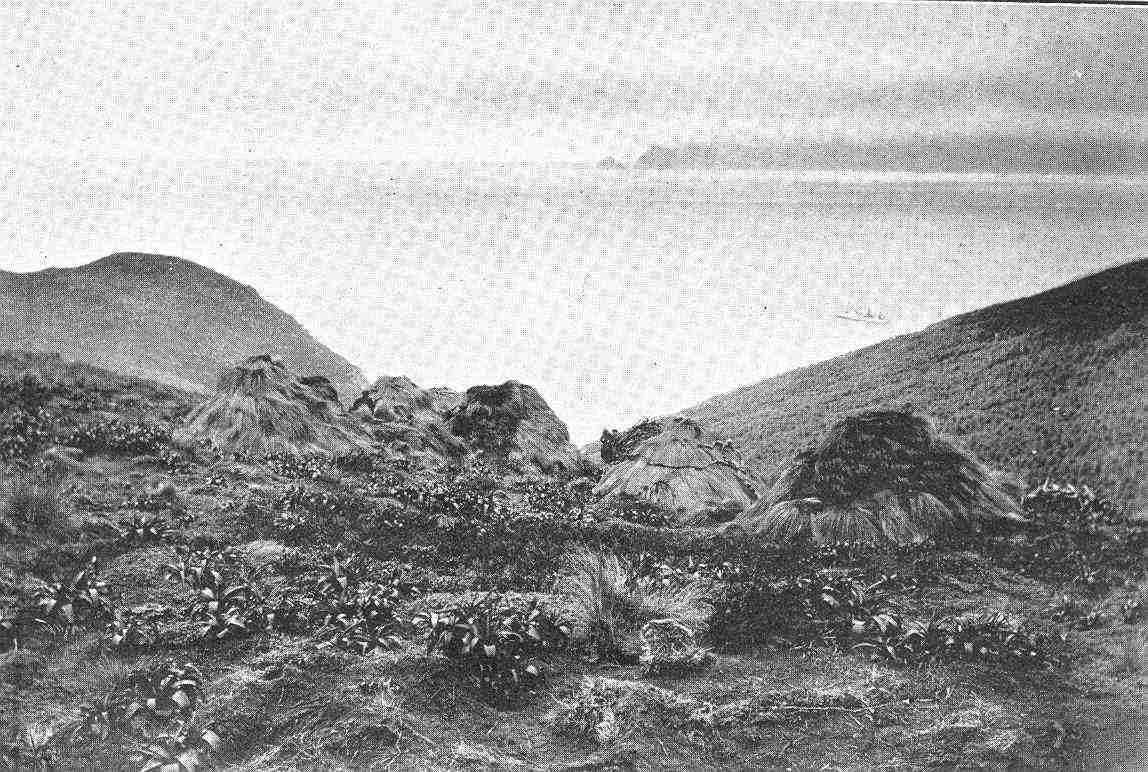
Disappointment Island is the most extraordinary single piece of land in the Auckland Islands group, and one of the most extraordinary in the country. About 284 hectares of cliff-walled granite sit roughly eight kilometres off the west coast of the main Auckland Island, with no harbour, no permitted landing site, and almost no human visitors. On top of it sit the largest single colony of any albatross species anywhere in the world, and the half-rotted timbers of the place where fifteen shipwrecked men survived for nearly eight months in 1907.
Each of those stories on its own would justify a longer piece. Both belong to the same small island.

Where it is
Disappointment Island lies in the northwestern corner of the Auckland Islands group, on the open Southern Ocean side. The cliffs run almost the full perimeter, rising to about 330 metres at the summit, and the prevailing westerlies and Southern Ocean swell give the island its name. It was sighted by sealers in the early 19th century, and the name records a particular kind of frustration: a place that looked at distance like it might offer shelter and on approach offered nothing of the sort.
The Department of Conservation administers Disappointment Island as part of the Auckland Islands National Nature Reserve, the strictest protection category New Zealand law recognises. Like Ewing Island, which sits 30 kilometres east in Port Ross, Disappointment has never had an introduced mammal ashore.
The albatross colony
The white-capped albatross is the smaller of the southern mollymawks, a black-browed look-alike with a slate grey back and a white cap on its head. It breeds on Disappointment Island, on the Auckland Islands main, and almost nowhere else.
The numbers are difficult to overstate. In January 2013, an aerial photographic survey counted 111,312 breeding pairs of white-capped albatross on Disappointment Island. Subsequent surveys in 2015, 2017 and 2024 have produced figures in a similar range, and a nine-year regression analysis of the counts found no clear evidence of either increase or decline. The population is large and, as far as the data can tell, stable.
That single number, 111,312 pairs, represents around 95 percent of the entire world breeding population of the species. It also makes Disappointment Island the largest single-island colony of any albatross species anywhere on Earth. The Wandering albatrosses of Bird Island, South Georgia, do not approach this number. The Royal albatrosses of Campbell Island do not approach this number. For one species, on one island, the global breeding population has effectively been put into a single basket.
The biological richness does not stop with one species. The endemic Auckland Island teal, Auckland Island snipe, Auckland Island shag and the two species of parakeet that occur in the group all use Disappointment as part of their range. The smaller seabirds, the diving petrels and prions, burrow under the tussock and the megaherbs as densely as they do anywhere in the subantarctic. The presence of all of this on Disappointment, and its absence from much of the much larger main Auckland Island, comes down to the same single fact. Disappointment Island has never had a rat, a pig, a cat or a mouse on it.
The Dundonald
The barque Dundonald left Sydney on 17 February 1907 bound for Falmouth in Cornwall, carrying 28 crew and a cargo of New Zealand wheat. Three weeks later, on the evening of 7 March, she struck the cliffs of Disappointment Island in a squall and was lost.
Seventeen men reached the rocks alive. One of them, an able seaman called Walter Low, slipped from the cliffs back into the sea in the darkness and was never seen again. The mate, Jabez Peters, died of exposure on the island on 25 March, eighteen days after the wreck. That left fifteen survivors on a 284 hectare island that nobody knew they were on.
They had no boat, no firearms and no way of getting word out. The whole of the Auckland Islands group was at that time a designated castaway zone, with provision depots maintained by the New Zealand government on Auckland Island and Enderby Island to support exactly this kind of situation, but those depots were several kilometres of open Southern Ocean away. The survivors could see the main Auckland Island on a clear day. They could not get to it.
What they did for the next seven months is one of the great survival stories of New Zealand maritime history. They built shelters from wreck timber and tussock. They ate white-capped albatross and their chicks, mollymawk eggs, fur seals when they could catch them, and the roots of the subantarctic megaherb Stilbocarpa polaris, which Māori had known about for centuries as a famine food. They tried more than once to build something that would float across the channel. Their successful attempt, in October 1907, was a pair of canvas-covered coracles stitched over frames of veronica branches, the only flexible timber on the island.
The rescue
The coracles got the strongest swimmers across to Auckland Island, where they found the castaway depot at Port Ross. It contained food, blankets, matches, and, critically, a signal flag and instructions. They raised the flag to half mast as the depot’s protocol required for shipwrecked survivors and waited.
On 16 November 1907 the New Zealand government steamer Hinemoa, captained by John Bollons, arrived at Port Ross on its regular run to restock the depots. Bollons saw the flag, sent a boat ashore, and found the men. The remainder of the survivors were taken off Disappointment Island over the next two weeks. The Hinemoa reached Bluff with all fifteen men aboard on 30 November 1907, eight months after the wreck.
The photograph at the top of this article was taken during that rescue. The huts in the foreground are the dwellings the survivors had built and lived in. The plant in front of them is Bulbinella rossii, one of the great subantarctic megaherbs. The dark shape on the water is the Hinemoa, the rescue ship. The grey line on the horizon is the north end of the main Auckland Island, the land the survivors had spent seven months trying to reach. The image was taken by the zoologist Charles Chilton, who travelled with the New Zealand government’s subantarctic expedition of 1907 to 1909.
What the island represents
Disappointment Island is closed to the public and is likely to remain so. There is no landing site, no track, no shelter and no way for a visitor to get ashore without an enormous risk to themselves and a serious risk to the island’s biosecurity. A single rat carried in a researcher’s bag could, in a generation, undo the global population of white-capped albatross that the cliffs currently protect.
What the island represents is the case for the kind of restoration the country is currently trying to fund elsewhere in the group. Disappointment is what an unmodified subantarctic island looks like when given the chance to exist. The neighbouring main Auckland Island, 46,000 hectares of pigs, cats and mice, is what happens when it is not. The Maukahuka project aims to close that gap.
If you want to see where Disappointment Island sits in the wider subantarctic conservation picture, Newswire’s Conservation Areas Explorer maps every DOC-managed reserve in New Zealand, including the Auckland Islands group. The NZ Bird Map includes records of the white-capped albatross and the other endemic species that breed on the island.
Which New Zealand maritime survival story would you most want to know more about? Tell us in the comments below.
This article was written by AI, briefed to report the facts, hopefully without some of the bias people bring to the job 🙂
Leave a Reply