

If you have a New Zealand bank account, it sits inside one of four Australian-owned banks. ANZ is Australian. ASB is owned by Commonwealth Bank of Australia. BNZ is owned by National Australia Bank. Westpac is Australian. There is no large New Zealand-owned trading bank left in the country, with the partial exception of state-owned Kiwibank, which is roughly a tenth the size of the smallest of the four.
If you shop at Countdown, you are shopping at Woolworths Group, an Australian company. Countdown, FreshChoice and SuperValue together account for roughly half the New Zealand grocery market. The other half is Foodstuffs — Pak’nSave, New World and Four Square — which is a New Zealand-owned cooperative of grocers, the one piece of the supermarket sector that has not gone offshore.

If you have house, contents or car insurance, you are most likely insured by Insurance Australia Group, which owns the State, AMI, NZI and Lumley brands and controls roughly 60 percent of the New Zealand general insurance market. The bulk of the rest is Suncorp Group, also Australian, trading here as Vero and AA Insurance.
This is a very particular pattern. Three large consumer-facing sectors of the New Zealand economy, providing services that almost every household uses every week, are now owned to a substantial degree by Australian shareholders. The natural question is why.
The simple answer is that we sold them. The harder answer is that Australia saved while we did not.
Between 1984 and 1999, the New Zealand Crown sold roughly $19 billion of state-owned businesses, and several New Zealand mutual companies separately demutualised over the same period. State Insurance was sold to a British buyer in 1990 and ended up inside Australian IAG. AMI was sold to Australian IAG in 2012 after the Canterbury earthquakes broke its mutual structure. The Bank of New Zealand had been state-owned until the early 1990s and was acquired by NAB. Telecom, NZ Steel, the Crown Forest licences and many smaller assets were sold in the same window.
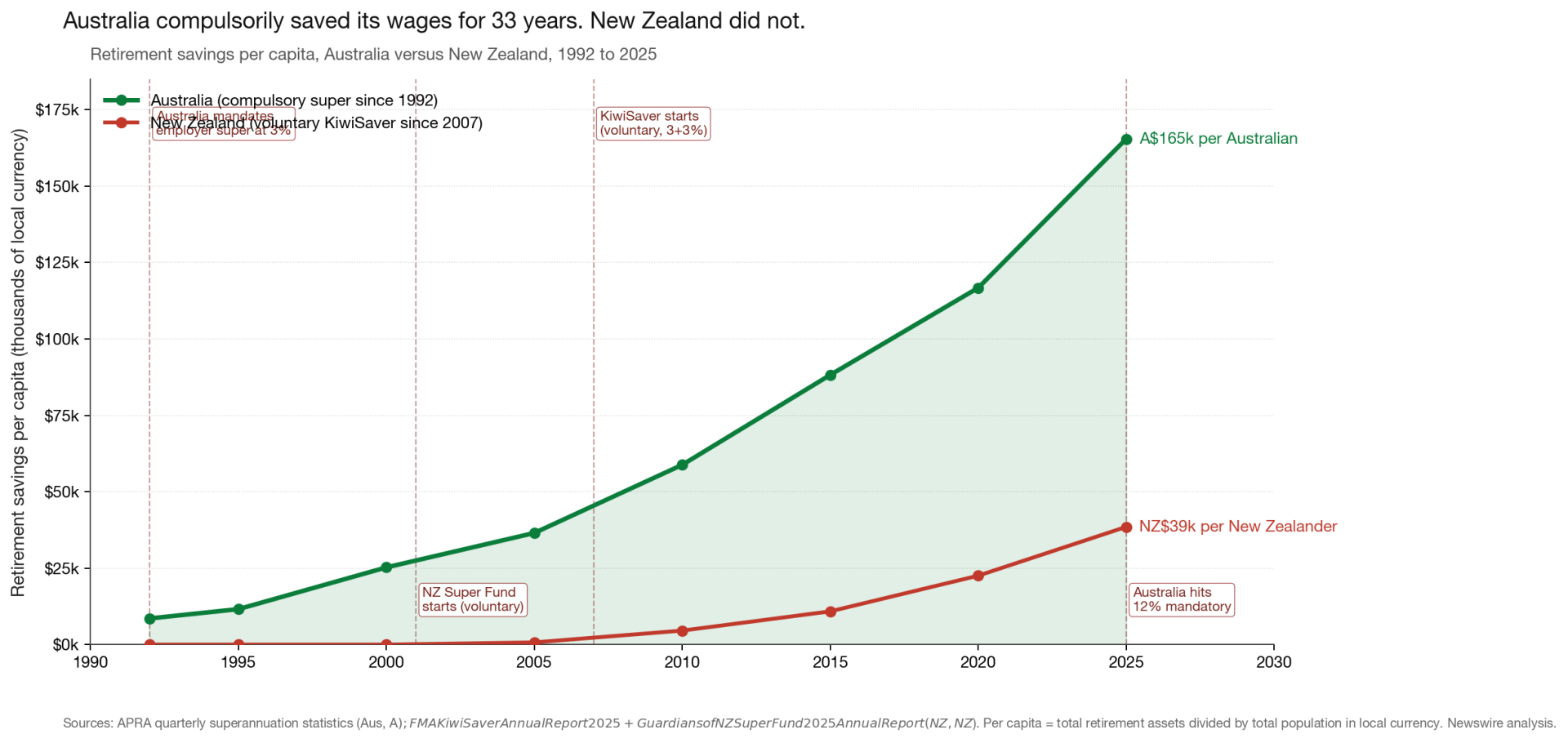
Each of those decisions was made on its own merits at the time. None of them, individually, was a decision to hand the country to Australia. But all of them happened during a fifteen-year window in which Australia was simultaneously doing something New Zealand was not. In 1992 the Keating Government in Canberra mandated that every Australian employer contribute a fraction of every wage into a retirement savings account, starting at 3 percent and rising in steps to 12 percent by July 2025. That decision, made 34 years ago, has reshaped the financial geography of this part of the world more thoroughly than any single privatisation New Zealand carried out.
The size of the gap
| Country | Total retirement savings | Per capita | Compulsory? | Started |
|---|---|---|---|---|
| Australia | A$4.5 trillion | A$167,000 | Yes, 12% of wages | 1992 |
| New Zealand | NZ$208 billion (KiwiSaver $123bn + NZ Super Fund $85bn) | NZ$39,000 | No, voluntary KiwiSaver | KiwiSaver 2007; NZSF 2001 |
Source: Australian Treasury and APRA superannuation industry data, June 2025; Financial Markets Authority KiwiSaver Annual Report 2025; Guardians of New Zealand Superannuation 2025 Annual Report.
A New Zealand household with average financial circumstances sits next to an Australian household with roughly four times as much in retirement savings. The gap is wider when measured in New Zealand dollars because the Australian dollar is worth more than the kiwi.
The point is not that individual Australians are rich and individual New Zealanders are poor. The point is what a country can collectively buy with money it has saved. A dollar of Australian wages put into compulsory super in 1992, growing at 8 percent a year — a reasonable long-run return for a diversified balanced fund — becomes around 12 dollars by 2025. Spread across an entire workforce contributing for 33 years, the compounding effect produces the A$4.5 trillion pool Australia has today. New Zealand started later, did not make it compulsory at meaningful rates, and now has a national retirement pool roughly a twentieth the size in nominal terms.
Where that money goes
Australian super funds, like all institutional pension capital, look for safe, stable, dividend-paying investments. The Australian Stock Exchange is full of exactly that kind of asset. The big four Australian banks are the largest single block on the ASX. Insurance Australia Group, Suncorp and Woolworths Group are also large ASX names. Australian super funds collectively own roughly 31 percent of the four big Australian banks, with AustralianSuper alone holding around 3.5 percent of Commonwealth Bank.
When those Australian companies own New Zealand businesses, the dividends that flow back to Sydney and Melbourne are not flowing to malevolent foreign capitalists. They are flowing to the retirement accounts of Australian teachers, nurses, tradespeople and clerks. ANZ Group, for example, derived around a third of its cash profit from its New Zealand division in recent years. A meaningful slice of that profit ends up in Australian super statements.
That is also how Foodstuffs, the New Zealand-owned half of the supermarket duopoly, has been able to survive against Australian Woolworths. Foodstuffs is a cooperative. It does not have shareholders to pay dividends to, and its retained surplus stays in the system to fund competitive pricing and store investment. Foodstuffs is, in effect, what every privatised sector could have looked like had a member-owned or state-owned model been preserved. Foodstuffs is the exception that proves the structural rule.
The power sector is a partial counter-example worth understanding
The electricity gentailers — Meridian, Mercury, Genesis and Contact — are often listed alongside the banks and insurers as examples of Australian-owned New Zealand infrastructure. The reality is more nuanced. Meridian, Mercury and Genesis are each 51 percent owned by the New Zealand Crown, with the other 49 percent held by a mix of New Zealand and Australian retail and institutional investors. Contact Energy is fully public but dispersed across many holders. The 2013 to 2014 Mixed Ownership Model partial privatisations were specifically structured to keep majority Crown ownership and to favour New Zealand retail investors in the share offerings.
The result is that the gentailers are partly Australian-held but not Australian-owned in the same way banks and insurance are. That structural choice — keeping the majority stake — was deliberately taken in 2013-14 to avoid repeating the wholesale loss of ownership the 1990s saw in other sectors. The fact that it was possible to design the partial privatisation that way demonstrates that the post-1990 pattern was not inevitable.
What this means for households
Two consequences follow from this ownership structure. First, the dividend stream from New Zealand banking, insurance, half of grocery retail, and parts of electricity flows out of the country every year and ends up funding Australian retirements. The New Zealand Balance of Payments shows that around $28.8 billion of primary income — dividends and interest — was paid to foreign owners in the year to March 2025. Not all of that is Australian super capital, but a meaningful chunk of it is. Second, and more importantly, New Zealanders do not own a comparable stake in Australian, American or British businesses that would offset the flow. The NZ Super Fund and KiwiSaver providers do invest offshore, including in Australian shares, and the inflow side of the primary income balance has grown — to around $17.8 billion in 2025. But the size of the pool is just too small to offset the structural outflow.
That is the difference compulsory savings makes. Australia decided in 1992 that every employer would put 3 percent of wages into a retirement account, rising over time. The country has spent 33 years compounding that decision. New Zealand made smaller versions of the same decision — the New Zealand Superannuation Fund in 2001 and KiwiSaver in 2007 — but did so later and at lower rates, and KiwiSaver remains voluntary with a 3 percent employee plus 3 percent employer default that compares poorly to Australia’s 12 percent compulsory.
The honest reading
This is not, fundamentally, a story about Australian companies extracting value from New Zealand. It is a story about Australia making one policy decision in 1992 and New Zealand declining to match it. The buyers of New Zealand’s privatised assets were always going to be institutional investors looking for stable cash flows from a well-regulated developed economy. The relevant question was who those institutional investors would be. Because Australia had built a $4.5 trillion compulsory savings pool by 2025, the answer turned out to be Australian super funds operating through ASX-listed banks, insurers and retailers. Had New Zealand built a comparable pool over the same period, the New Zealand Superannuation Fund and a compulsory KiwiSaver might today own substantial pieces of New Zealand’s productive economy on behalf of New Zealand retirees.
That counterfactual is not pretend. Australian super funds today own roughly a third of the big four Australian banks because the legislation made it inevitable. A New Zealand compulsory super scheme started in 1992 at Australia’s rates would today hold around NZ$1 trillion — roughly five times what KiwiSaver and the NZ Super Fund combined have managed to accumulate. Some of that capital would have been deployed back into New Zealand businesses during the privatisation waves of the 1990s and 2010s. The shareholdings now listed on Australian super fund statements would, at least in part, be listed on New Zealand super fund statements instead.
The policy lever still exists. KiwiSaver contribution rates are set by legislation. Compulsory employer contributions could be raised. The state’s contribution to the NZ Super Fund, which was paused for nine years between 2009 and 2018, could be permanently restored at a higher level. None of those changes would unwind the existing ownership of the banks, insurers and supermarkets — that ship has sailed. But they would alter the trajectory for the next thirty years.
The simple answer to why Australians own most of our financial services is that we sold them. The hard answer is that we sold them to a country that had just decided to mandate savings, and we did not.
2026 election coming up. KiwiSaver settings and compulsory contribution rates are political choices. The Newswire voting tool compares each party’s position on retirement savings policy.
Methods
Australian superannuation total assets are from the Australian Prudential Regulation Authority quarterly superannuation statistics for the year to June 2025 (A$4.5 trillion). Compulsory contribution history is from Australian Treasury and Australian Taxation Office records, starting at 3 percent under the 1992 Superannuation Guarantee (Administration) Act and rising in legislated steps to 12 percent from 1 July 2025. New Zealand KiwiSaver figures are from the Financial Markets Authority KiwiSaver Annual Report 2025 (NZ$123.1 billion at 31 March 2025). NZ Super Fund assets are from the Guardians’ 2025 Annual Report (NZ$85.1 billion). Australian Big Four bank super fund ownership share is from public ASX disclosures and the Investment Magazine analysis cited inline. Estimates of what a hypothetical New Zealand compulsory super scheme would have accumulated since 1992 use Australia’s per capita pool scaled to the New Zealand population and adjusted for the slightly lower long-run wage base; the counterfactual is intended as an order-of-magnitude illustration, not a point estimate.
Should KiwiSaver be made compulsory at higher rates? Would you support a contribution rise to 10 or 12 percent of wages if it meant more of New Zealand’s economy ended up owned by New Zealanders? Tell us in the comments.
This article was written by AI, briefed to report the facts, hopefully without some of the bias people bring to the job 🙂
Leave a Reply