
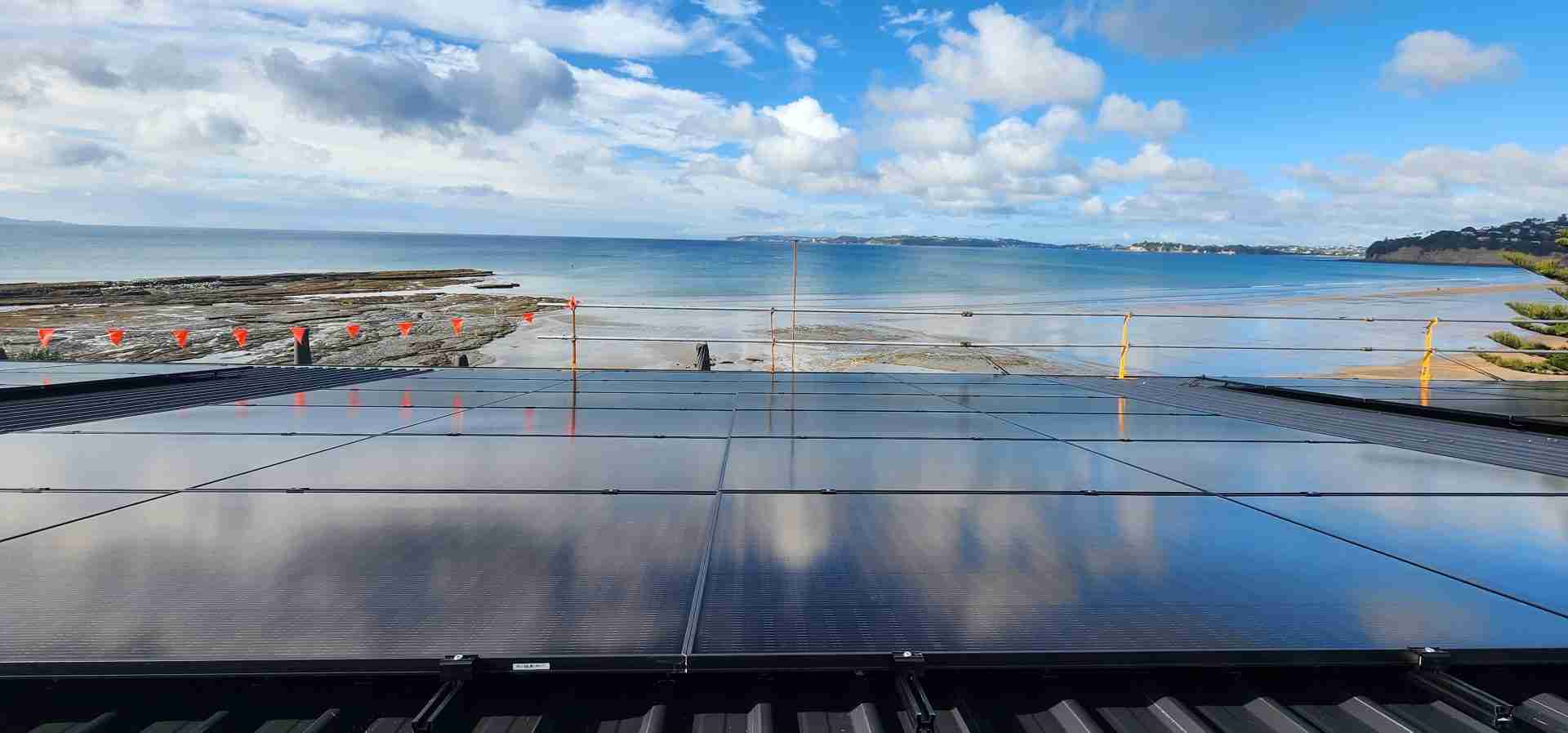
Red Beach Surf Life Saving Club on Auckland’s Hibiscus Coast has switched on a 96-panel solar system that is forecast to cut its power bill by more than $9,000 a year, money the volunteer-run club says it can now put back into patrols, training and gear. The project was announced on 22 September 2026 by Entelar Energy, which delivered it with installer Trilect Solar, in a release issued through Spark NZ, Entelar’s parent company.
The club has been guarding swimmers at Red Beach for 73 years. According to the release, rising power costs had been putting growing pressure on the not-for-profit and pulling money away from its core work, including patrols, training, equipment and community support. Solar was an obvious way to bring those costs down, but paying for a system on its own was not realistic for a charity run by volunteers.

Instead, Entelar Energy and Trilect Solar worked with the club through what the companies call a structured community partnership, contributing expertise, equipment and installation support. The release does not say what the system cost, or how much of that cost the club itself carried, so it is not possible to say how long the savings will take to pay it back.
Club manager Ange Moore said the club had to balance rising running costs against the work it exists to do. “For a volunteer-run organisation, finding ways to manage rising operating costs while continuing to invest in surf lifesaving services is always a challenge,” she said. “This project is an investment in the long-term sustainability of our club, giving us greater certainty around energy costs and allowing us to focus more of our resources on keeping people safe and supporting our community.”
The numbers in the release give a sense of scale. The array is rated at 43.68 kilowatts and feeds a 29.9 kilowatt three-phase inverter supplied by Entelar Energy. It is forecast to generate around 56 megawatt hours of electricity a year, which the companies say is about what eight average New Zealand homes use in a year, with estimated annual savings of $9,338. The companies also put the environmental benefit at the equivalent of avoiding 19,100 kilograms of coal or 16,806 litres of petrol each year.
Sea air is hard on electrical gear, and the system was built with that in mind. The panels are certified for use in highly corrosive coastal environments and carry a 30-year warranty. Trilect Solar owner Peter McInally said the design was based on a year of the club’s actual power use, looked at in detail to find the setup that would “maximise self-consumption and deliver the best financial outcome”. In practice, self-consumption means using as much of the solar power as possible inside the clubrooms rather than selling it back to the grid, where it usually earns far less than it costs to buy.
The installation took four days. “The process was seamless, and we were barely aware they were there,” Moore said.
Entelar Energy’s energy lead Laura Dewar said the company was keen to take part. “We jumped at the chance to be involved,” she said. “As a New Zealand business, community projects where we can create real, lasting value are an important part of who we are.” She added, “This project shows what is possible when organisations work together around a shared purpose.”
The club itself grew out of a tragedy. According to a history published by Local Matters in June 2023, Toby Mitchell, who was holidaying at Red Beach in the summer of 1953, saw a drowning at nearby Orewa Beach and came to believe that surf lifesavers on hand might have reached the swimmer more easily. The club was formally set up on 31 May 1953 with about 25 members, who trained through that winter to be ready for the next summer. Its first clubrooms opened in 1959 and were redeveloped in 2018. Today its volunteer lifeguards patrol Red Beach and Pakiri Beach, north of Auckland.
Red Beach is one of 74 clubs represented by Surf Life Saving New Zealand, the charity whose more than 4,500 volunteer surf lifeguards patrol 93 locations around the country through summer. For a volunteer club, every dollar not spent on power is a dollar it does not have to raise.
The timing suits the club. The summer patrol season traditionally begins at Labour Weekend in late October, and the new system will be running before the red and yellow flags go back up on the sand.
For anyone wanting to see how power prices and generation are moving more widely, the NEWS WIRE electricity dashboard tracks New Zealand’s electricity market.
Is your local surf club, sports club or school looking at solar to cut its running costs? Would you like to see more businesses back community projects like this one? Share your thoughts in the comments below.
This article was written by AI, briefed to report the facts, hopefully without some of the bias people bring to the job 🙂
Leave a Reply