
The crowds at Mystery Creek told one story. Fieldays sold out for the first time in years, drawing around 100,000 people, more than 1,100 exhibitors and a record 73 international companies. Retailers reported record sales as farmers, flush with the best payout in memory, signed up for new utes, new fences and new ideas. After three hard years, rural New Zealand walked the muddy aisles in June 2026 with money in its pocket.
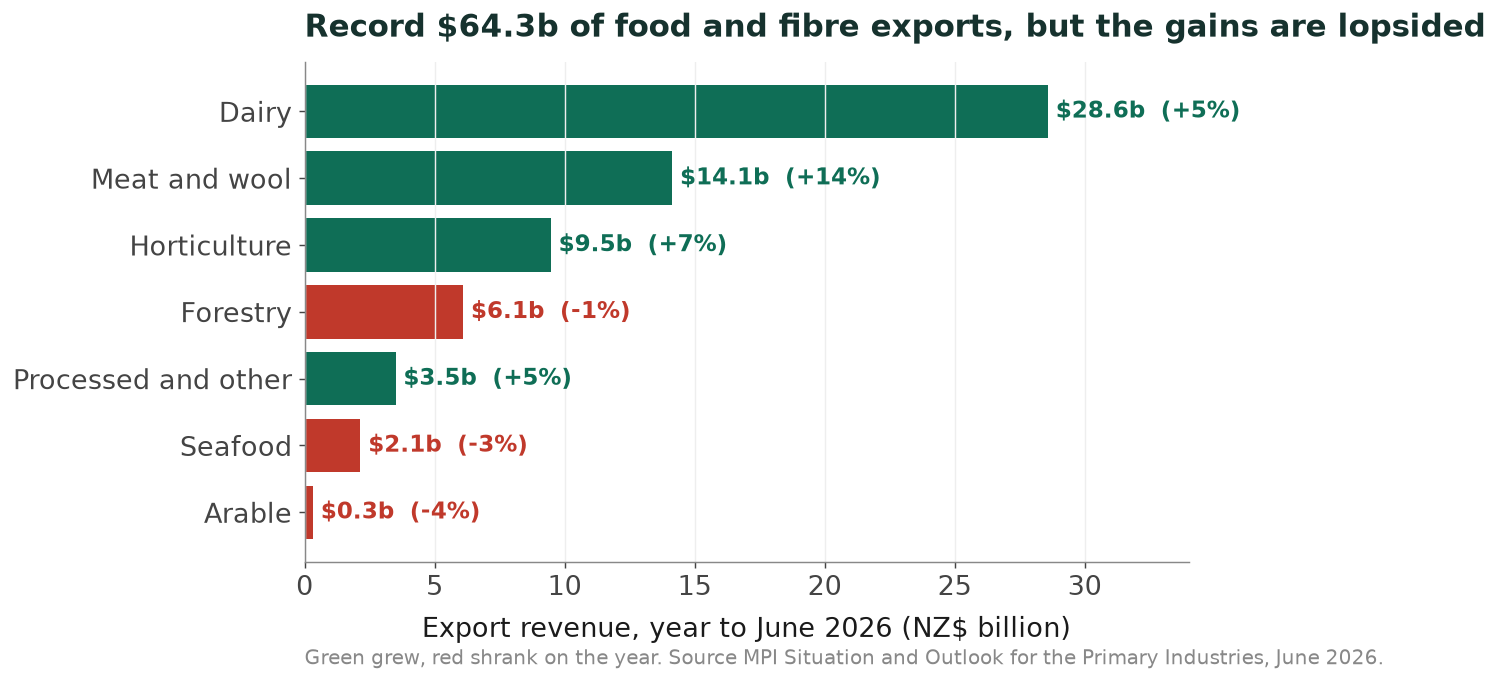
The official numbers tell the same story, only bigger. New Zealand is about to earn a record $64.3 billion from food and fibre exports in the year to June 2026, up 6 percent on the year before. Dairy, red meat and horticulture each set individual records. The Ministry for Primary Industries expects the total to keep climbing toward $70 billion by 2030.

And yet, talk to the people doing the farming and the mood is more complicated than the headline suggests. Costs are biting, the gains are wildly uneven between sectors, and the same world prices that are filling farm bank accounts are also why butter and mince keep getting dearer at the supermarket. This is the story underneath the record, and the data tells it more honestly than the press releases.
A record year for exports
Start with the good news, because there is plenty of it. The country has genuinely never been paid better for what it sells. New Zealand’s terms of trade, the ratio of the prices we get for exports against the prices we pay for imports, reached an all-time high at the end of 2025. Drawing on Stats NZ data going back to 1957, the latest reading is the strongest of all 276 quarters on record.
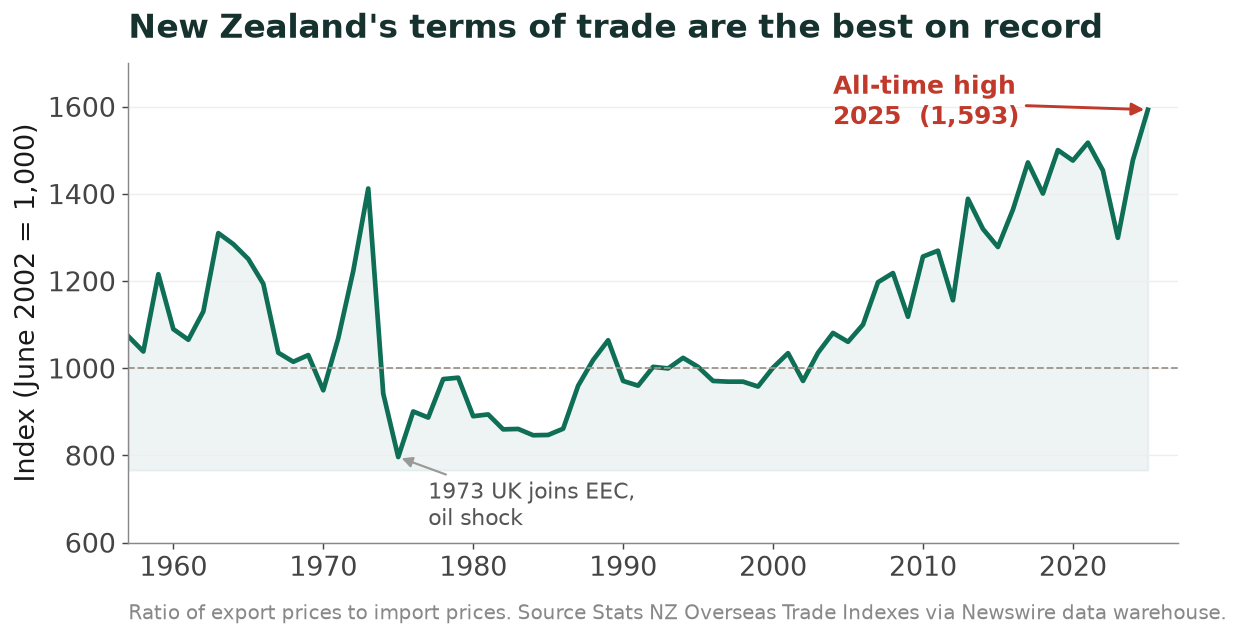
That is a long way from 1973, when Britain joined the European Economic Community and the first oil shock hit, and New Zealand’s trading fortunes fell off a cliff. The recovery since 2000 has been driven by Asia, and by China above all, paying premium prices for protein and timber. The modern primary sector is a China story as much as a New Zealand one.
Within the record, the spread of fortunes is stark. Dairy alone will bring in $28.6 billion this year, up 5 percent and close to half of all food and fibre earnings. Meat and wool jumped 14 percent to $14.1 billion. Horticulture rose 7 percent to a fresh record of $9.5 billion. But forestry slipped 1 percent, seafood fell 3 percent, and arable, the smallest sector, dropped 4 percent.
Why the record doesn’t feel like one
Here is the catch that the dollar figures hide. A record in nominal dollars is not the same as a record in what those dollars actually buy. When you adjust New Zealand’s export prices for inflation, using the Consumers Price Index that has risen 81 percent since 2000, a very different picture appears.
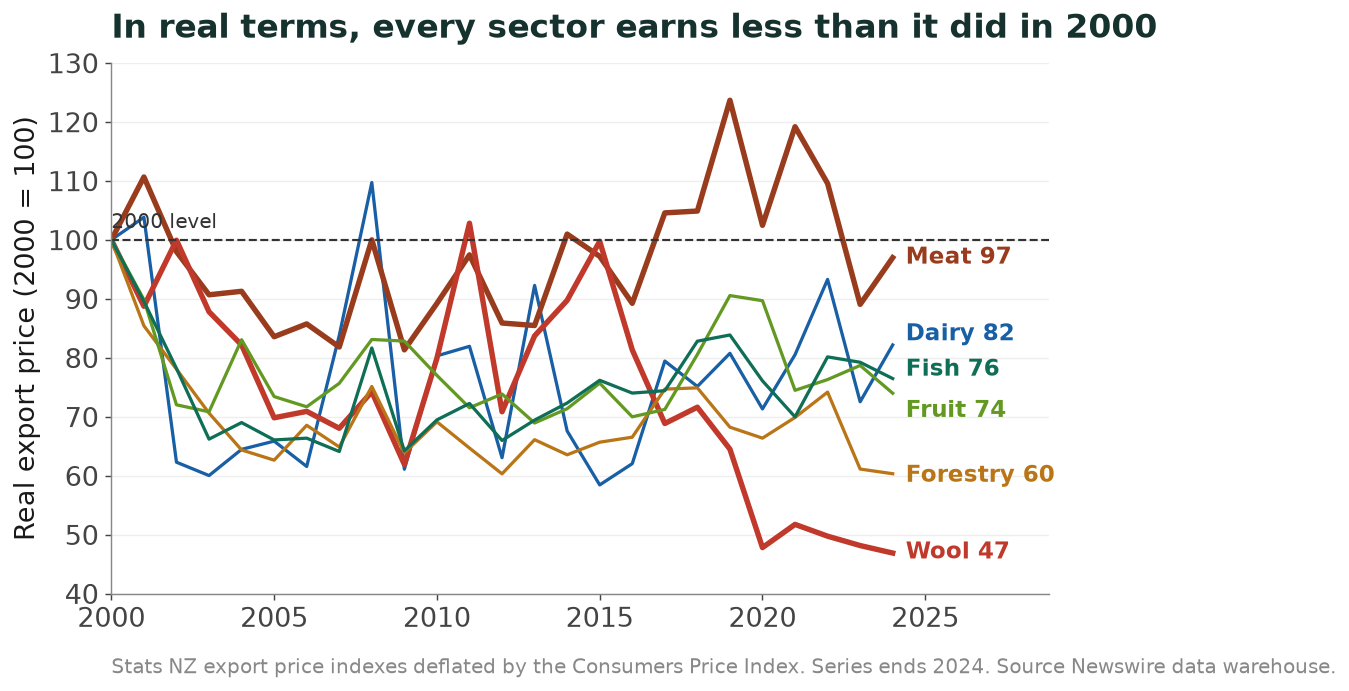
On this measure, every major primary export earns less per unit than it did a quarter of a century ago. Meat has just about held its value, down 3 percent. Dairy is down 18 percent. Fish and fruit are down around a quarter. Forestry has fallen 40 percent. Wool, once the backbone of the rural economy, has more than halved, down 53 percent in real terms.
The lesson is that the record is built far more on volume and a weak New Zealand dollar than on farmers being paid handsomely per kilo. Produce more, ship it cheaper in currency terms, and the total climbs even as the underlying price softens. It is a real achievement, but it is a treadmill, not a windfall.
Dairy
Dairy is the engine, and it is running hot. New Zealand produced a record 2.02 billion kilograms of milk solids this season, the first time output has passed 2 billion, on the back of good weather and strong supplementary feed. The farmgate milk price sits around $9.85 a kilogram of milk solids, the second highest on record, and Fonterra has opened the new season near $9.90.
On top of that came a one-off $3.2 billion capital return to Fonterra shareholders in April, following the sale of its Mainland consumer business. Much of that cash is going where it does the most good, paying down debt. Dairy carries roughly 60 percent of the country’s farm lending, and the Reserve Bank notes farmers have cut average dairy debt to about $18.40 per kilogram of milk solids, down sharply from the 2016 peak.
The shadow over the boom is cost. The same Middle East conflict that lifted oil prices in early 2026 pushed up the price of fertiliser, fuel and freight, with urea up more than 80 percent at one point. The milk cheque is big, but the bills are bigger than they were, and the margin is tighter than the payout alone implies.
Beef and lamb
For sheep and beef farmers, 2025/26 is shaping up as the best year in roughly half a century. Beef and Lamb New Zealand forecasts average farm profit before tax to nearly double, a rise of around 96 percent, to the highest level in about 50 years. Tight global supply has driven beef and lamb schedule prices well above last year.
The margin story is even clearer when you compare what farmers are paid against what they pay out. Using producer price data to the end of 2025, the ratio of sheep, beef and grain farmers’ output prices to their input costs has surged to its highest in the series, while dairy’s equivalent ratio was squeezed back in late 2025 as costs kept climbing. Red meat, for once, is the sector with genuine pricing power.
Trade politics remains the wildcard. After a turbulent year of United States tariffs, beef ended up effectively exempt, while New Zealand lamb faces a tariff of around 11 percent and wine around 10 percent. The original 15 percent red meat tariff had been modelled to cost the sector more than $300 million a year, so the beef exemption is a meaningful reprieve, even as sheepmeat and wine still wear a cost.
Wool
Wool is the comeback. At the end of May 2026, the best crossbred fleeces broke 700 cents a kilogram clean for the first time since around 2011, a 15-year high, with good-style fleece averaging close to $6.80 a kilogram and prices roughly a fifth above a year earlier. For the first time in a generation, the wool cheque is covering the cost of shearing and then some.
Put that in context, though. As the real-terms chart above shows, wool prices collapsed by more than half over the previous quarter-century. The rally is real, but it is climbing out of a very deep hole, and it is partly a story of scarcity. The national flock has fallen from a 1982 peak of around 70 million sheep to about 23 million today, so there is simply far less wool to go around.
Kiwifruit, apples and wine
Horticulture splits three ways. Kiwifruit is the star of the entire economy. Zespri returned a record $3.56 billion to New Zealand growers from the 2025 season, on a record 248 million trays, with net profit up 80 percent. Kiwifruit export revenue is forecast to jump 16 percent to $4.8 billion, with per-hectare returns at record levels across every variety.
Apples and pears are in solid recovery, with a record crop and excellent quality after the Cyclone Gabrielle years, lifting revenue around 6 percent to $1.3 billion, helped by improved access under the new India trade deal.
Wine is the laggard. A once-in-a-generation 2025 harvest left the country with a sauvignon blanc glut, and export value slipped even as volume rose, because more wine shipped in cheaper bulk form. Growers are deliberately capping the smaller 2026 vintage and pulling out some vineyards to bring supply back into line. It is a correction year, not a growth year.
Forestry, seafood and arable
The three shrinking sectors each have their own headwind. Forestry slipped 1 percent as softer Chinese construction demand weighed on log prices. The bigger forestry story is political, the long fight over planting whole sheep and beef farms in carbon pine. Beef and Lamb estimates somewhere between 261,000 and 350,000 hectares of pastoral land has gone into forestry since 2017, taking with it around 2.5 million stock units.
That pressure has eased a little. A law capping farm-to-forest conversions took effect on 31 October 2025, and the carbon price has fallen to around $54 a tonne, below the government auction floor of $71, which weakens the case for buying farms purely to plant trees for carbon.
Seafood fell 3 percent, the only major sector that earned less in dollar terms, hit by softer rock lobster prices and by warmer seas affecting mussel spat and salmon survival. The longer-term plan is an aquaculture push aiming to triple sales to $3 billion by 2035. Arable, meanwhile, remains the quiet casualty. Wheat prices are roughly where they were two decades ago, undercut by cheap imported grain, and a large share of arable farmers have been running at a loss.
Why your groceries keep climbing
Here is the part that matters for everyone, not just farmers. If the country is earning record sums from food, why does food keep getting more expensive at home? The answer is that New Zealand exports the vast majority of what it produces, and the domestic price of milk, butter, cheese and meat tracks the world price. When Fonterra’s payout hits a record, the price on the supermarket shelf goes up too, not down.
The numbers are blunt. Since 2020, the domestic price of milk, cheese and eggs has risen 37 percent, meat and poultry 31 percent, and fruit 46 percent. Food overall is up 31 percent, faster than general inflation at 26 percent. Stretch back to 2000 and the price of milk, cheese and eggs has more than doubled. The export boom is not a discount for shoppers, it is the reason the checkout keeps hurting.
The cost squeeze
Beneath every sector sits the same pressure. The Middle East conflict that broke out in early 2026 sent oil toward US$135 a barrel, with diesel forecast to approach $3.77 a litre. Fertiliser, freight and chemicals all jumped, because the Strait of Hormuz carries a large share of the world’s fuel and fertiliser. For farmers, the record prices arrived at the same time as a wall of rising costs.
Interest rates are turning too. The Reserve Bank held the Official Cash Rate at 2.25 percent in May, but with inflation pushed up by fuel, the next move is expected to be up, possibly as soon as July. After an easing cycle that helped lift farm confidence to a decade high, the cost of money is set to rise again, just as the urban economy weakens. The manufacturing sector slipped back into contraction in May, a reminder that the farm boom and the city slowdown are happening at the same time.
What happens next
For all the records, the Ministry for Primary Industries thinks the run is about to pause. It forecasts food and fibre exports to dip 1 percent to $63.9 billion in the year to June 2027, the first fall in years, as the global fallout from the Middle East conflict raises costs and softens demand. After that, it expects the climb to resume, reaching $70.1 billion by 2030, led again by dairy and horticulture.
So this is the real shape of the richest year New Zealand farming has ever had. The terms of trade have never been better and the export total has never been higher, yet in real terms farmers are paid less per unit than they were in 2000, the gains are split unevenly between a booming protein and fruit sector and a struggling forestry, seafood and arable one, and the same world prices that reward the farm gate punish the supermarket trolley.
It is a record worth celebrating and worth reading carefully. The cheques are real. So is the treadmill underneath them.
Sources and further reading
- MPI, Situation and Outlook for the Primary Industries, June 2026, the source of the export revenue forecasts and sector outlooks.
- Stats NZ Overseas Trade Indexes, export and import price indexes and terms of trade, the basis for the terms of trade and real-price analysis in this article, calculated via the Newswire economic data warehouse.
- Beef and Lamb New Zealand, farm profitability forecasts, stock numbers and afforestation research.
- Zespri and New Zealand Apples and Pears, horticulture returns and crop figures.
- Reserve Bank of New Zealand, farm debt, the Official Cash Rate and financial stability commentary.
You may also enjoy our piece on a sold-out Fieldays and the two-speed economy, and on wool prices hitting a 15-year high.
Have your say
Are you farming through this boom, or watching the grocery bill climb at the other end of it? Do the records match what you are seeing on your own balance sheet? We would love to hear how the two-speed economy looks from where you stand. Share your view in the comments below.
This article was written by AI, briefed to report the facts, hopefully without some of the bias people bring to the job 🙂
Leave a Reply