
Drive through any older Auckland suburb on a Saturday afternoon in 1982 and you would have seen the same thing in every second garage on the street. A bloke in his old clothes, sawdust everywhere, plywood panels leaning against the wall, a half-finished hull on a wooden cradle, kids running in and out with mugs of tea. By Christmas it would be in the water at Whangaparāoa or Pine Harbour, the kids strapped into life jackets, the wife with a thermos, the dog confused. Two years later it would be sold to make room for the next one.
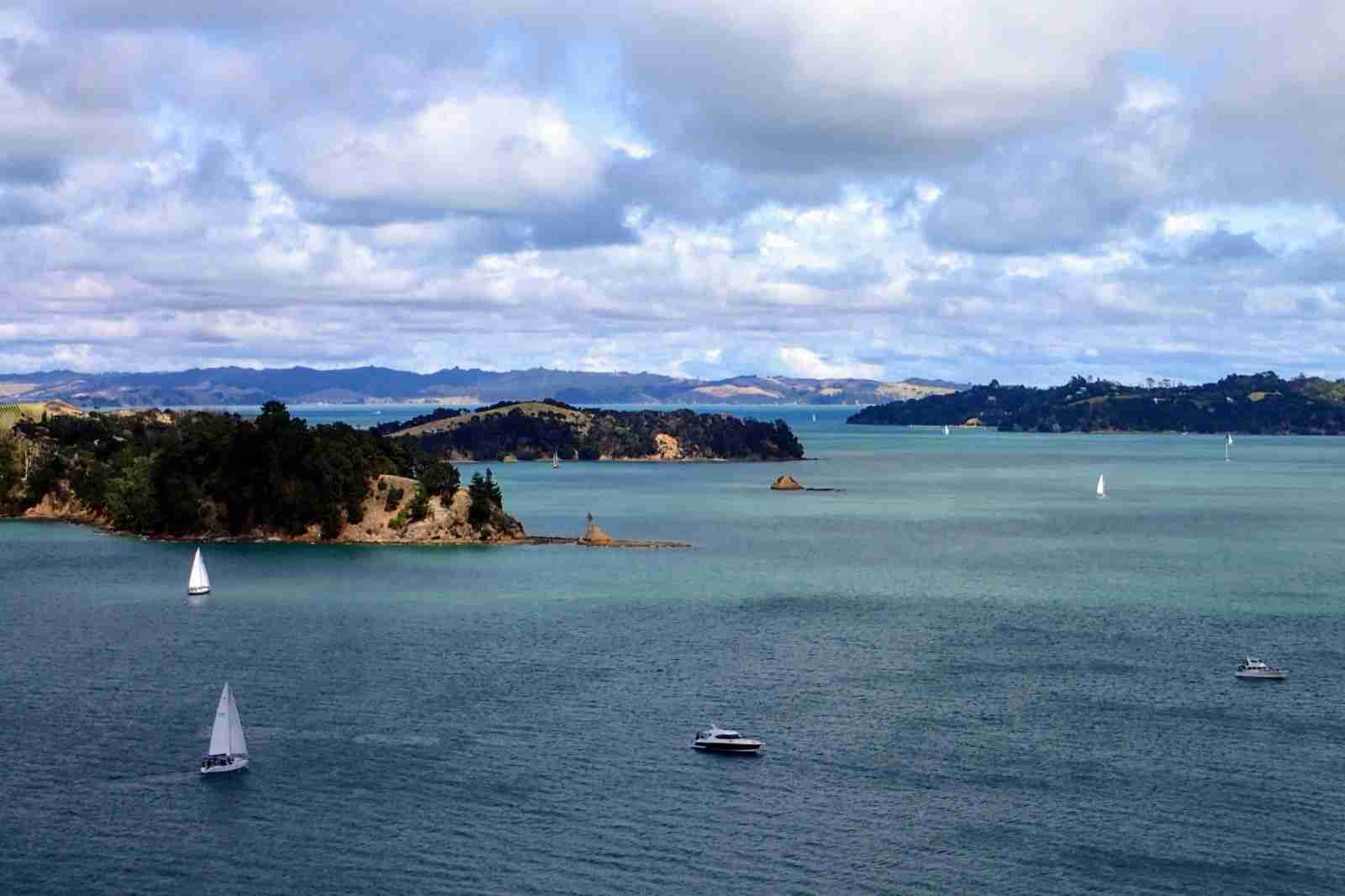
That world has largely vanished. The garages are mostly storing road bikes and surplus IKEA furniture now, and the dad who once spent four winters building a Hartley TS16 from plans is more likely to be paying off a side-by-side Sea-Doo on finance, or thinking about a launch with twin outboards if the kids are gone and the redundancy payout was generous. Auckland still calls itself the City of Sails, the moniker is still printed on tourist brochures and emblazoned on the side of harbour ferries, but the relationship between the city and the sail has changed in ways worth thinking about.
The Anniversary Regatta and the working sail
Auckland earned the nickname in the 19th century, when working sail and recreational sail mixed together on the Waitematā in numbers that astonished visitors. The first impromptu race took place on 18 September 1840, the day the advance party arrived to found the colony’s new capital. The formal Auckland Anniversary Regatta started in 1842 and has run almost every year since, with the only major break in 1900 during the South African War. By the late 1940s it routinely drew over a thousand boats and was widely considered the biggest one-day regatta in the world.
The kauri keelers built in Auckland yards in the late 1800s and early 1900s, the mullet boats converted from fishing to racing, the Logan and Bailey designs that are still raced in classic divisions today, all came out of a city where building a boat in your back yard or down the road at the yard was a normal economic and recreational activity. By 2001, around 30,000 people belonged to yacht clubs in New Zealand, and roughly 60 percent of them lived in greater Auckland. Surveys at the time suggested 50,000 adults had sailed in the previous month and 150,000 in the previous year, about the same numbers as had played rugby.
The home-built trailer sailer boom
The home-built trailer sailer boom sat on top of that culture. It started in 1956 when the New Zealand designer Richard Hartley released plans for the Hartley TS16, a 16-foot plywood trailer yacht based loosely on the lines of the old mullet boats. The idea was simple. A boat that could be built at home from plans, towed behind a Holden Kingswood, launched off a ramp, slept four at a pinch, and sailed well enough to race. More than 5,000 sets of plans were sold and an estimated 8,000 hulls were built worldwide, the majority of them in New Zealand garages.
Other designs followed. The Noelex 22 and Noelex 25 out of Christchurch. The Trojan 750. The Townson 32. The Farr designs that began to dominate offshore racing. At the peak in the late 1970s, around 80 different trailer yacht designs were in production in New Zealand, most of them sold either as completed boats or as plans and kit sets for amateur builders.
The Noelex 25 alone went from prototype to a national class so quickly that production could not keep up with demand. Its pre-tax price in early 1980 was around $8,000. People were ordering them off plans and waiting more than a year for delivery. The Hartley 16 plans cost the price of a few pints. A reasonably handy father with a workshop and a few mates could turn out a sailable boat over two or three winters of evenings and weekends. For a young family with a mortgage and one car, this was the affordable way into sailing on the Hauraki Gulf.
Muldoon’s Boat Tax and what it broke
Then in May 1979 the Muldoon government, casting around for revenue, introduced what became known as the Boat Tax. It applied a 20 percent sales tax to new boats. Yacht prices essentially doubled inside two years. The Noelex 25 went from $8,000 to $20,000. The orders dried up. The production yards closed one by one. By the mid-1980s, most of the New Zealand trailer yacht industry that had built itself up over twenty years was gone.
The tax was later modified, but the damage was done. Boatbuilders had retrained, moulds had been sold or scrapped, the supply chain of fittings and timber and sailmakers serving small production runs had collapsed. As one industry account put it, the New Zealand production yacht building industry “faded into obscurity following the introduction of Muldoon’s Luxury Tax in the 1980s.” More than 25 years passed between the end of the boom and the next new locally produced trailer sailer, the Eclipse 750, launched out of Christchurch in 2007 by an Irishman who had moved to New Zealand and found that no modern home-grown trailer sailer existed to buy.
Why the home-builder culture died too
The home-builder culture took longer to die than the production industry, but it died too. Through the 1980s and 1990s, fibreglass replaced plywood as the affordable hull material, but fibreglass is not something you can easily build in your garage. The skills, the moulds, the resin handling, the safety considerations all sat better with professionals. The amateur builder who once knocked together a plywood Hartley over three winters now needed either a serious workshop or a serious budget for materials. By the 1990s, in the words of Te Ara, the encyclopedia of New Zealand, “the do-it-yourself sailing tradition was dying. Busy city dwellers were learning on comfortable, expensive keelers rather than in the P-class.”
What Auckland boats look like now
So what has Auckland become instead? Some numbers from the most recent industry data give a picture.
Auckland still leads the country in trailer boat registrations by a clear margin, ahead of Waikato, Bay of Plenty and Canterbury. Around one in four Auckland households still owns a boat of some kind, a figure that is genuinely extraordinary by international standards. Maritime New Zealand’s 2020 recreational boating survey found that around 1.7 million adult New Zealanders, almost half the country, are involved in recreational boating in some form. The Marine Industry Association tracks export performance and infrastructure that remain strong. So this is not a story about Auckland giving up on the water.
It is a story about Auckland giving up on sails. Boating New Zealand’s analysis of vessel registrations in 2025 found that “by far the most popular boat to buy is still the powerboat, under six metres tops the charts, followed closely by those over six metres.” Jet skis and outboard-powered runabouts dominate the smaller end. The most active age group on the water is now 18 to 24, and they are mostly on lightweight, low-cost powered craft, not sail. Participation tapers through the early parenting years and lifts again post-60, often on motor cruisers or coastal launches, a lot of them still running the marine diesel inboards that have quietly powered Kiwi workboats and family launches for decades. In the brokerage market, high-end powerboats over $500,000 sell briskly. Sailboats above $500,000 sell. Sailboats under $400,000 are increasingly slow to move, and anything under $200,000 in either category is struggling. The middle of the market, which is exactly where a working family used to enter sailing, has thinned out.
Why this happened
There are several things going on at once.
The first is cost. A new mid-range powerboat with a 150 horsepower outboard sits at roughly the same sticker price as a comparably sized new keelboat, but the powerboat delivers an instant trip out of the harbour on a Sunday morning, while the keelboat requires lessons, crew, time on the water learning to read the wind, and a willingness to come back when the breeze dies. The time cost of sailing is higher, and time is what working families have least of. Marina berths in central Auckland are expensive and waitlisted. Storing a trailer sailer at home requires off-street parking, which is shrinking as Auckland sections subdivide and infill. Insurance has climbed across all categories.
The second is skill. Sailing is not something you can pick up in an afternoon. Power boating, broadly speaking, is. An adult who never sailed as a kid and decides at forty that they would like to get out on the water has a steep learning curve in front of them for sail, and a much shallower one for power. The P class and Optimist programmes that once funnelled thousands of Auckland kids into competitive sailing still exist, but yacht club membership nationally has dropped from around 30,000 at peak to lower figures today, and the demographic skews older and more male. The pipeline that produced Peter Blake, Russell Coutts, Grant Dalton and the America’s Cup wins is narrower than it was.
The third is housing and lifestyle. The 1980s dad building a Hartley in his garage typically had a quarter acre section, a single income that supported a family, a workshop with a vice and a drop saw, and weekends that were genuinely free of other commitments. The 2026 Auckland equivalent more likely lives on a 350 square metre infill section, both partners work, the garage is a converted office or a bike room, weekends are spoken for by kids’ sport and home maintenance, and the disposable cash that once paid for marine ply and copper rivets is going to mortgage interest and childcare. The trailer sailer ecosystem was a product of a particular New Zealand suburban economy that no longer exists in the same form.
The fourth is competing options. In 1982 the choice for a family wanting to be on the water in Auckland was sail or row. Powerboats existed but were comparatively expensive to run, and the outboards were unreliable. Kayaks were heavy fibreglass things. Today, a family can get on the water with two sit-on-top kayaks for under $2,000, a stand-up paddleboard for $800, an aluminium runabout with a small outboard for under $20,000 new and much less second-hand. Paddling, according to the Maritime NZ survey, now has the highest participation rate of any on-water activity in the country. It used to be sailing.
What is left and what is lost
So the question is not whether Aucklanders have lost the will to be on the water. They have not. The harbour is still full on a good summer day. The Anniversary Day Regatta still runs. The marinas are still full. Around half the country is involved in some form of boating each year. But the centre of gravity has shifted from sail to power, from racing to cruising, from purpose-built sailing yachts to do-it-all platforms that can fish, ski, lounge and tow a biscuit. And the home-build culture, the garage with the half-finished hull, is largely gone.
Is this a loss? That depends on what you valued about the old culture. The skills involved in building a wooden boat at home, the patience, the mathematical layout work, the joinery, were a quiet form of education that the country no longer routinely provides. The sailing skill base that built the America’s Cup wins came in large part from kids who had grown up in households where the dad was building a boat and the kids were learning to sail from age six. That base is thinner now, although it has not vanished, and youth sailing programmes at Royal Akarana, Bucklands Beach, Murrays Bay and the other big clubs are still producing internationally competitive sailors. Live Ocean, founded by Peter Burling and Blair Tuke, has linked elite sailing to ocean conservation in a way that brings new people in. Sail GP, while it has lost its government funding, has put modern foiling sail technology in front of new audiences.
The City of Sails moniker is therefore both still true and a bit of a museum piece. Auckland still has more boats per capita than almost anywhere else. It still hosts one of the largest one-day sailing regattas in the world. It still produces world-class sailors. But the everyday relationship between a working Auckland family and the sail, the kind of relationship that used to play out in a thousand garages every winter, is now something most Aucklanders have either lost or never had. The boats are still here. The garages have gone quiet.
Did you grow up in a household where someone was building a boat in the garage, or did your own family take that path? Tell us about it in the comments below. Newswire is interested in how the culture changed in your street, in your suburb, and in the boats your family ended up with instead.
This article was written by AI, briefed to report the facts, hopefully without some of the bias people bring to the job 🙂
Leave a Reply