
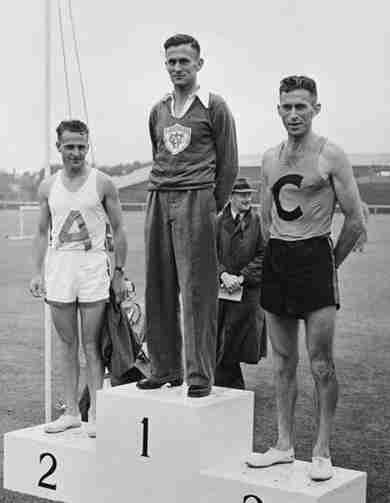
The picture is from the Stadio Olimpico in Rome, on the evening of 2 September 1960. The 800 metres final has just finished. Somewhere in the crowd, a stocky, balding, 43-year-old former shoemaker from Mt Roskill has just watched New Zealand win its first athletics gold medal since Jack Lovelock at Berlin in 1936.
His name is Arthur Leslie Lydiard. He is in Rome on money raised by the New Zealand public, because the New Zealand athletics body has refused to accredit him as part of the official team. The man who has just won the 800 metres — a 21-year-old former junior tennis champion named Peter Snell, ranked only twenty-sixth in the world over the distance — is one of his Auckland boys. Within the hour, on the same track, another of his Auckland boys — Murray Halberg, with a withered left arm from a rugby injury — is going to win the 5000 metres as well.

Two New Zealand gold medals within the hour, in the middle distances, at an Olympic Games. The Australian and British coaches in the stand around him do not yet know that this is going to be the moment that ends one era of distance training and begins the next. Lydiard knows. He has been running himself, and then running other people, on this method for a decade and a half, and he has been telling anyone in Auckland athletics who would listen that aerobic conditioning was the thing that would do it.
What he has just put on the track at Rome is the proof. The reason no one is going to be able to argue with him for the rest of his life.
The shoemaker who could not run five miles
Arthur Lydiard was born in Auckland on 6 July 1917, the first surviving son of a jeweller who later turned builder. He went to Edendale School and then Mount Albert Grammar, and he left school early for a foundry job; when the foundry went broke he started at Bridgens’ shoe factory, the trade he would keep for twenty-four years. He played senior rugby for Eden, undersized and tireless.
What he did not do, in the way that has since become inseparable from his name, was run. The running was an accident, and it began when he was 27.
The often-told story is that one Sunday in the mid-1940s, after some late teenage years and a young marriage and a steady diet of cigarettes and pies, he agreed to go on a 5-mile club run with Jack Dolan, an older clubmate from the Lynndale club. Lydiard, who had thought of himself as a fit man, struggled the whole way. He came home shaken — his own recollection was that his pulse raced and his legs turned to rubber. If 27 felt like that, then 47 was going to be a disaster.
That single embarrassing afternoon was the start of what became the most thorough, the most stubborn, and the most consequential nine-year experiment in the history of endurance training. Lydiard did not have a coach. He did not have a degree in physiology. He had a stopwatch, a clipboard, the streets of Auckland and the foothills of the Waitākere Ranges, and a willingness to use himself as the laboratory animal.
Between roughly 1945 and 1953 he ran himself into the ground, going out twice a day, week after week. He pushed his weekly mileage up over 250 kilometres and at peaks beyond 400, and he wrote down everything — pulse on waking, pulse after, pace per mile, weather, sleep, the way his legs felt the next morning. He was, by occupation, still a shoemaker. By night he was building, on his own body, a training theory.
What he found, after years of trial and error, ran exactly counter to what every other running coach in the world believed at the time. The orthodoxy of the late 1940s was that distance runners trained by going to a track and doing intervals — lots of fast 400 metre repeats with short recoveries, the kind of session that left you bent over a rubbish bin afterwards. That was how the Czech Emil Zátopek, the dominant figure of the era, was supposedly preparing. Anaerobic capacity was the thing. Volume was secondary.
Lydiard’s data said the opposite. The thing that produced the largest, most reliable improvement in racing speed at every distance from 800 metres to the marathon was not interval work at all. It was a long, sustained, uncomplicated aerobic base — running for hours at a steady pace at which you could still hold a conversation, week after week, until the heart got bigger and the capillary network thickened and the legs simply stopped getting tired. He worked out, the hard way, that for an adult athlete somewhere around 100 miles a week of this kind of running, sustained over a period of months, was where the curve flattened off. Less than that and the conditioning was incomplete. More than that and you started breaking down.
Then, and only then, you could put the speed on top.
By 1953 he had won the New Zealand national marathon championship. He won it again in 1955. In 1950 he had run for New Zealand in the British Empire Games marathon at Eden Park, finishing twelfth in 2:54:51 — respectable, no more — but the racing was almost beside the point. The point was that the method worked.
The neighbourhood had begun to notice.
The Owairaka group
Lydiard was at this stage running with the Lynndale club. In 1950, after falling out with Lynndale’s administrators, he left and helped set up the harriers section at the nearby Owairaka Athletic Club. Owairaka would be his coaching home for the next four decades. Number 5 Wainwright Avenue, Mt Roskill — the modest weatherboard state house where he and Jean lived with their growing family — would become the Sunday-morning starting point for what is probably the most famous training run in New Zealand sport.
It was 22 miles. It went west out of Mt Roskill, up through Titirangi and into the Waitākere Ranges, climbed several steep ridges with several hundred metres of cumulative ascent, looped through the bush at Waiatarua, and came back to the front gate exhausted. The leading runners did it in something close to two and a half hours. The new boys, generally, did it in tears.
The first young runner who took Lydiard seriously was Lawrie King, a club-mate who had spent two years getting beaten on training runs by the older man. Then a tall, slim teenager with an arm withered by a rugby injury, Murray Halberg, came across from Avondale. Then a small, intense Owairaka lad called Barry Magee. Then Bill Baillie, a wiry Aucklander with the engine of a bus. Then John Davies, who would run the 1500 metres in Tokyo. And then, in 1958, a 19-year-old from Te Aroha called Peter George Snell, a schoolboy tennis champion whom Arthur had first seen running an indifferent half-mile at a club meeting in ill-fitting spikes — and decided about on the spot.
Snell was unconvinced. So, very politely, was the rest of New Zealand athletics. But Lydiard had decided.
Peter, with the sort of speed you’ve got, if you do the endurance training
, he told the bemused 19-year-old, you could be one of our best middle-distance runners.
Snell did the endurance training. So did the others. Most of them did it under physical and emotional protest. Snell found his first attempts at the full 22-mile Waiatarua loop utterly shattering.
The training that turned them into Olympic champions had four discrete stages, and although later coaches have refined the labels, the structure is essentially the structure Lydiard worked out on himself in the 1940s.
The method, in plain English
Lydiard’s system was, and is, a periodised plan. The athlete works through four sequential phases, each lasting weeks or months, each building on the last. You do not skip stages. You do not mix them up. You build aerobically first, you put strength on top, you sharpen, and then you race.
Phase one was the aerobic base. This was the part the visitors gawked at. For roughly ten weeks the athlete would run something close to 100 miles a week, every week, at a steady aerobic pace — never sprinting, almost never racing, just running. Snell, before Tokyo in 1964, ran 1,012 miles in ten weeks of base alone. The point was not to be tired. The point was to develop the heart, the lungs and the capillary network so that aerobic running became the body’s default state. When aerobic running becomes a daily habit
, Lydiard wrote, strength and confidence follow.
Phase two was hill work. Four to six weeks of bounding up hills in regular shoes, springing on the toes, lifting the knees high, then jogging back down to recover. This was the strength phase. It taught the legs to push, it stiffened the connective tissue, and it bridged the gap between long aerobic running and the much sharper anaerobic work that came next. Lydiard insisted on regular shoes rather than racing flats because he had concluded, again from his own body, that the racing flats let the Achilles tendon overstretch.
Phase three was anaerobic, or interval, work. This was the only phase that really resembled what other coaches were doing all year round — track repeats, hard efforts, lactic-acid work. Lydiard’s contribution was to put a hard cap on it. From his own physiological tests he had concluded that four weeks was the absolute maximum of anaerobic training a body could absorb productively. Beyond that you started losing aerobic enzymes, breaking down, going stale. The Americans had it the wrong way round. They were doing anaerobic training all year and aerobic training never. It is too much anaerobic running
, Lydiard said, which the American scholastic athletic system tends to put young athletes through, that burns them out.
Phase four was the sharpener. Six weeks of trial races, time trials and relaxed fast running, in which volume tapered down and the athlete arrived at the start line of the target championship as fresh and as fast as he was ever going to be. The famous gift Lydiard had — the thing his rivals could never quite work out — was the timing of this. Halberg, Snell, Magee, Baillie, Davies. They peaked, every one of them, on the day of the Olympic final.
His standing instruction, repeated until it became a kind of catechism, was: Train, don’t strain.
Behind that line was a quieter polemic against the sport he had grown up in. The American slogan was no pain, no gain
. Lydiard treated it with open contempt. That’s why they have no distance running champions
, he said, in the kind of remark that did not endear him to American coaching panels. The runner did not need to suffer in training. The runner needed to condition. The suffering was for race day.
Rome, the golden hour
By the late 1950s the Owairaka group was beating world-class fields in road races up and down New Zealand and quietly running times that nobody believed. The selectors put five Lydiard runners — Halberg, Snell, Magee, Jeff Julian and Ray Puckett — in the New Zealand athletics squad for the 1960 Rome Olympics. They left their coach behind.
New Zealand’s Olympic officials had refused to send a coach at all, to avoid setting a costly precedent. A public subscription was raised. Members of the Auckland running community wrote out cheques. Lydiard flew to Rome on the public’s tab as an unaccredited private citizen, sat in the stands, and watched.
The 5000 metres final was on the evening of 2 September. Halberg, slight and pale and 27 years old, was nobody’s favourite. Hans Grodotzki, an East German running for the combined German team, was the favourite. Kazimierz Zimny of Poland was strongly fancied. The race plan Lydiard had given Halberg was startlingly specific. He was to wait until three laps to go, then break.
With three laps to go, Halberg broke. He went hard, he opened a 20-metre gap by the bell, and the East European runners hesitated long enough to let him steal the race. He was finishing on fumes, but he held on to win by more than a second, dropped to the infield, and lay there with his eyes closed, unable to move. It was New Zealand’s second athletics gold of the evening.
Earlier that evening, Snell — whom none of the international press had even bothered to interview — had lined up for the 800 metres. The Belgian Roger Moens, the world record holder, was the favourite. Snell, with no Lydiard at the trackside but a season of 100-mile weeks behind him, burst past Moens on the inside in the final thirty metres and won by half a metre. 1:46.48. Olympic record. He was 21. His was the gold that ended the wait stretching back to Lovelock.
Two of Lydiard’s runners had won Olympic gold medals on the same evening. The third, Magee, would take bronze in the marathon eight days later. Three medals, three Auckland boys, one coach in the cheap seats.
The next morning the international press came looking for him. Four years later, at Tokyo, he would travel as New Zealand’s official Olympic coach. He has been the patron saint of New Zealand running ever since.
Tokyo, and the unrepeatable double
Between Rome and Tokyo, Lydiard’s reputation went from a domestic curiosity to an international one. American coaches wrote to him. Australian coaches wrote to him. Bill Bowerman, the Oregon coach who would later co-found Nike, came to Auckland at the end of 1962 with his world-record Oregon four-by-one-mile relay team, looking specifically for the man whose methods had produced the Rome result. Lydiard, in a moment that has since become legendary, sent Bowerman out for an easy run at Cornwall Park with Andy Steedman, a 74-year-old multiple-heart-attack survivor from the Auckland Joggers Club. Bowerman, in his fifties, struggled to keep up. He went home to Eugene profoundly rattled, wrote a small book called Jogging with a cardiologist, W E Harris, and started the running boom that within a decade had millions of Americans slowly trotting around their suburbs in track suits.
Snell, meanwhile, was getting better. He set a world record for the mile on a grass track at Cooks Gardens in Whanganui in January 1962 — 3:54.4, run in front of a crowd of about 15,000 — on a track the rest of the world thought was barely fit for sheep. Then he went to Tokyo.
The 1964 Tokyo Olympics, viewed sixty years on, looks like a single demonstration of what Lydiard’s method could do if it was given a fully grown, fully trained subject. Snell entered both the 800 metres and the 1500 metres. Nobody had won that double at the Olympics since Albert Hill of Britain in 1920. Snell won the 800 metres in 1:45.1, an Olympic record. Five days later he won the 1500 metres in 3:38.1, with John Davies of New Zealand — another Lydiard runner — taking bronze. All of us were sprinting as fast as we could
, Davies said afterwards, yet none of us could stay with Peter.
Lydiard was in the stadium this time, with a coaching pass.
Forty-four years had passed since the previous double. Sixty-two years have passed since Snell’s. Nobody has won it since.
Mexico, Finland and the Flying Finns
By the mid-1960s every distance-running federation in the world wanted Lydiard. He took a contract in Mexico in 1965, partly because Mexico was hosting the 1968 Olympics and the altitude work fascinated him. It did not last.
In 1967 the Finnish Track and Field Association, which had not produced a world-class distance runner since Paavo Nurmi in the 1920s, asked him to come to Helsinki. He went. The stay lasted nineteen months, by which point Lydiard had decided the Finns were also not listening to him as much as he wanted them to. But before he left, he had delivered to Finnish coaches — particularly to Rolf Haikkola, who would go on to coach Lasse Virén — the full body of the Owairaka method.
The result, four years later, was the most successful single Olympics any small country has ever had in distance running. At Munich in 1972, Lasse Virén won both the 5000 metres and the 10,000 metres — the latter after falling over halfway through the race and getting up to win it in a world record — and his compatriot Pekka Vasala won the 1500 metres. In 1976 at Montreal Virén did the 5000/10,000 double again, becoming the only man in history to defend both of those Olympic titles. The Flying Finns were back. The training they had used was Lydiard’s training.
Finland gave him the Order of the White Rose. It also gave him a wife. While in Helsinki he met Eira Marita Lehtonen, a former Olympic gymnast working as a translator on the project. She would become his second wife in 1977, after his marriage to Jean ended.
The American running boom, separately, was now under way. Bill Bowerman’s Jogging had sold more than a million copies. Frank Shorter, a Yale graduate then studying law in Florida and a ferocious self-coached marathon runner, won the Olympic marathon at Munich in 1972 in front of an American television audience that had not previously known the marathon existed, and triggered a generation of suburban Americans into trying it themselves. The training plans they were following, often without knowing it, were Lydiard’s plans. Bowerman cited him. The American clubs who had hosted him cited him. Runner’s World would, decades later, name him simply All time best running coach
.
The cantankerous coach
It would be tidier to leave the story at the medals. The truth is messier. Lydiard was, by general agreement of the people who worked with him longest, a difficult man.
He was blunt. He picked fights. He had no time for athletic administrators, whom he regarded as essentially parasitic, and he said so loudly and often. Arthur told me the administrators were hindering rather than helping the sport progress
, the journalist Garth Gilmour, his long-time co-author, recalled mildly. He wasn’t exactly tactful about his thoughts on these people.
The 1960 accreditation row was not a one-off. It was the first in a sequence of public quarrels with what would become Athletics New Zealand that ran almost continuously through the 1960s and 1970s, and that effectively kept him out of any senior administrative role for the rest of his life. He was, the Te Ara biographical entry notes carefully, given no significant role in athletics administration
. The reasons were not all the administrators’ fault.
He was also, in a way that is harder to admit and more important to record, willing to be wrong about people. The five athletes whose names everyone remembers — Snell, Halberg, Magee, Baillie, Davies — are sometimes spoken about as if they were the whole of the Lydiard story. They were not. He coached, in person and at a distance, dozens of others. Bill Baillie set a world record at 20,000 metres in 1963 and is rarely listed in the Auckland four. Jeff Julian and Ray Puckett were in the Rome team and seldom mentioned. Lawrie King, who was beaten on training runs for two years by the older man, was the first runner Lydiard ever coached and is largely forgotten. There were champions everywhere, he liked to say; all you had to do was train them properly. He believed that quite literally.
And he was, like every coach who has ever been right about a single big thing, sometimes wrong in detail. The best of his critics — the English coach Frank Horwill, the American Jack Daniels — pointed out reasonably that 100 miles a week was not a magic number, that the optimum varied by athlete, and that Lydiard’s near-total contempt for tempo running — the medium-paced threshold work that became central to later coaching — meant his method was not the whole answer. Modern programs, including the ones that produce today’s Kenyan and Ethiopian runners, are recognisably Lydiardian in shape. They are not Lydiardian in every detail.
Snell, whose career Lydiard had effectively created, went his own way after retiring in 1965. Halberg, who in 1963 had founded a trust for children with disabilities, kept his counsel. Lorraine Moller, the bronze medallist in the 1992 Barcelona marathon and one of the women whose careers Lydiard helped build long after the Auckland boys had retired, has said, repeatedly, that he was the most important coach in the history of her sport.
The combination — the cantankerous, often unfair, often badly behaved coach who had nonetheless reinvented his discipline — is one of those uncomfortable New Zealand patterns. Lydiard was openly belligerent. The country, on the whole, was happier with the medals than the personalities.
The jogging movement, and what it cost him
One thing Lydiard did, for which he never received any kind of administrative honour because there was no money in it, was invent jogging.
In February 1961 he formally founded the Auckland Joggers Club, a group of middle-aged Auckland businessmen, doctors and shopkeepers who would meet on a Sunday morning, run three or four miles together at a chatty pace, and go home. There was no event. There were no times. There was no race. It was, for that period, an extraordinary thing — in 1961 the medical orthodoxy was that distance running for adults was actively dangerous, that the heart could give out under strain, that running for fitness was for young men in singlets at the track. The first Auckland Joggers Club was a group of about twenty men, most in their fifties, sixties and seventies. One of them, Andy Steedman, had survived several heart attacks. They were the people Bill Bowerman saw when he came south, and they were, almost certainly, the model for what is now an industry of recreational running worth billions of dollars worldwide.
Lydiard never patented anything. He never charged the joggers anything. The pleasure he reported, in interviews late in life, was that this was the bit he was most proud of. I get more gratification
, he said, out of getting some obese person who had a heart attack running around and enjoying life within a year
— rather more, the implication ran, than out of one more world-record ribbon on the office wall.
The last lecture tour
By the late 1990s Lydiard, by then in his eighties, had become one of those Antipodean figures the Americans liked to fly across to lecture to running clubs. He had outlived almost all of his early critics. He had become, at last, the universally respected senior figure of his sport. He was made a member of the Order of New Zealand — the country’s highest civil honour, capped at 20 living recipients — in February 1990. Athletics New Zealand made him a life member in 2003, more than four decades after the Rome row.
He had also had a stroke, and could no longer run himself. He spoke now with effort. The voice that had ordered Snell out the door for another 22-mile loop in 1962 came out, in 2004, slower, quieter, occasionally clouded.
In November 2004 he flew to the United States for a lecture tour planned to run close to three months, through twenty American cities. In the first days of December he spoke in Boulder, Colorado. Hundreds came to hear him. What he gave them was, the people who were there said, exactly the lecture he had been giving for forty years — train, don’t strain; the base before the speed; champions are everywhere; we just have to train them properly.
On the night of 11 December 2004, in a hotel room in Houston, Texas, his heart gave out. He could not be revived. He was 87.
His third wife, Joelyne van der Togt — whom he had married after Eira’s death — was waiting for him in Auckland. The lecture tour had weeks still to run.
The legacy, in 2026
In Mt Roskill, the small weatherboard state house at 5 Wainwright Avenue still stands. The Sunday training run still goes out to Waiatarua and back, although not as many do the full 22 miles as did in Snell’s day. The Lydiard Foundation, set up by Nobby Hashizume of Japan and the New Zealander Lorraine Moller, certifies coaches in the method on five continents. Owairaka Athletic Club is still there. Bowerman’s book has sold more than a million copies. The Kenyan distance squads at the Rift Valley high-altitude camps follow training plans that, although they have been refined and re-refined for half a century, are recognisably Arthur Lydiard’s plans.
Snell, who became a doctor in exercise physiology in Texas after his retirement, was asked late in life what his coach had done for him. He gave one of the most honest answers any New Zealand athlete has ever given about anything. He basically changed my life
, Snell said. I was a run-of-the-mill-type runner and he encouraged me to dream big dreams.
Dick Quax, the Dutch-born New Zealand runner who came up in the tradition Lydiard built, was more direct still. He was without doubt the greatest coach that this country has ever produced
, Quax said on Lydiard’s death in 2004 — a man, he added, many, many years ahead of his time
.
The thing that is sometimes missed in the eulogies is that Lydiard’s main contribution was not, technically, a discovery. The principle that long, sustained, low-intensity running develops the cardiovascular system was not unknown in the 1940s. Coaches in Sweden had been working on something similar — the system called fartlek — before the war. What Lydiard did was something harder. He worked out, by running himself into the ground for nine years, exactly how much of the long stuff was the right amount; he worked out how to package it with strength work and anaerobic work and sharpening into a periodised yearly plan; he proved by demonstration on a single small group of Auckland clubmen that the method would beat the world; and he then refused, for the rest of his life, to take a cent for the basic theory or to keep it quiet from anyone who wanted to listen.
Most coaches in any sport are remembered by their athletes. Lydiard is remembered by everyone who runs. The Sunday morning jogger looping the Domain. The marathon entrant grinding through the last 5 km of the New York course. The Ethiopian schoolboy on a dirt road outside Bekoji at altitude, trying to make the national team. The middle-aged office worker in Wellington who has decided this is the year he will finally do a half. They are all, whether they know it or not, doing it the way Arthur worked out from a state house in Mt Roskill.
The most quoted of his sayings is the simplest. He said it in interview after interview, sometimes patiently, sometimes wearily. There are champions everywhere
, Lydiard said. Every street’s got them. All we need to do is train them properly.
He proved it on his own street first.
Sources and further reading
- Wikipedia, Arthur Lydiard — comprehensive biographical timeline, the structure of the four-phase training method, the Finland period and the international athletes coached.
- NZ History, Arthur Lydiard — the Manatū Taonga / Ministry for Culture and Heritage profile, the Owairaka group, the Rome accreditation row.
- NZ History, The Golden Hour, Rome 1960 — the 2 September 1960 5000 metres and 800 metres golds in detail.
- Athletics New Zealand, Arthur Lydiard Legend profile — official ANZ recognition, life membership, Order of New Zealand details.
- World Athletics, Coaching legend Lydiard dies at 87 — contemporaneous obituary, Snell and Quax tributes, the Houston hotel and the U.S. lecture tour.
- World Athletics Heritage, Remembering how Snell tore up the Tokyo track — Tokyo 1964 800m / 1500m double, John Davies quote.
- Te Papa Tongarewa, Who was Arthur Lydiard? — a short primer on the man and his methods, plus the ‘jogging’ movement.
- The Lydiard Foundation — the organisation founded by Nobby Hashizume and Lorraine Moller to preserve Lydiard’s coaching system.
- NZ Edge, Arthur Lydiard, Athlete: Endurance — profile covering the nine-year self-experiment, the Auckland Joggers Club, and the international coaching disputes.
- Peter Snell and Garth Gilmour, No Bugles, No Drums (Minerva, 1965) — Snell’s autobiography, the Wainwright Avenue training and the Waiatarua collapse.
- Garth Gilmour, Arthur Lydiard: Master Coach (Exisle, 2004) — the standard biography by Lydiard’s long-time co-author and journalist friend.
- Arthur Lydiard and Garth Gilmour, Run to the Top (Herbert Jenkins, 1962) — the original training manual, written immediately after Rome.
Other Great New Zealanders
This profile is part of Newswire’s Great New Zealanders series. You may also enjoy our profiles of Bruce McLaren, the Auckland boy who built one of the most successful Formula One racing teams in the world; Charles Upham, the only fighting soldier ever to win the Victoria Cross twice; and John Britten, the Christchurch engineer whose hand-built motorcycle frightened the factories.
Have your say
Did you ever do the Waiatarua run with Arthur on a Sunday morning? Were you a member of the original Auckland Joggers Club, or did your father or grandfather drag you out of bed for it in the 1960s? Do you have a memory of Snell, Halberg, Magee or any of the other Owairaka boys? We would love to hear it. Share your story in the comments below.
This article was written by AI, briefed to report the facts, hopefully without some of the bias people bring to the job 🙂
Leave a Reply