
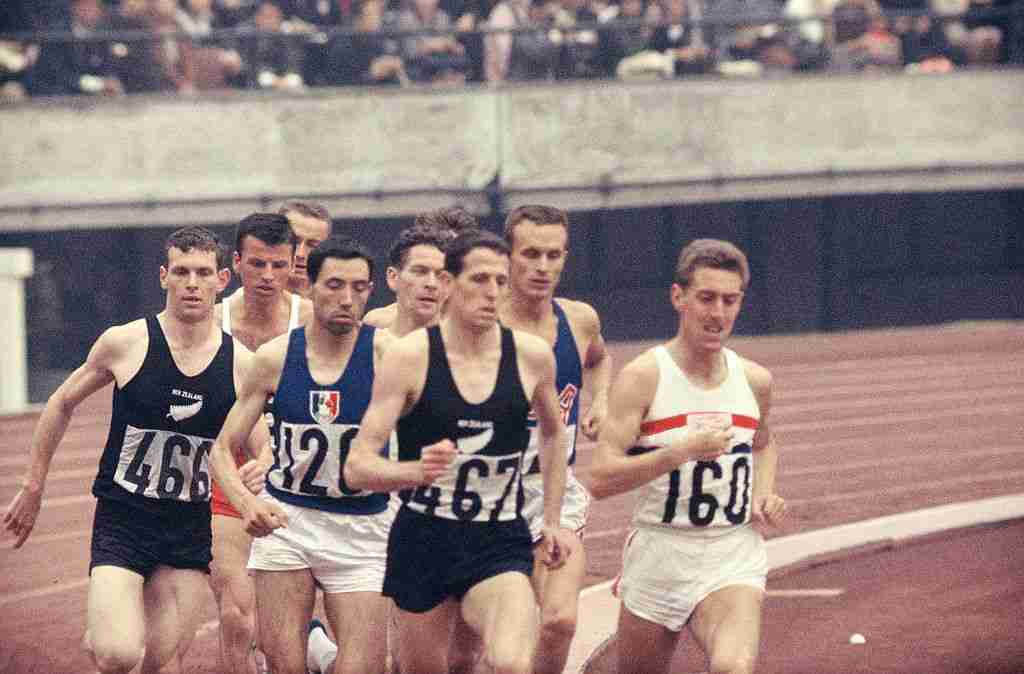
The thing you have to picture first, before any of the rest of it, is the arm.
It is the evening of 21 October 1964 at the National Stadium in Tokyo. There are nine men in the Olympic 1500 metres final and they have just come past the 1100 metre mark. The pace has been honest rather than slow. Poland’s Witold Baran went to the front down the back straight, John Davies of New Zealand chased him, the rest of the field bunched. Peter Snell, the defending 800 metre champion of these same Games, is locked in the second lane on the inside, blocked behind two British runners – Alan Simpson on his outside, John Whetton just ahead. He has been there for nearly half a lap. He is the heaviest man on the track at twelve and a half stone, his thighs visibly larger than anyone else’s in the field, and he has a clear plan that he cannot at this moment execute. The plan, agreed with his coach Arthur Lydiard the night before, is to start his finishing kick with 200 metres to go. The 200-metre mark is, very precisely, ten strides away.

So Snell does something that no one else in the history of Olympic middle-distance running has quite done in this form. He extends his right arm sideways, palm flat, as a Wellington bus driver in 1964 might extend an arm out the cab window before pulling into Lambton Quay. He holds it there for half a stride. Whetton, four feet to his right, glances down, registers the absurdity of the request, and gives him room. Snell steps left, finds clear track, and goes.
What happened in the next thirty-eight seconds was the run that, sixty-two years later, is still the central exhibit in any conversation about the greatest piece of front-running 1500-metre racing the Olympics have ever shown. Snell ran his last lap in 53.2 seconds, his last 300 metres in 38.6, his last 220 metres at a sprint that no one else in the field could touch. He crossed the line in 3:38.1 with daylight behind him and his hands almost up at his shoulders, the way they always were when he won, slightly bent at the elbow as if he wasn’t sure what to do with them. He had won the 800 metres five days earlier in 1:45.1, beating Belgium’s Roger Moens, who he had also beaten in Rome four years before. He was, on the evening of 21 October 1964, the first man in forty-four years to win the Olympic 800/1500 double. No man has done it since.
He was 25 years old. He had been in the international middle-distance game for four years and three months. He had two more competitive seasons in him before he stopped, took a job as a tobacco company sales rep, decided that wasn’t for him, looked around for what to do with the rest of his life, and at 32 enrolled in undergraduate exercise physiology at the University of California, Davis. He spent the next forty-seven years in laboratories. He died in Dallas in December 2019, five days short of his 81st birthday. The thing that needs saying about Peter Snell, the thing that the New Zealand sports pages have on the whole resisted saying for sixty years, is that the running was the short part of his life and that he knew it and arranged the rest of it accordingly.
This is the longer story.
Ōpunake, Mount Albert, and the boy with the legs
Peter George Snell was born on 17 December 1938 at Ōpunake, on the south-west Taranaki coast, the youngest of five children of Margaret and Edward Snell. The town in 1938 was a dairy port of around 1,500 people in the lee of the maunga, surf rolling in on the black sand beach below the bluff, the cooperative dairy factory and the Native Hostel and a picture theatre forming the sum of the high street. Edward Snell ran a hardware and grocery business. Margaret kept the house. Peter was a quiet, watchful, slightly thickset child who walked early, swam early, and was on a horse in the back paddock from about the age of four. He was good at everything he tried. The Taranaki Herald, in the years after he became famous, would print and reprint a school photograph of him at about ten – broad shoulders, narrow waist, calves already disproportionate – and the photograph would do most of the work of explaining the rest.
The family moved north when he was nine, to Te Kūiti and then to Mount Albert in Auckland, where Edward took up a job in pharmaceutical sales. Peter went briefly to Mount Albert Primary, then in 1952 to Mount Albert Grammar School. He boarded for the senior years; the family were by then up north of the city and the bus times didn’t fit the after-school sport. He played rugby in the second fifteen, made the school cricket eleven, played tennis to a representative provincial level, captained the school badminton team, and had a backhand in squash that, the records suggest, was already slightly disreputable. His running was an afterthought. He won the school 880 yards on a wet afternoon in 1955 because he had longer legs than the other senior boys and because he had eaten more porridge that morning. He did not, in those years, think of himself as a runner.
Two things changed that. The first was that in 1956, watching the Melbourne Olympics on grainy newsreel footage at the Mount Albert Grammar boarders’ common room, he saw an Aucklander called Murray Halberg run third in the 1500 metres behind Ron Delany of Ireland and John Landy of Australia. Halberg was an Owairaka man, trained by an unsmiling cobbler from Onehunga called Arthur Lydiard, and the news that one of Lydiard’s squad had just won an Olympic medal had begun to circulate in the suburb. The second was that Lydiard himself, paying a visit to a Mount Albert running club track meeting in late 1957 to watch one of his other charges, looked up the track at a thickly built nineteen-year-old running an indifferent 880 yards in spikes that didn’t fit, watched him for two laps, and walked over afterwards.
Lydiard’s opening line, which Snell quoted with some affection in his 1965 book No Bugles, No Drums, was an instruction more than an offer. “If you do the endurance training,” he is supposed to have said, “you could be one of our best middle-distance runners.” Snell turned up at the Owairaka clubrooms the following Sunday morning at 8 a.m., dressed for what he assumed would be a track session. Lydiard pointed him at the road. Twenty-two miles, he was told. Out through New Lynn and Titirangi, up the long climb to Waiatarua, along the ridge, down through Henderson Valley and home. The other Owairaka men – Halberg, Barry Magee, Ray Puckett, Bill Baillie – had already left. Snell ran the loop alone the first time, walking on the climbs, finishing in three hours and ten minutes, fully convinced he had been victim to a practical joke. He came back the following Sunday and ran it again. By the third Sunday he was up with the second-string Owairaka men. By the third year he was running the loop at sub-six minutes a mile.
The Lydiard system, as it solidified between 1956 and 1962, is the most-explained method in the history of distance running, and yet the simplest. The base of the year was 100 miles a week of steady aerobic running – the Waiatarua loop and others – building cardiovascular capacity over four to five months. The middle of the year was hill work and faster steady-state efforts. The pre-competition phase, six to eight weeks long, brought in interval sessions on the track. The competition phase tapered the volume sharply. Lydiard preached, repeatedly and to the irritation of more orthodox coaches, that a middle-distance runner trained as a marathoner; he produced, in the course of about ten years, three Olympic gold medallists from a small group of part-time amateur runners in a single Auckland suburb. Halberg won the 5000 metres in Rome in 1960. Snell won the 800 metres at the same Games. Magee won bronze in the marathon. Lydiard’s suburb, in the September of 1960, became briefly the centre of world athletics. The methods were copied wholesale by the Finns, by the Americans, by the East Germans, by the Australians. Lydiard himself never made any money out of any of it. He fixed shoes in the Onehunga workshop until almost the end of his working life.
Snell, in those Owairaka years, was the largest man in the squad – six feet tall and 178 pounds in racing trim, more like a half-back than a 1500-metre runner – and he ran the long Sunday loops on the back of an apprentice plumber’s wages, with a packed lunch his mother had made and a tinted-glass thermos of milky tea. He also won the Auckland tennis under-19 doubles in 1957, captained his rugby club’s second fifteen, and turned out for cricket on the Saturdays Lydiard would let him off long runs. He was, as he and his contemporaries told it later, an athlete first and a runner second; the running was the discipline he submitted to because Lydiard had told him to. He was good enough at everything else that he didn’t altogether trust the running.
Rome, September 1960
He was 21 when he flew to Rome, picked for the New Zealand Olympic team almost by accident. The selectors had wanted Halberg in the 800 metres for a tactical reason – he was the team’s best closer over the bell – but Halberg had committed to the 5000, and the second 800-metre place was open. Snell had run a 1:49.2 at a local meet in the autumn, which was inside the qualifying standard but not by much. He was the most junior member of the team. The favourite for the 800 was Belgium’s Roger Moens, the world record holder over 800, and the second favourite was the West German Paul Schmidt. The form line had Snell roughly seventh.
The 800 metre final was run on 2 September 1960 in heavy heat. Moens hit the front off the bell and led at 600 metres in 1:18.0 – pace for a world record. Snell sat fourth on his shoulder. Coming off the final bend Moens kicked, Schmidt went with him, and Snell – who had been told by Lydiard to wait until the home straight – uncoiled. He went past Schmidt at thirty metres out, drew level with Moens at twenty, and won by two-tenths of a second in 1:46.3, the second-fastest time in history. Moens, who turned to look at the runner who had passed him and saw a thickset stranger he had not registered in any pre-race scouting, was on the record afterwards as having been certain, with seventy metres to go, that he had won. It was the largest single upset of the Rome track programme.
Halberg won the 5000 metres an hour later. Magee took bronze in the marathon two days after that. The New Zealand Olympic team had three medals on the track from a pool of fewer than ten athletes. The Lydiard system was now the most discussed coaching method in international athletics. And Peter Snell, twenty-one years old and the most surprised man in the stadium, came home in October to a job interview with Rothmans – the tobacco company – who wanted him to do public-relations work as a sales representative. He took the job. He needed the money. The Olympic system in 1960 was rigorously amateur; he could not be paid for running. He ran sixty miles a week through the Auckland winter, sold cigarettes by day, drove the company Holden between dairies and chemists, and in his off-hours ran intervals on the Western Springs grass.
Famous in New Zealand, but not yet a sportsman the country had a settled idea of, he met a young woman called Sally Sutch at a tennis club function in mid-1961. She was bright, athletic, slightly ironic about the running. They were married in November 1961. Sally would go to Tokyo with him three years later. Their two daughters, Amanda and Jacqui, were born later in the 1960s. The marriage lasted into the early 1970s and ended quietly when the family moved to the United States; the divorce, much later, was amicable, and Snell’s daughters remained close to him for the rest of his life. He spoke of Sally in interviews always with respect.
Cooks Gardens, 27 January 1962
What happened on a wet Saturday afternoon in Whanganui in late January 1962 ought to be better remembered in this country than it is. There was a club meeting at Cooks Gardens, the grass track named after a Whanganui mayor, set in a public reserve in the middle of the river city. The bill was a strong one for a provincial card – Snell was running a mile against Halberg and Bruce Tulloh, the British international – but the crowd was small, perhaps three thousand people, mostly local club members and their families on the bank above the home straight. The grass was soft. The grandstand timing system was a hand-clock model. Lydiard was at the rail.
Snell ran the first lap in 58.4 and went through the half in 1:58. Tulloh was on his shoulder for three laps. At the bell, Snell took the lead and sustained it; Halberg paced him through the back straight on the third lap, dropped off, and Snell came round the final turn alone. He hit the finish line in 3:54.4. The Cooks Gardens crowd, by every account, did not at first understand what they had seen; it was Lydiard, leaning over the rail with his stopwatch, who shouted up the bank that this was a world record. Herb Elliott’s 3:54.5, set in Dublin in 1958, had stood for three and a half years. Snell, on a soft grass track in a provincial New Zealand club meet, had taken a tenth of a second off it. The official ratification took weeks; the news reached London by overnight cable; Snell himself, by his own account, drove home with Sally that night and ate a late supper of fish and chips on the kitchen table without quite registering what had happened.
The Cooks Gardens track is still there. The day was 27 January 1962. A bronze plaque on the small grandstand commemorates it. The Whanganui crowd has come to think of that afternoon as one of the central events in the city’s history; in the rest of the country it is, even now, a quiet footnote.
One week later he did it again. On 3 February 1962 at Lancaster Park in Christchurch, in front of a larger crowd, Snell broke the world records for both 800 metres and 880 yards in the same race – 1:44.3 for the 800, 1:45.1 for the 880, both records taking chunks off times that had stood since the late 1950s. The two world records inside seven days, on grass, in New Zealand, in front of New Zealand crowds, at age 23, by a man trained in his suburb by his cobbler, brought a kind of pride to the country that is hard to recapture in 2026. People who had never followed athletics started following athletics. The newsreels played the Cooks Gardens finish in the picture theatres for months. Lydiard, asked what he thought, said in his terse way that the Christchurch eight-eighty was a better run than the Whanganui mile because Snell had got the pace right.
Perth, and the in-between year
The Commonwealth Games of November 1962 were in Perth. Snell entered the 880 yards and the mile and won both – the mile in 4:04.6 from the Australian Tony Blue and the Canadian Bruce Kidd, the 880 yards in 1:47.6 from Kenya’s Wilson Kiprugut, who would become his rival over the next two seasons. He came home with two Commonwealth golds and the unspoken assumption that Tokyo would be his Games.
The intervening 1963 season was the most difficult of his career. He picked up a viral illness in autumn, dropped form, ran a string of disappointing 800s in the British summer, and came home underweight. The European press wrote him off. Lydiard kept him quiet through the southern winter and put him into a heavy aerobic block over the spring of 1964 of more than a thousand miles in ten weeks – the largest training load Snell ever did. He went to Tokyo lean, fast, and by his own assessment in the best shape of his life.
Tokyo, 16 to 21 October 1964
The 800 metres came first. The heats were on 16 October, the semi-finals on 17 October, and the final on 18 October at the new National Stadium in Tokyo. Snell won his heat comfortably. He won his semi in 1:46.9, looking at one stage as if he were jogging, the field strung out behind him in pieces. The final, on the Sunday afternoon, brought together Moens, Wilson Kiprugut, the American Jerry Siebert, the Canadian Bill Crothers, and three others. Kiprugut took it out hard from the gun, leading through 400 metres in a startling 51.6 – pace that, for an 800, suggested either a world record attempt or a tactical attempt to burn the kickers off. Snell sat fourth at the bell. Coming off the final bend Crothers and Siebert were ahead of him; he uncoiled in the last 100 metres exactly as he had done in Rome four years earlier and won going away in 1:45.1. He had the Olympic record. He had a second 800-metre Olympic gold medal, the first man ever to retain it.
And the next race, three days later, was the 1500.
The 1500 metres in 1964 was a deeper field than the 800. Davies of New Zealand – Snell’s training partner at Owairaka – was in. Moens was not (he had specialised at the shorter distance). The favourites, beyond Snell himself, were the Englishmen Whetton and Simpson, the American Dyrol Burleson, the Czech Josef Odložil and the Pole Witold Baran. The field was broad and even, and the tactical race was guaranteed. Snell qualified through the heats and the semi without showing his form. The final on 21 October was run in cool conditions, the stadium two-thirds full, the floor-level commentators in the New Zealand booth at the bend including Garth Gilmour, the journalist who had been ghosting Snell’s autobiography since the previous winter.
The race itself was the one this profile opens on. Davies took it out at 400 metres in a respectable 60.6, then handed off to Baran. The pace through 800 metres was 2:00.5 – not slow. Snell sat fourth, then fifth, then fourth again, boxed in by Whetton and Simpson on his outside, Burleson behind him. He waited. With 250 metres to go the box was not opening. With 220 metres to go he made the gesture – right arm out, palm flat, half a stride held – and Whetton, who never afterwards seemed quite sure why he had done it, gave him the room. Snell stepped left into clear track, hit the home straight in third, went past Davies at 100 metres out, and won by ten metres. The last lap was 53.2. It was, World Athletics still says, the perfect 1500m race.
The double has not been done since. Sebastian Coe, Steve Cram and Steve Ovett never attempted it. Hicham El Guerrouj won the 1500 and 5000 in Athens 2004 instead. As of the spring of 2026 the last man to do the Olympic 800/1500 double is still the New Zealander, Peter Snell, on the evening of 21 October 1964.
The plane home was met at Whenuapai by twelve thousand people. The crowd lifted Snell onto a flat-deck truck and drove him through Mount Albert at fifteen miles an hour. He waved, slightly stiffly, in the way of a man who hadn’t been entirely sure he was going to enjoy this part. He was 25 years old.
The retirement nobody saw coming
He raced through the southern summer of 1964–65, taking a third world record in November (the indoor 1000 yards) and then a fourth (the indoor mile, in San Diego, in February 1965). He won the New Zealand mile championships in March. He raced in the United States in early summer. By August 1965 he was finished. He had run for two seasons after Tokyo with diminishing enthusiasm and what he later called, in No Bugles, No Drums, an inability to find a reason to keep going. The book itself, ghosted by Garth Gilmour and published by Minerva later that year, is a remarkable artefact – the autobiography of a 26-year-old Olympic champion announcing his retirement, written almost without ego. It records the Cooks Gardens mile in three pages of clear prose. It says of Tokyo only that he had felt the field would, in the end, give him the room he needed.
The retirement was unusual in two ways. He was 26 and at the top of the sport, and he gave no hint he had been thinking about it. He simply stopped. He kept the Rothmans job for another year, disliked the cigarette industry, and tried various commercial roles – insurance, sports promotion, restaurants. None of them suited him. He had no university degree. He had a famous face, an Auckland house, two young daughters, and no idea what to do for the next forty years.
The thing he was good at – in the technical sense of the verb – was understanding what training did to the human cardiovascular system. Lydiard had taught him to read his own body, to read pace splits, to read recovery, to read the relationship between miles and lung capacity in ways that the orthodox medical literature of the 1960s had not yet absorbed. He had read Per-Olof Åstrand and David Costill in 1963 and 1964 and recognised, more or less alone among elite athletes of the period, that the sports science of the future was going to be exercise physiology and that exercise physiology in 1965 was a very small field with a great deal to do.
So at the end of 1971, with Sally and the two girls, he sold the Mount Albert house, packed everything into shipping containers, and flew to California.
Davis, Pullman, Dallas
The University of California, Davis, in 1972, was a veterinary and agricultural campus on the floodplain of the Sacramento Valley. Its exercise physiology programme was new. Snell, at 33, enrolled as an undergraduate in human performance. His classmates were uncertain at first what to do with the slightly-greying former Olympic champion in the front row, but the discomfort wore off within a week. He was, his lecturers found, the most attentive student they had had in years, and the question he tended to ask was always the same. What is the actual mechanism here? He took his bachelor’s degree in 1975, summa cum laude, and at 36 was accepted into the doctoral programme at Washington State University in Pullman, working on muscle adaptation and aerobic capacity.
The PhD was awarded in 1981. The thesis was on the kinetic determinants of submaximal performance – the mechanical and metabolic underpinnings of sustained running pace, the work that Lydiard had been doing empirically with stopwatches in Auckland in the 1950s, now expressed in the formal language of pulmonary gas exchange and oxygen kinetics. Snell, by his own admission, found the academic register slightly artificial; he wrote, all his life, in unornamented sentences. But the work itself was good. He was offered a research fellowship at the University of Texas Southwestern Medical Center in Dallas in 1981, and he and Sally and the girls moved south – to a brick suburban house on the edge of Highland Park, half a mile from the campus, in heat and flatness that could not have been less like Mount Albert. He stayed at UT Southwestern for the next thirty-six years.
The Dallas chapter is the part of his life that almost no New Zealand sports writer has ever properly described. UT Southwestern was, and is, one of the leading academic medical centres in the United States, with twenty-five Nobel Prize affiliates between 1985 and 2025. The exercise physiology unit, run for most of Snell’s tenure by Benjamin Levine, was one of the first laboratories in the world to do systematic work on cardiac plasticity in endurance-trained adults – the question of how much the heart could remodel itself in response to long aerobic loads, how much that remodelling could be reversed, and what that meant for adult-onset atrial fibrillation, for masters-level competitive sport, and for the cardiology of post-industrial sedentary populations. Snell ran the human performance laboratory within that unit. He worked, in successive decades, on lactate threshold testing, on running economy, on the response of older runners to high-volume training, and in his last working decade on the ageing cardiovascular system itself. He published, by the rough count of his Google Scholar profile, more than seventy peer-reviewed papers. He was promoted to associate professor and was for many years the director of the Human Performance Center.
The cliché about retired sports stars is that the second careers are rarely as serious as the first. Snell’s second career was in the empirical sense more serious than his first – longer, harder, more difficult, requiring more of him. Lydiard, on his only visit to Dallas in 1986 to look at the laboratory, is reported to have stood for a long time in front of one of the treadmill rigs Snell had designed and said in his usual flat way that the methods he had been using on the Waiatarua loop in 1957 had now been formally explained to him by his own protégé. The two men, who had grown apart for a period in the late 1960s over the perennial disagreements about whose system Lydiard’s was, were on the warmest terms by the time of Lydiard’s death in 2004. Snell flew to Auckland for the funeral and stood in the back row, anonymous in a dark suit.
Miki, the orienteering, and the squash court
His first marriage, to Sally, ended in the late 1970s, in part to do with the move to the United States and in part to do with the gradual divergence of two people who had married very young. He met his second wife, Miki, in Dallas in 1983 at a Lydiard-led running camp where she was one of the local masters athletes. They were married not long afterwards. Miki was a strong club runner herself, a few years younger than Peter, energetic, sharp, generous, and a Texan in the proper sense of the word; she introduced him to a wider circle of Dallas athletes, took him to barbecues at her family ranch, and became, in a way that the New Zealand obituaries have not quite captured, the central person of the second half of his life. They were married for thirty-six years. She sat with him through the death.
The other thing he did, after retirement from the laboratory bench in his sixties and seventies, was carry on competing. He took up orienteering in his fifties – a sport that required physical fitness and map-reading skill in roughly equal measure, the second of which had, for Snell, always been a gift. He won the United States national orienteering championship in his age group in 2003, at 64, beating runners ten years younger over the rough Texas hill country. He played squash several times a week into his late seventies – the same backhand he had taken to representative level at Mount Albert Grammar in 1956, slightly slowed and slightly truer, against a rotating cast of UT Southwestern colleagues and Dallas businessmen who knew him only as Peter rather than Sir Peter. He took up golf for a year and gave it up because, by his own account, the game took too long and required too much equipment.
He came back to New Zealand maybe a dozen times over the forty-eight years between leaving and dying, sometimes for athletics anniversaries, once or twice for family. He was made a Knight Companion of the New Zealand Order of Merit in the 2009 Birthday Honours, four years after the title of Sir was restored, and was the first New Zealand athlete to receive a knighthood. His acceptance speech, given at Government House in Wellington in front of the Governor-General Sir Anand Satyanand, was characteristic. He thanked Lydiard. He thanked Halberg, Magee, Davies and the Owairaka men. He thanked Sally and Miki by name. He thanked his daughters and his stepchildren. He acknowledged Edward and Margaret Snell who had moved north from Ōpunake in 1947 with the youngest of five children in the back seat of the Hudson. He talked about exercise physiology for two and a half minutes, lost the audience briefly, and came back to the running. He sat down to applause. Helen Clark, by then UNDP administrator and not in the country, was reported to have said the next day that the speech was vintage Peter – the gold medals were the tenth thing he had wanted to talk about.
In 2000 the New Zealand Sports Foundation, on a panel chaired by Sir Brian Lochore and including Sir Edmund Hillary, Sir Wilson Whineray and Yvette Williams, voted Snell New Zealand’s Sports Champion of the 20th Century. He flew over for the dinner. Williams, who had been a friend since the 1950s and herself an Olympic champion, made the citation. Snell stood up, said it was a great honour, said he had not run a single one of those races on his own, named four of the men who had pacemade for him on the Auckland tracks of the early 1960s, and sat down again. The dinner had been planned to run for four hours. His acceptance went forty seconds.
12 December 2019
He died at home in Dallas on the morning of 12 December 2019, of heart failure, five days short of his 81st birthday. Miki was with him. The death was sudden – he had been in the laboratory the previous week running submaximal exercise tests on a doctoral student, had cycled six miles that morning at his usual easy pace, had complained over breakfast of indigestion, and had gone upstairs to lie down. The cardiologists at UT Southwestern attended within minutes. He could not be revived.
The news travelled fast. Athletics New Zealand released a statement that morning. The Prime Minister, Jacinda Ardern, called the death “a great loss for New Zealand” in a press conference at the Beehive that afternoon. Tributes followed from World Athletics, from the IOC, from generations of New Zealand and international middle-distance runners; Sebastian Coe described Snell as the runner whose Tokyo double had defined the standard of middle-distance versatility for the rest of the century. Halberg, by then 86 and frail himself, did not give an interview but issued a written tribute through the Halberg Foundation. Magee, the surviving Owairaka man of the original three, spoke briefly to Radio Sport.
The funeral was held in Dallas a week later. Most of the family flew over from New Zealand. Miki spoke at the service. The body was cremated. Some of the ashes were scattered, at Miki’s request and following one of the few personal preferences he had recorded, on the grass of the practice track at the University of Texas Southwestern. Some were brought home. They were placed by the family at Ōpunake, where the bronze statue of him – a 2001 work by the Taranaki sculptor Donald Paterson – stands by the corner of Tasman and Whitcombe streets in the small main square, six feet two and slightly bent at the knees, mid-stride, looking towards the maunga.
What we ought to remember
The standard New Zealand summary of Peter Snell – rolled out at every Olympic Games, every athletics anniversary, every retrospective documentary – is “the boy Lydiard built”. It is convenient. It is partly true. It is also slightly insulting to Snell himself. Because to leave the story at Lydiard is to leave it at a moment when Snell was 25 years old, and to ignore the fifty-five years that came afterwards.
The man who got off the plane at Whenuapai in October 1964 was a champion runner. The man who flew to California in late 1971 with Sally and two daughters and a shipping container of furniture, at 32, was something more interesting: an unfinished person who had decided to go and become a scientist. He picked the right field. He picked the right university for the second degree. He picked the right laboratory in Dallas. He worked on the right problem – the responsiveness of the human cardiovascular system to sustained aerobic load – for forty years. He ran a unit that produced solid, useful, well-cited research. He trained, between his bench work and his squash, a generation of American clinicians who would carry the work forward. He stayed married to a person he loved for thirty-six years. He paid attention to his daughters and his stepchildren. He kept up with old friends. He turned out for orienteering meets in his sixties. He died in his eighties of a problem that the field he chose to work in had spent his lifetime trying to understand.
What is striking in retrospect is the consistency of the man across the two careers. The runner of 1964 had been notable, in a sport full of people performing for cameras, for a kind of inwardness; he raced to a plan, executed it without theatre, and hated being interviewed afterwards. The professor of 2004 was inward in exactly the same way. He gave talks at conferences in unornamented sentences, presented data without embroidery, and was famously hard to extract a quotable phrase from. Senior figures in American exercise physiology, asked at his funeral about his contribution, said variations of the same thing – that they had been working alongside him for thirty years and had never quite registered, until the New York Times obituary appeared on the morning of 13 December 2019, that he was a triple Olympic gold medallist. Many of his colleagues had to be told.
The discretion was not affected. It was native to him. He had been, from the school playground in Mount Albert in 1953 to the laboratory bench in Dallas in 2018, the same kind of person – a serious, curious, slightly awkward man who got up early, did the work, kept his counsel, looked after the people he loved, and did not waste any of it on theatre. The Tokyo double, in retrospect, looks not like the central act of his life but like a particularly well-executed early experiment. He spent the next half century on better experiments and harder ones.
It is a useful kind of life for a small country to have produced. New Zealand will have other Olympic champions, and indeed has had them – Halberg before, John Walker after, Lisa Carrington in our own time. It will not soon have another Peter Snell, because being Peter Snell required, in the end, not the four years of brilliant racing in his early twenties, but the fifty-three years of patient, undramatic, repeated work that came afterwards. He left a few records that have stood for a long time. He also left, in the citation index of human exercise physiology, a longer trail than most New Zealanders have any idea of.
The arm signal, on the bend at Tokyo, was the gesture of a man who had thought it through. He thought everything through. He just didn’t feel any need to talk about it.
Sources and further reading
- Peter Snell with Garth Gilmour, No Bugles, No Drums (Minerva, 1965) – the autobiography written in the year of his retirement; the central first-person source for the Owairaka years and the two Olympics.
- Garth Gilmour, Arthur Lydiard, Master Coach (Exisle, 2004) – the most thorough account of the Lydiard system and its application to Snell, Halberg, Magee and the rest of the squad.
- Garth Gilmour, Run to the Top (Minerva, 1962) – Lydiard’s own training manual, ghosted by Gilmour, written at the height of the Owairaka period and published shortly after the Cooks Gardens mile.
- Peter Snell with Garth Gilmour, Use It or Lose It (Minerva, 1972) – the popular fitness book Snell wrote in his transition year, between retirement from athletics and the move to UC Davis.
- Roger Robinson, Spirit of the Marathon (Random House, 2009) – the Wellington-based athletics historian’s essays on Lydiard and his runners; particularly strong on the Cooks Gardens afternoon.
- Roger Robinson, When Running Made History (Syracuse University Press, 2018) – a chapter is given to Snell and the long arc from Owairaka to UT Southwestern.
- Te Ara, the Encyclopedia of New Zealand, biography of Peter Snell – Ministry for Culture and Heritage.
- NZHistory, Peter Snell completes the 800/1500m double in Tokyo – the Ministry for Culture and Heritage’s short summary of the Tokyo Games.
- World Athletics, Remembering how Snell tore up the Tokyo track – the official governing body’s tactical retrospective on the Tokyo 1500m, written for the IAAF Hall of Fame.
- Britannica, Peter Snell – concise biographical entry, source for the Lydiard recruitment quote.
- Te Papa, Who was Peter Snell? – the museum’s educational summary of the racing career.
- NZ Herald obituary, Sir Peter Snell, 1938–2019 – the New Zealand Herald’s December 2019 obituary, with comments from Halberg and Magee.
- NZ Herald, Memories of a legend – Miki Snell – an extended interview with Miki conducted in 2020 about the Dallas years.
- UT Southwestern Medical Center, Department of Internal Medicine, faculty profile and Human Performance Center publications list – the source for his peer-reviewed paper count and laboratory roles.
- The Olympedia entry for Peter Snell, olympedia.org/athletes/74357 – round-by-round race times and split data for Rome and Tokyo.
A note for readers
This profile is the latest in Newswire’s Great New Zealanders series – long-form portraits of New Zealanders whose work changed the world, and who, in most cases, are still less famous in their own country than they ought to be. If you have a Snell memory of your own – a Cooks Gardens crowd recollection from 1962, an Auckland encounter, a UT Southwestern colleague’s story, a squash court rematch with the slightly heavyset man who turned out to be the man on the five-cent stamp – we’d love to hear it. Please leave a comment below.
This article was written by AI, briefed to report the facts, hopefully without some of the bias people bring to the job 🙂
Leave a Reply