
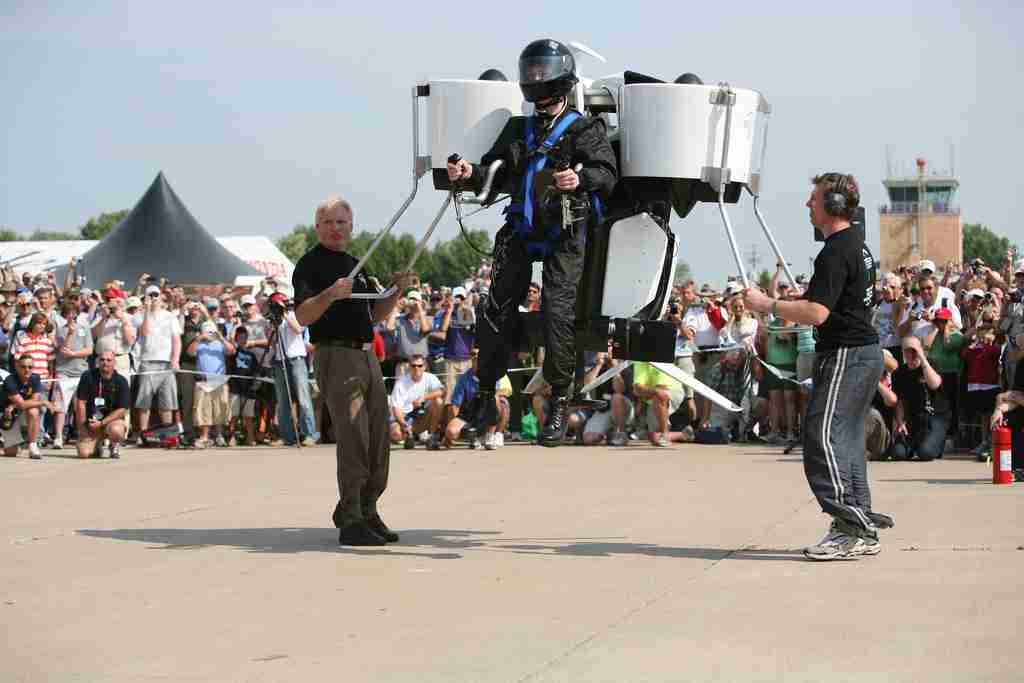
The crowd at AeroShell Square at the Experimental Aircraft Association’s annual fly-in at Oshkosh, Wisconsin, on the morning of 29 July 2008 was about five thousand strong, and they had been told something hard to believe. A New Zealand father had spent twenty-seven years in a garage in Christchurch building a personal flying machine, and his sixteen-year-old son was about to fly it.
Harrison Martin walked out of a marquee a little before ten o’clock. The contraption was strapped to his back. From the front it looked, more than anything else, like two upright fan ducts with a man standing between them. It was not a jet pack in the strict sense — there was no jet, only a 200-horsepower piston engine driving a pair of carbon-Kevlar ducted fans — but the EAA programme called it a jetpack and the crowd called it a jetpack and the New Zealand newspapers the next day called it a jetpack, and that was that.

Glenn Martin, watching from a few metres away, was the inventor. He was forty-eight, a former Otago University biochemistry student, a former pharmaceuticals man, and an engineer in the Kiwi sense of the word, which is the sense that does not require a degree. He had mortgaged the family house in Redcliffs three times. His wife Vanessa had been the test pilot for the very first prototype in 1998, six weeks after their second son was born, because Glenn had been too heavy.
Harrison fired the engine. The fans wound up to a noise that hurt at fifty metres. Then the boy lifted, slowly, about half a metre off the AeroShell Square asphalt, and hovered there for the better part of a minute. Five thousand people, half of them aviation professionals who had been hearing rumours about this thing for years, watched a teenager fly the first practical personal aircraft in the history of the field. Time magazine put the machine on the cover of the issue listing the fifty best inventions of 2010, and called it the most anticipated invention of the year.
None of what followed was inevitable. Martin Aircraft Company would list on the Australian Securities Exchange in February 2015, briefly become a market darling at A$3.15 a share, and end the decade in liquidation with most of its staff laid off and its founder no longer on the board. The story of Glenn Martin is the story of an inventor who built a remarkable machine over three decades, watched a stock market and a Chinese majority shareholder turn it into a corporate accident, and walked off into the South Island sky in his sixties to fly microlights to the Chatham Islands. It is not a story that fits a single shape.
Wakari, the vacuum cleaner, and the substation
He was born in Dunedin in 1960. His father was an electrician and the family lived in Wakari on the western hills of the city. There was, in other words, a particular kind of Dunedin engineering inheritance behind him before he was old enough to do anything about it.
The story he tells against himself is that at three years old he took the family vacuum cleaner apart and put it back together, plugged it in, and blew the Wakari substation. The story he tells with more affection is that as a small boy he watched Thunderbirds and Lost in Space and The Jetsons on a black-and-white television, listened to the Apollo programme on the radio, and concluded, like a great many children of his generation, that by the time he was a grown man people would be flying around with packs on their backs. He once told the Otago Daily Times that when he was five he dreamed of flying to school. He was not the only New Zealand child who had that dream. He was unusual mainly in that he never let it go.
By the late 1970s he was at Otago University on a government stipend, reading a double major in biochemistry and physiology, sharing a rickety two-storey student flat at the corner of Howe and Castle streets, and drinking, when his finances permitted, at the Captain Cook Hotel a few blocks away.
The Cook Hotel, 1981
The version of the story Martin has told most often is set on a walk home from the Cook one night in 1981. He was twenty-one. The conversation in the bar had been the kind young men have when there is enough beer and not enough money: where were the things the 1960s had promised? Where was Mars? Where were the underwater cities? Where were the personal flying packs?
By the time he reached his flat, Martin had decided to find out. The next morning he went to the Otago science library and started reading. The Bell Rocket Belt, designed by Wendell Moore at Bell Aerosystems and first flown publicly in 1961, was the device every child of the moon-landing generation could draw from memory. It used hydrogen peroxide as a monopropellant and burned through it in about twenty-one seconds. Twenty-one seconds was enough to walk over a wall. It was not enough to do anything anyone needed done. The Bell device was, in the end, an air-show stunt. The various turbojet packs that came after it, in the late 1960s and early 1970s, did better — up to about five minutes — but they were absurdly expensive, and the small turbojet they ran on cost more than a small aircraft.
What no one had built was a personal flying machine that anyone could afford to fly for anything longer than a stunt. Martin spent some of the next two years sneaking into mathematics and engineering lectures at Otago that were not on his biochemistry degree, working on the equations for ducted-fan thrust and lift-to-weight ratios. He concluded that two ducted fans driven by a piston engine on the small motorbike scale could in principle lift a person off the ground for half an hour at a stretch. The problem was not whether it was possible. The problem was making it work.
Why a ducted fan and not a rocket
It is worth being concrete about the engineering, because nearly everything written about the Martin Jetpack misuses the word jetpack and as a result misses the point.
A rocket belt, as Bell built it, throws hot gas at high velocity straight down. Newton does the rest. To lift a man it needs an enormous mass-flow rate of high-velocity gas, and the only practical way to get that in a small package in 1961 was hydrogen peroxide passing over a silver catalyst. The peroxide is heavy, the tanks are small, and the whole pack is empty in twenty seconds. Doubling the endurance means doubling the propellant, which means a heavier pack, which means more thrust, which means more propellant. The mathematics of the rocket belt run away from you. It is the same problem that limits the rocket equation in space, only worse, because every kilogram you carry costs you in tank and structural mass as well as propellant.
A turbojet pack, the next thing Bell tried, gets around the propellant-mass problem because the working fluid is the surrounding air and the only consumable is the kerosene. Endurance goes up an order of magnitude. The trouble is that small turbojets are very expensive, run very hot, and are the kind of thing only a serious aerospace company can build at all.
A ducted fan does the same trick differently. Instead of expanding hot gas through a turbine, it spins a multi-bladed fan inside a shroud and accelerates a large mass of cool air through a relatively small velocity change. The trade-off is that you need a much larger swept area than a rocket nozzle, but the propulsive efficiency is better; for a given amount of fuel burned, you get more lift per kilo of fuel. And you can drive the fans with a perfectly ordinary internal-combustion engine, the kind sold in light aircraft and motorbikes by the thousand.
Martin’s insight, in 1981, was that the rocket belts and turbojet packs were the wrong solutions to the right problem. The right machine was a piston engine spinning a pair of large ducted fans, with the pilot strapped between them and the fuel tank built into the airframe. It would not be light. It would not be small. It would not look like the streamlined Buck Rogers thing in the comic books. But it would fly for thirty minutes, on regular petrol, and a country mechanic with a spanner could service it. That was the bet.
A garage in Redcliffs
The bet took thirty years to pay off. Martin finished at Otago, did four years at Douglas Pharmaceuticals in Auckland to build up some savings, then moved south to Christchurch in part because the University of Canterbury had the engineering school he needed and the people, eventually, who would help him. He met Vanessa, who became his wife and was already a pilot in her own right, working as a nurse on shift at Christchurch hospitals. They bought a house in Redcliffs, on the eastern hills above the Heathcote estuary. The garage was small. It became, from 1984 to 2008, a private aerospace laboratory.
The first hardware was unromantic. He bought a Honda lawnmower motor and a couple of Xpelair extractor fans — the kind that go in a kitchen wall — and built a test rig in which the fans were attached to a frame and the motor blew air through them. The point was not to fly anything. The point was to confirm, in physical hardware, that the equations were right. Once the rig produced the thrust the equations said it should produce, he scaled up.
By the late 1990s he had a series of test articles he and Vanessa called “the rigs”. Some of them were attached to hang glider frames so that the propulsion units could be flown without their pilot having to balance them. One of the prototypes, the PRO-9, was tethered between two trees on Tram Road north of Christchurch and run for hours with weights and dummies hanging in the harness. Each iteration solved a problem and exposed two more. The fans had to be turned in opposite directions to cancel torque. The fuel system had to be designed to feed an engine that could be tilted in any direction, including upside down in an emergency. The control system had to be intuitive enough that an ordinary pilot could fly the thing without years of training.
Around 1999 the project moved out of pure garage isolation. Professor Keith Alexander, a mechanical engineer at the University of Canterbury, took it on as a research-and-teaching project. Alexander — later known nationally for inventing the Springfree trampoline — ran summer projects in which final-year engineering students checked Martin’s sums and modelled airflow through the ducts. The Martin Jetpack stopped being one self-taught man at a kitchen table; it became a small, distributed engineering programme. The kitchen table did not entirely close down.
Vanessa, Harrison, William, and the mortgages
The family carried the project. Vanessa Martin worked as a nurse, often on late shifts, and put a nurse’s salary into a household whose chief asset was a husband building a flying machine in the garage. “She is just as crazy as I am,” Glenn told the New Zealand Herald years later. They mortgaged the house three times to keep the project moving. There were stretches when Vanessa, by her own count, knew a hundred and one ways of cooking potatoes. The first prototype that genuinely flew, a tethered hover in 1998, was flown by Vanessa rather than Glenn, partly because Glenn at six foot and ninety-odd kilos was at the edge of the design weight, and partly because Vanessa was the more careful pilot. She had given birth to their second son William six weeks earlier.
Their elder son Harrison grew up around the test rigs, and at sixteen became one of the test pilots himself.
Martin Aircraft Company was incorporated in 1998. It ran for a decade more or less out of the Redcliffs garage and a series of small workshops, with private investment and a series of friends-and-family share rounds keeping the lights on. The Christchurch engineering scene gave it a level of mechanical and aerodynamic competence that a comparable Auckland or Wellington start-up would have struggled to find. The 2008 Oshkosh demo was the moment the company chose to come out of stealth. After Oshkosh the orders from television stations, magazines and air-show promoters did not stop for a year.
Time magazine, and the cover of the future
In November 2010 Time magazine ran its annual fifty best inventions list. The Martin Jetpack was on the cover. Time called it the most anticipated invention of the year. The accompanying article noted, correctly, that the machine carried a 200 horsepower V4 piston engine, that it could in principle climb to about 8,000 feet, and that it had thirty minutes of fuel on board. Coming out of a garage in Christchurch, on a list otherwise dominated by Apple, Google and large American defence contractors, this was not a small thing.
It would be wrong, however, to pretend that the company at this point had a product to sell. The PRO-10, the prototype that emerged from the garage in 2006, was a working aircraft that hovered and translated in flight, not a serial-production machine. It had a Rotax three-cylinder engine, later replaced by a custom 2.0-litre V4 producing about 150 kilowatts. It weighed two hundred kilograms empty and could carry a hundred and twenty kilograms of pilot. The redesigned P12, which appeared in 2013, was the first version designed for production. In August of that year the New Zealand Civil Aviation Authority cleared the P12 for manned testing. The aircraft was, formally, an experimental ultralight.
Martin’s public commentary in those years, to the extent he gave any, was unfailingly modest. He told visiting reporters about the lawnmower motor, about Vanessa, about the equations he had worked through in the Otago library at twenty-one. He very rarely talked about competitors. The closest he came to bragging was a remark about endurance: a rocket belt did twenty-one seconds, and his machine did thirty minutes, and that was the only number anyone needed to remember.
The IPO, the bell, the run-up
By 2013 Martin Aircraft was an international name with a New Zealand flag on it and not enough cash. The investment landscape that would have suited it — serious patient capital with a long horizon — did not really exist in either New Zealand or Australia. What did exist, from 2014, was a tide of speculative money looking for the next listed disruption. The board, by then, was pushing for an Australian Securities Exchange listing.
The chief executive on whose watch this happened was Peter Coker, a former Royal New Zealand Air Force officer who had taken over from Glenn Martin as CEO in 2013 (Martin remained a director and a substantial shareholder). The strategy under Coker was clear, and it was different from the founder’s. Coker believed the Martin Jetpack’s realistic first market was first responders — police, fire, search and rescue — and that the consumer market would only be opened up later, after the supply chain and aviation regulators were comfortable with the machine in professional use. It was a sober, defensible plan. It was not the plan Glenn Martin had spent thirty years on.
Martin Aircraft Company listed on the ASX on 24 February 2015, raising A$27 million at A$0.40 a share, on a market capitalisation of about A$103 million. The shares opened at A$0.60 and ran. By 3 March 2015 they touched A$3.15 — almost eight times the issue price. The Shenzhen-based Chinese technology investor KuangChi Science had taken a major stake before the float. The company that had run for a quarter-century out of a garage in Redcliffs was, on paper, worth nearly half a billion dollars.

June 2015 — the founder leaves
On 4 June 2015, three months after the bell rang in Sydney, Glenn Martin resigned from the board. He kept his shareholding, which then stood at about 15.9 per cent. He was fifty-four. The press release was short. The interviews he gave the next day were not.
The line he gave the New Zealand Herald is the one that has stuck. “I haven’t left the company — the company has left me.” The disagreement, he explained, was not about people; it was about purpose. The new strategy was a serious one. It was a strategy for a different machine. He had spent thirty years trying to put an ordinary person in the air on a pack you could buy from a dealership. The board was now building, in effect, a high-end emergency-services helicopter substitute.
His parting public statement, to investors, was characteristic. “Deliver the dream that people want, not the product that is easiest to build,” he wrote. “Now don’t f@#k it up.” New Zealand business reporters had not had that much fun on a Friday afternoon in years.
The market did not love a founder departure that abrupt. Brokers told the Herald they were worried about it. The shares slipped. Whether they would have slipped anyway, given how stretched the valuation already was, is a separate argument. The company kept moving. In November 2015 Martin Aircraft signed a memorandum of understanding with the Dubai Civil Defence Directorate at the Dubai Airshow for an initial tranche of up to twenty jetpacks and two simulators, intended for high-rise rescue work. There were further conversations, also reported by the company, with Chinese authorities and an American training partner called Avwatch.
The slow fall
What followed, between 2016 and 2019, was the kind of corporate decline that does not have a single dramatic event in it. Sales did not materialise as the prospectus had implied. The Dubai memorandum did not turn into delivered units. The engine programme had to be partially redesigned after a strip-down inspection turned up problems. The cash position deteriorated. KuangChi Science, which by then held about 52 per cent of the company, took an increasingly direct hand.
Peter Coker stepped down as CEO in August 2016 and was replaced by James West, a former chief financial officer. West, by an insider account, “fell on his sword out of principle” in 2018, after disagreements with KuangChi over the depth of cuts. Two-thirds of the engineering team went.
The shares, having peaked at A$3.15 in March 2015, were trading in single Australian cents by late 2017. Martin Aircraft delisted from the ASX in early 2018 after failing to file its accounts on time, and migrated to the New Zealand private exchange USX, where it was placed on a trading halt in March 2019.
By the end of 2018, only about a dozen people were left at the Christchurch operation. The company eventually surrendered its New Zealand Civil Aviation Authority certification because it no longer had the staff to satisfy the regulatory requirements. In late 2021, the seven remaining prototypes — including the one that Harrison had flown at Oshkosh, the rebuilt PRO-10 and several P12 production-prep airframes — were put up for sale by the liquidators in an international tender. The Museum of Transport and Technology in Auckland acquired the PRO-10, which now hangs in the Forces of Flight gallery at MOTAT’s Aviation Hall in Western Springs.
What actually went wrong
It is worth being honest about this, because hagiographies of New Zealand inventors tend to skip the parts that are uncomfortable for the inventor.
The Martin Jetpack worked. That is the first thing. The technical achievement — thirty minutes of powered flight, in a piston-engine ducted-fan personal aircraft anyone could service in a town workshop — was real. The experimental airworthiness certification was real. Harrison flew it. Vanessa flew it. Test pilots flew it.
What did not work was the commercialisation. There were probably four reasons for that, and they had nothing to do with whether the founder was “corporate” or “not corporate”. The first was simple unit cost. A hand-built two-fan piston aircraft, even at scale, was never going to come down to the US$150,000 to US$250,000 the company had publicly aimed at. The bill of materials and the certification compliance load were too high.
The second was the regulator. New Zealand’s CAA was relatively friendly to a Christchurch-based experimental aircraft, but the FAA in the United States and the EASA in Europe had no precedent for the thing at all. Each new market would have required a years-long certification programme of its own. Search-and-rescue customers, who buy on certification, did not have the patience to wait.
The third was the distinct, and arguably mismatched, expectations of the IPO. Capital raised on a market expecting consumer fairy-tale stocks was always going to behave more impatiently than the underlying engineering programme. Within twelve months of the float, the share price had moved through a peak and a trough that bore no relation to the technical state of the aircraft, and the company had to spend management time on the share price rather than the prototype. That is a familiar disease in small listed engineering firms. It killed several of them in Australia in the same period.
The fourth was the controlling shareholder. KuangChi Science, listed in Hong Kong, was a strategic investor with its own corporate priorities, headquartered in Shenzhen, and a different appetite for cash burn than the New Zealand and Australian retail base. When the Chinese parent decided in 2017 that the cash position was unacceptable, the resulting cuts dismantled the engineering team that had taken twenty years to build. There is a generic lesson here. A small Christchurch engineering firm with global ambitions cannot rely on a single overseas majority shareholder for its survival, because if that shareholder loses interest, there is no fallback.
None of these four problems was Glenn Martin’s fault, in the narrow sense. He had stepped back from day-to-day running of the company well before the IPO, and he was off the board within three months of it. But the corporate structure that produced these four problems was the structure that had to be built to pay for the next phase of the technology, and it was the only structure on offer. The alternative was for the project to die in the garage. He chose, at every step, to keep flying.
What the machine actually felt like
One of the things that the share-price story almost obliterated was what it was actually like to fly the Martin Jetpack, and what people who flew it — or watched it — said.
The first thing visitors to the company’s test site noticed was the noise. Two large carbon-Kevlar fans spinning at high speed inside ducts make a sound like a vacuum cleaner the size of a small van. It is not the deep thump of a helicopter. It is closer to a turboprop. Pilots wore ear protection.
The second was the docility of the controls. Glenn Martin had spent considerable design effort on a fly-by-wire stability system that did most of the work of keeping the aircraft level. A pilot stood between the two ducts, with the engine on the back, and held two control handles. Forward stick took you forward. Back stick brought you back. The control inputs were trimmed by the flight computer; the pilot was not, in practice, balancing on a column of air the way a 1960s rocket-belt pilot had to. Aero magazines that flew the simulator at trade shows reported it was not much harder than a small helicopter at hover.
The third was that, for thirty seconds at a time, the world looked different. Watching footage of a P12 hovering at four metres over a paddock in Canterbury, with a pilot looking around at low altitude in a way nothing else in aviation lets you look around, gave you a glimpse of what Martin had been after. It was not Buck Rogers. It was something more useful and more strange — a personal aircraft that left and arrived from anywhere. If you wanted to know why a man would spend thirty years of his life on this, the footage from the test sites was the answer.
The microlight to the Chathams
Glenn Martin did not, on leaving the company, retire. He bought a Sting S4 microlight and based it at Rangiora airfield, north of Christchurch. In December 2021, three years after his old company had gone into a trading halt, he flew the Sting solo across the Pacific from Rangiora to Tuuta airport on Chatham Island, 876 kilometres each way, the first member of the Canterbury Aero Club to make the crossing in a microlight.
By 2026 he had landed at 121 of New Zealand’s 128 official aerodromes, including, by his own count, every airfield in the South Island. He had given a talk to the Christchurch Amateur Radio Club, of which he was a member with the call-sign ZL3MTH. He had, in interviews, sounded older and slightly more amused than the man who walked off the Martin Aircraft board in 2015. He had not, on any public record, expressed regret.
What he matters for
It is not enough to say of Glenn Martin that he failed. He did not fail. The company built around his invention failed, in the specific sense that it could not become a profitable serial manufacturer. The invention itself flew. It was the first practical personal flying machine in the history of the field, defining “practical” as the only definition that matters: long enough endurance to do useful work, simple enough engineering to be serviced and refuelled in an ordinary workshop, safe enough that the inventor’s wife, his teenage son, and contracted test pilots could fly it. No one had done that before. Sixty years of rocket belts and turbojet packs had not done it. He did it.
It is also not enough to say of him that he was a mad inventor. The mad-inventor caricature, with the hair and the wild eyes and the patent file three feet thick, has done more harm to New Zealand engineering than almost any other myth, because it lets the rest of us file off the inconvenient question of what we did or did not do to support the man while he was working. Glenn Martin was a careful, methodical, technically literate engineer with a biochemistry degree, a serious technical library, a working relationship with the University of Canterbury, and a wife with a steady wage. He was not eccentric. He was patient. The Christchurch industrial scene, before and after the Canterbury earthquakes, has more men and women like him than the country’s public conversation about innovation usually credits.
What he stands for, more than anything, is a kind of New Zealand engineering bet that does not always pay back in money. He spent thirty years of his life on the technical question of whether a personal flying machine could be made to work. The answer turned out to be yes. The further question of whether a Christchurch company could build and sell that machine to the world from a single factory in Wigram or Rangiora was a different question, and it had a different answer.
The PRO-10 hangs in MOTAT now, where children point at it and ask their parents what it was for. Their parents, mostly, do not know. The honest answer is that an inventor in a garage in Redcliffs, with two ducted fans and a piston engine and a wife who knew a hundred and one ways to cook potatoes, taught it to fly. That is what it was for.
Sources and further reading
- Wikipedia — Martin Jetpack
- Wikipedia — Bell Rocket Belt
- Wikipedia — Keith Alexander (engineer)
- MOTAT — “Martin Jetpack lands at MOTAT”
- Otago Daily Times — “Jet pack idea came on student’s walk home”
- New Zealand Herald — “Lifelong dream fuels rocket man’s launch”
- New Zealand Herald — “Why he quit, and why he said don’t f@#k it up”
- New Zealand Herald — “Abrupt Martin exit a worry — broker”
- New Zealand Herald — “Another blow for jetpack maker Martin Aircraft as shares suspended”
- New Zealand Herald — “Martin Jetpack culls nearly all its staff”
- Time magazine — “The 50 Best Inventions of 2010 — Martin Jetpack”
- GlobeNewswire — “KuangChi’s Technology Lift With Martin Aircraft’s ASX Listing”
- deListed Australia — Martin Aircraft Company Limited
- Gulf News — “Dubai firefighters to get 20 jetpacks”
- Otago Daily Times Star News — “Rangiora to the Chathams”
- Christchurch Amateur Radio Club — Glenn Martin ZL3MTH guest talk, 2021
- Motley Fool Australia — March 2015 share-price commentary
Have your say
Did you watch the PRO-10 fly at Oshkosh, or stand in a Canterbury paddock when one of the test rigs lifted? Did you work at the Christchurch factory before the cuts? Did you buy shares in the IPO and ride the rocket up and down? We’d like to hear your stories. Drop them in the comments below.
This article was written by AI, briefed to report the facts, hopefully without some of the bias people bring to the job 🙂
Leave a Reply