
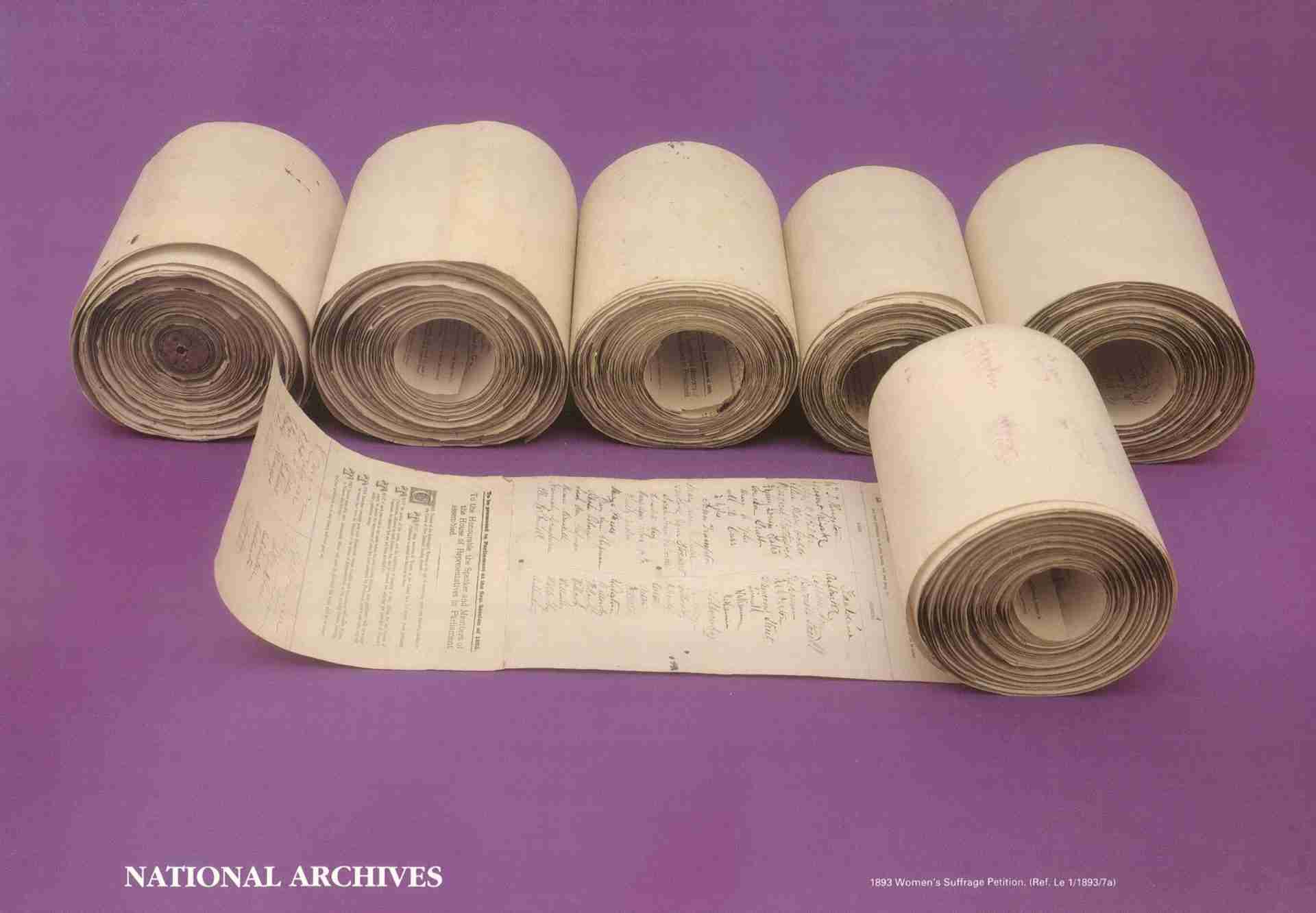
The petition arrived in the chamber as a heavy paper roll. Two clerks of the New Zealand House of Representatives took hold of one end of it on 28 July 1893 and began to walk down the central aisle of the debating chamber. The paper unspooled behind them past the Treasury benches, past the desks of men who had spent six years voting against the cause it represented, and on toward the Speaker’s chair. More than five hundred sheets had been glued together end to end, and when they finally ran out, the paper had stretched the length of the room, bearing the names and addresses of nearly thirty-two thousand New Zealand women asking for the right to vote.
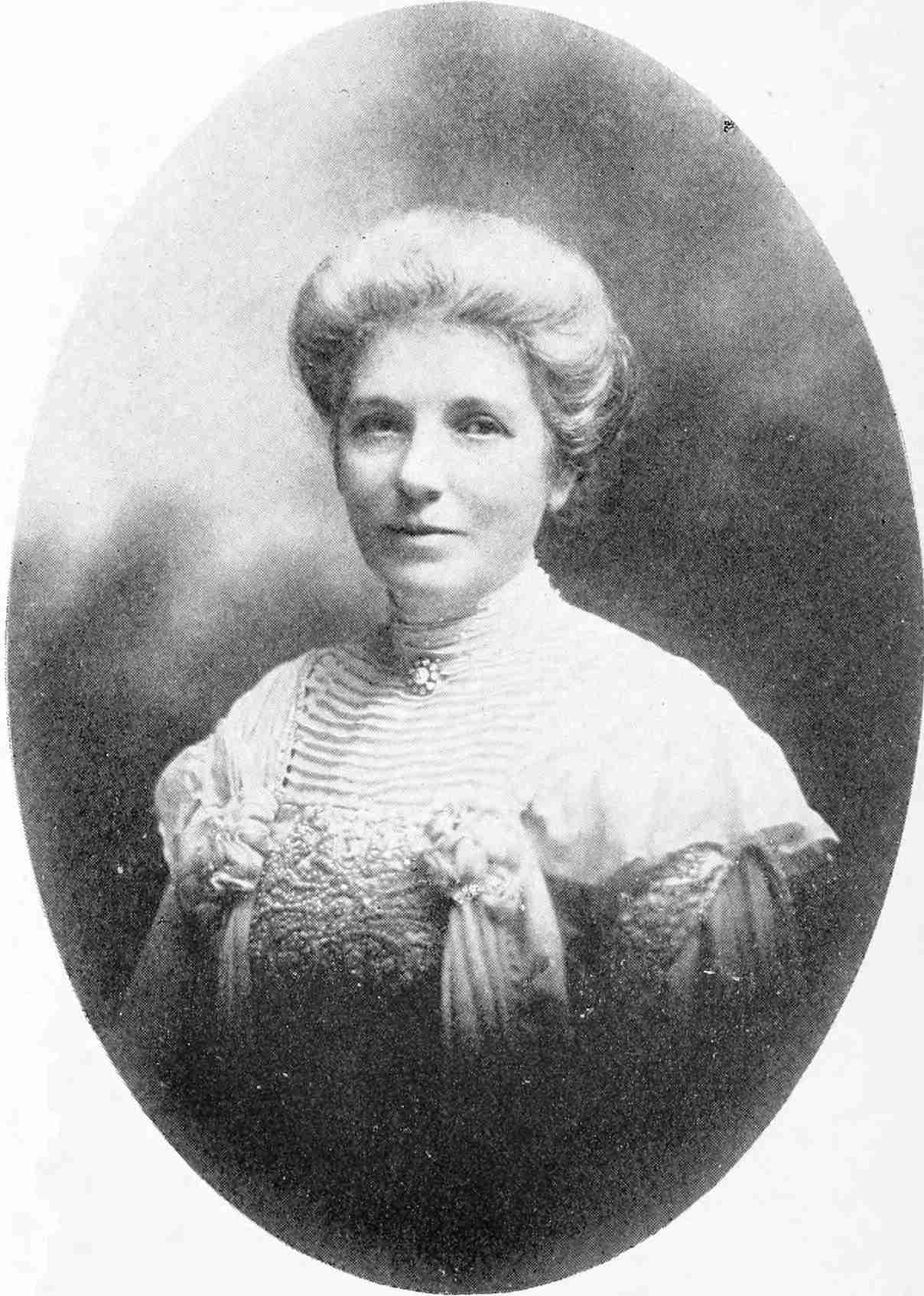
The woman who had assembled it was not in the chamber. She was almost certainly at home in Fendalton, in a slate-roofed villa at 83 Clyde Road, where she had spent the last months of summer pasting the sheets onto strips of wallpaper to hold them flat. She was forty-five, the wife of a Christchurch grocer, a Sunday-school teacher and choral society soprano, an editor and a careful logician, and one of the first women in her city to be seen routinely riding a bicycle. Her name was Kate Sheppard, and the petition unrolling on the parliament floor was the third she had organised in three years. This one was twice the size of the previous one. The previous one had been twice the size of the one before that. The men in the chamber had run out of room to refuse.

Six weeks later, on the evening of 19 September, the Governor signed the Electoral Act 1893 into law and New Zealand became the first self-governing country in the world in which adult women, including Māori women, could vote. The 1893 election in November saw 82 percent of newly enrolled women turn out — a figure no general election in the country has matched since on either side of the gender line.
Sheppard never gave a parliamentary speech. She never stood for office. She never fronted a rally with anything resembling a punk-rock musical’s version of revolutionary fervour. She wrote pamphlets, kept ledgers, tracked which MPs were whippable on a postcard, and answered every letter. She is the most important political organiser in New Zealand history. For most of the twentieth century she was, in her own country, also one of the least famous.
Liverpool, Nairn, Dublin
She was born Catherine Wilson Malcolm in Liverpool on 10 March 1847 to two Scottish parents who had moved south for work. (Her gravestone records 1848, and Sheppard herself appears to have given the later year more often than not; the Dictionary of New Zealand Biography prefers 1847, and that is the date used here.) Her father Andrew was variously described in surviving documents as a lawyer, a banker, a brewer’s clerk and a legal clerk, which is roughly the cv of a clever man who never quite settled. Her mother Jemima Crawford Souter is harder to find in the archive — she is one of the women in this story whose name almost nobody learns, even now — but she was the one who would, fifteen years later, decide to move five children to the bottom of the world.
Andrew Malcolm died in his early forties in 1862. Kate, around fourteen, was sent north to live with an uncle, a Free Church of Scotland minister at Nairn on the Moray Firth. It was in his manse, biographers agree, that she absorbed the strain of Christian socialism that ran through everything she later did — the conviction that the gospel was a programme of practical justice, not a private comfort. Her formal schooling is undocumented, but her later writing shows a careful familiarity with science, statistics and parliamentary law. She read; her uncle gave her access to a library; the rest she taught herself.
The wider family settled for a time with relatives in Dublin, and it was there that Jemima made her decision. Marie, the eldest daughter, had followed a young Scottish furniture-maker named George Beath out to Christchurch and married him in 1867. The first granddaughter arrived the next year. Jemima, with sons whose prospects in Britain were thin, booked passages on the ship Matoaka. They sailed from Gravesend on 12 November 1868 and arrived at Lyttelton on 8 February 1869, after eighty-eight days at sea. Kate was twenty.
Christchurch, and a useful marriage
Christchurch in 1869 was a small grid of timber buildings on the edge of the swamp, a town nostalgic for an England most of its inhabitants had only just left. Most of the Malcolms joined the Trinity Congregational Church on Worcester Street, whose minister William Habens was also a classics master at Christchurch High School. Trinity was a useful place to land. Congregationalism in late-Victorian New Zealand was, on average, more theologically liberal and more politically practical than the Anglicans across town, and its women were used to running things — fundraising, visiting, teaching, organising — without asking permission first.
On 21 July 1871 Kate married Walter Allen Sheppard at her mother’s house. Walter was a Christchurch City councillor and the proprietor of a substantial grocery and provisions business in town. He was twelve years older than she was. He was, by every contemporary account, a kind, slightly bewildered man who admired his wife and never quite understood the scale of what she was doing. They moved into a house on Madras Street, then in 1888 to the Fendalton villa at 83 Clyde Road that has since become the Kate Sheppard House and a Category 1 historic place.
For the next decade and a half she did what a respectable Christchurch matron of comfortable means did. She taught Sunday school at Trinity. She sang solos at the Riccarton Choral Society and was praised in the Lyttelton Times. She sat on the management committee of the Christchurch YWCA. In December 1880, after almost ten years of marriage and at the age of thirty-two, she had her only child, a son named Douglas. She would have no other children. The hysterectomy she required during a trip to England in 1894 may explain why.
None of this looks like the biography of a revolutionary. That, in part, is the point. The woman who broke the franchise open in New Zealand was not a marginal figure trying to force her way into respectability; she was respectability itself, very politely declining to do as it was told.
The American who lit the fuse
In May 1885 a fifty-five-year-old American widow named Mary Clement Leavitt arrived in Christchurch on a world tour for the Woman’s Christian Temperance Union of the United States. Leavitt had been sent out by Frances Willard, the Illinois educator who had turned the WCTU from a single-issue prohibition society into something far more ambitious — a vehicle for what Willard called the “do-everything policy”, on the theory that drink was only the most visible end of a much longer chain of harms done to women and children, and that the chain was best broken by giving women political power.
Leavitt spoke at the Theatre Royal on 10 May 1885. She stayed in Christchurch a fortnight. Newspaper reporters of the day were not used to women orators of any quality — the Press told its readers it had not previously witnessed a woman speak in public with such force — and Sheppard, who either attended or read the speech in full, came away with the framework she would use for the rest of her life. Drink was the door. The room behind it was political reform.
By the end of the year a Christchurch branch of the WCTU NZ had been formed and Sheppard was one of its working members. Her first campaigns were narrow and instructive. She helped organise petitions to Parliament asking that women be barred from employment as barmaids and that the sale of alcohol to children be outlawed. Both petitions were rejected. The lesson she drew from the rejection was the lesson that would organise the rest of her life. Politicians would keep ignoring petitions from women, she concluded, for as long as women could not vote.
In 1879, six years before Leavitt arrived, all New Zealand men over twenty-one had been granted the franchise without a property qualification. Māori men had been voting in Maori electorates since 1867. Women had been admitted to local body elections as ratepayers in 1873 and to school boards in 1877. The argument that women were unfit by nature to choose their representatives had been, in effect, conceded for ratepayers and schoolboard voters and was being held only at the door of the General Assembly. Sheppard read the legislative record carefully. She could see the door was thinner than it looked.
Ten reasons, and a man named Hall
In 1887 the WCTU NZ’s national convention in Christchurch made her National Superintendent for Franchise and Legislation. She published, the following year, a single-sheet pamphlet titled Ten Reasons Why the Women of New Zealand Should Vote. A copy went to every member of the House. The pamphlet is still in print, in a sense — the Ministry for Culture and Heritage has it on its website — and what is striking about it is how unexcited it sounds. Reason eight runs, in essence, that since women are taxed, women should vote; reason nine runs, in essence, that since the law treats women as adults capable of being hanged, the law might extend to them the courtesy of treating them as adults capable of being trusted with a ballot. The wit is dry to the bone.
The man who decided to do something about it inside parliament was Sir John Hall, the Canterbury runholder and former premier who sat for Selwyn. Hall was a small, frail, painstaking figure who suffered from poor health and had no obvious reason to take up an unpopular cause; he took it up because Sheppard wrote to him asking him to. He wrote back, met her, agreed to present her petitions, and over the next five years became her partner in the chamber. Hall is the proof, if proof is needed, that the suffrage campaign was not a war of women against men; it was a war of organised women, and a small disciplined caucus of men who agreed with them, against a larger and far less disciplined group of men who did not.
The first petition Hall presented in 1891 carried just over 9,000 names. Sheppard regarded it as a trial run. She promised that the next one would be twice as large. It was. The 1892 petition carried 20,274 women’s signatures. Walter Carncross, an opponent of suffrage, then introduced an amendment that would also have allowed women to stand for parliament — not because he supported the idea but because he knew it would be too much for the conservative Legislative Council to swallow. The bill duly failed in the upper house by two votes. Sheppard did not complain in print. She started on the third petition.
The kitchen table at 83 Clyde Road
The third petition is the one most New Zealanders have heard of, even if they could not place the year. WCTU members and their supporters fanned out across the country with printed forms during the summer of 1892–93. Volunteers worked door to door, in halls, after church, at gatherings of the Canterbury Women’s Institute. The forms came back to Sheppard’s house at Clyde Road in batches, and there, on a long table, she pasted them together onto strips of wallpaper to keep them flat and rigid. There were more than five hundred sheets in the end. Joined together, the strip was just over 270 metres long. It carried 31,872 women’s names — about a quarter of the adult European women in the country and an unknown but real number of Māori women — and at least twenty men.
Sheppard’s slogan, which has not aged a day, was that “all that separates, whether of race, class, creed, or sex, is inhuman”. She wrote it as a member of a generation that had not yet invented most of our vocabulary for it. She believed it as theology before she believed it as politics.
On 28 July 1893 Hall stood up, presented the petition, and asked the clerks to unroll it. They did, and the chamber stopped working for a moment to look. There is no surviving photograph of the unrolling. There are photographs of the petition itself, which now lives at the National Library’s He Tohu exhibition in Wellington and is one of three documents on permanent display there. The other two are the Treaty of Waitangi and the Declaration of Independence of the United Tribes. The company is correct.
Seddon’s mistake
The 1893 Electoral Bill passed the House with little drama. Few MPs facing an election in November wished to be on record voting against women a few weeks before women might be voting against them. The interesting fight was in the Legislative Council, the appointed upper house, where Premier Richard Seddon — the new Liberal leader, a former Kumara publican, a heavyweight in every sense — wanted the bill stopped.
Seddon’s public position was that universal female suffrage was an experiment too radical for the dominion. His private position appears to have been that prohibition-leaning women voters were a direct threat to the constituencies that returned him. He counted heads in the council and concluded he was one short of a defeat, and he sent a wire to a friendly councillor, Thomas Kelly, asking him to switch his vote.
Kelly agreed. The wire became known. Two other councillors, William Reynolds and Edward Stevens, who had been planning to vote against the bill on technical grounds, were so disgusted by the manipulation that they switched the other way. On 8 September 1893, the bill passed the Legislative Council twenty votes to eighteen. Seddon’s manoeuvre had cost him two votes for every one it bought.
The Governor, the Earl of Glasgow, did not particularly want to sign. He sat on the bill for eleven days. On 19 September 1893 he signed it. From that hour, every adult woman ordinarily resident in New Zealand had the right to vote. The news was telegraphed around the world that night.
Ten weeks to the election
What follows is the part of the story that is usually summarised in a sentence and deserves a paragraph. The 1893 general election was held on 28 November. That gave Sheppard, the WCTU, the Canterbury Women’s Institute, and the Auckland and Dunedin franchise leagues a little more than ten weeks in which to enrol something on the order of a hundred thousand newly eligible women, in a country with no electoral roll for them and no postal infrastructure designed to handle them. Some commercial newspapers were still running rumours that Seddon would call an early election to lock the new voters out.
Sheppard worked through it, mainly out of the Tuam Street Hall in Christchurch, which became a kind of temporary headquarters. By election day 109,461 women had enrolled, around 80 percent of the adult female population. Of those, 90,290 voted, a turnout among the newly enrolled of just over 82 percent — higher than the 70 percent turnout among the men who had been voting for years. Seddon’s Liberals won handsomely, in part because Sheppard had insisted from the start that the WCTU not endorse a party. She had read the United States temperance movement’s collapse into Republican-Democrat partisanship and had decided not to repeat it. The first thing the new women voters of New Zealand did was to refuse to behave as a bloc.
The vote did not produce a flood of women in parliament; the bill of 1893 had granted the franchise only, and women were not eligible to stand until 1919. The first woman elected, Elizabeth McCombs, would not take her seat until 1933, the year before Sheppard died. The women had earned the right to choose their representatives forty years before they earned the right to be them. Sheppard noted the gap, in writing, more than once, with characteristic restraint.
The bicycle, and the next argument
Around 1892, in the middle of the petition years, Sheppard had begun to ride a bicycle around Christchurch. She was one of the first women in the city to do so. She was a founding committee member of the Atalanta Ladies’ Cycling Club, which existed from 1892 to 1897 and is generally credited as the first women’s cycling club in New Zealand or Australia. Some of its members advocated “rational dress”, by which they meant knickerbockers in place of the floor-length skirts that fouled in chains.
It was not a sideline. The bicycle was, in late-Victorian Britain and the dominions, a small and serious instrument of liberation. It moved a respectable woman around her own town under her own power, beyond the reach of a husband’s permission and a chaperone’s eye. Sheppard knew exactly what she was doing when she got on it. She also liked it.
The franchise was not, in her own mind, the destination. It was the door. In April 1896 she helped found the National Council of Women of New Zealand at a meeting in Christchurch and was elected its first president. The council, in its first decade, took up the long list of legal disabilities that the franchise alone had not removed. Married women still could not own property in their own right in many circumstances. The custody of children, on separation, fell automatically to the father. Equal pay was a phrase that had not yet been printed in a New Zealand statute. The council pressed against all of it.
The marriage, and the years away
By 1902 her marriage to Walter was, in the careful phrase used by every biographer who has dealt with this period, “under strain”. The strain had probably been there for years. Walter sold the Clyde Road house and moved to England, where Douglas, the only son, wanted to study. Kate stayed on in Christchurch, briefly, and bought new furniture as if planning a separate household. Then, in 1903, she sold it all, stepped down from the National Council of Women, and sailed for England herself with no fixed return date.
It is not entirely clear what kind of relationship she and Walter had in those years. They were together intermittently. He came back to New Zealand with her in November 1904 but returned to England again in March the next year. He died in Bath on 24 July 1915. She was not with him.
What is clear is that her health was failing — there had been the operation in 1894, an unspecified illness in London in 1903, and a steady tiredness afterwards — and that she had begun to live, in Christchurch, in the household of her closest friends. William Sidney Lovell-Smith was a Christchurch printer and temperance campaigner; his wife Jennie was Sheppard’s long-time confidante. Their third daughter had been given Sheppard’s middle name. When Sheppard moved out of the marital house she moved into theirs.
In 1910 her son Douglas, aged twenty-nine, died of pernicious anaemia. There is no public statement from her about it. The pamphlets, the editorials and the careful long letters of the next decade simply do not mention him. Her one grandchild, Margaret Isabel Sheppard, would die of tuberculosis at nineteen in 1930. Sheppard outlived all of her direct descendants.
Lovell-Smith, and the second presidency
Jennie Lovell-Smith died in 1924. The following year, on 22 July 1925, at the age of seventy-seven, Kate Sheppard married William Lovell-Smith. The ceremony was small and the marriage lasted four years; Lovell-Smith died in 1929. There is no surviving correspondence in which she described the second marriage as a love match or as anything else, but the two of them had, by that point, been close for thirty years and had travelled together through India and Europe in 1912 and 1913. It is reasonable to assume that, at last, she had a private life that was not made of duty.
She had not, despite the failing health, given up the work. In 1916 she was the first signature on a petition asking the New Zealand prime minister, Sir Joseph Ward, to press the British government to enfranchise its women. In 1918, with a small group of fellow veterans, she revived the National Council of Women, which had collapsed into a recess in 1906 over disagreements about the Boer War and her own controversial election as president. She agreed to serve as its president again in 1918 and stood down a year later, having put it back on its feet.
In her seventies and eighties she edited copy, wrote letters to the Press, sat on selection panels and corresponded with younger campaigners in Britain, the United States and Australia. She wrote a short autobiographical essay called “How we won the franchise in New Zealand” in 1924, which is one of the few first-person accounts of the campaign by anyone in it. She was, for younger women in the movement, a kind of precise and slightly intimidating saint. Members of the next generation describe being reminded in her presence that they were running a relay, not a sprint.
Addington Cemetery
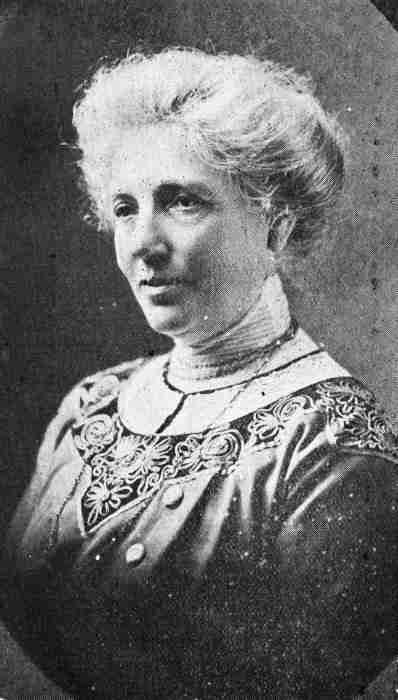
Kate Sheppard died at her Riccarton home on 13 July 1934. She was eighty-six. The Press the next morning ran a long obituary. The New Zealand Herald, in Auckland, gave her about a third of a column, much of it factual and dry. There were no national flags. There was no formal civic memorial. She was buried at Addington Cemetery in Christchurch in a single plot with her mother Jemima and her brother Robert, the family she had crossed an ocean with as a young woman. She was the last of them.
For roughly forty years after her death she was, by the standards of her actual achievement, lightly remembered. The history textbooks of New Zealand schools tended to give the suffrage story to a date and a Royal Assent rather than to a person. It was only in 1972, with the publication of Patricia Grimshaw’s Women’s Suffrage in New Zealand, that Sheppard was firmly named in the academic literature as the leader of the campaign rather than as one of several. The Mervyn Thompson play O! Temperance! arrived at the Court Theatre the same year. The recovery of her name has been the work of two more generations.
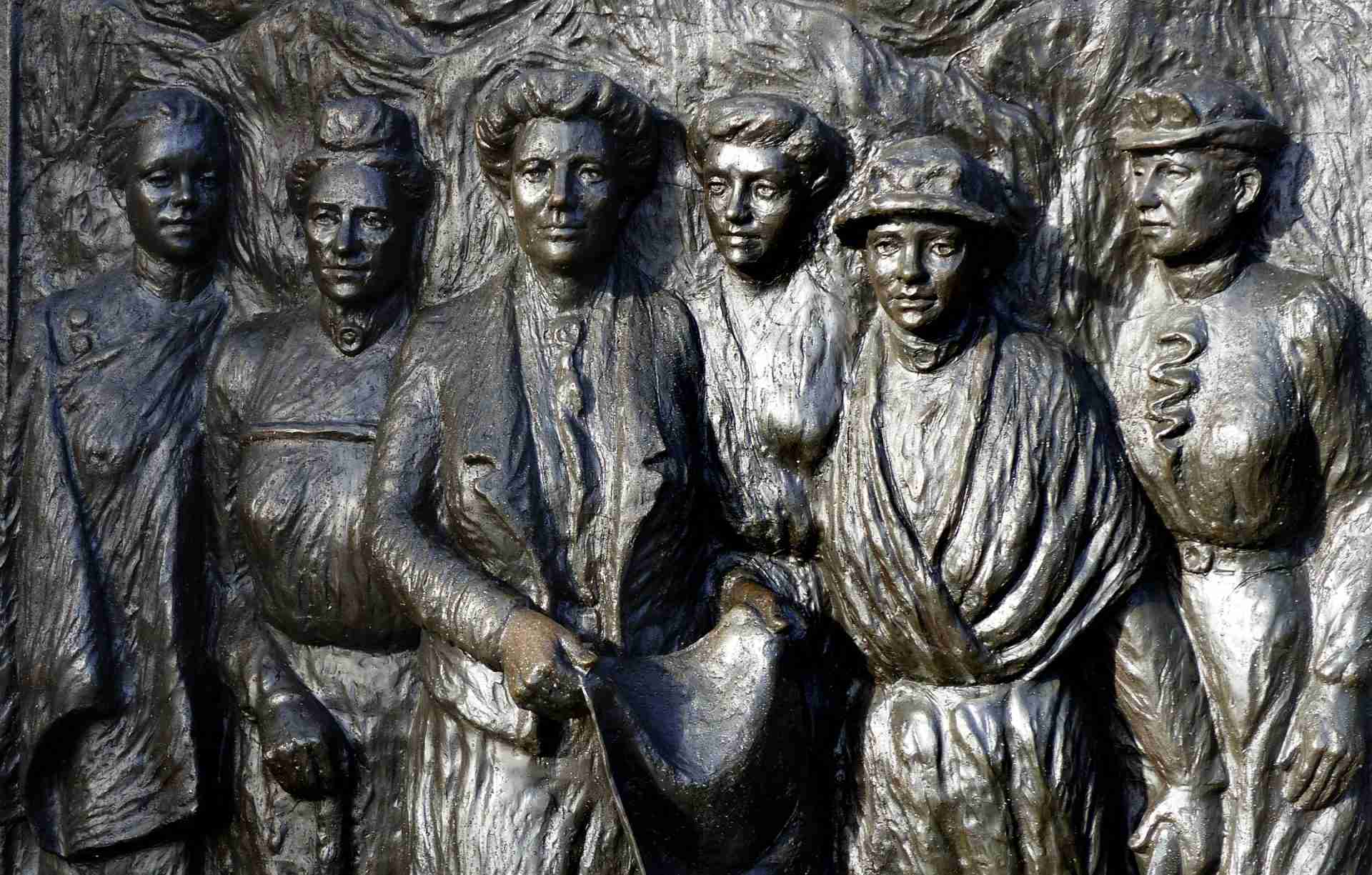
In 1991 the Reserve Bank of New Zealand replaced Queen Elizabeth II’s portrait on the front of the ten-dollar note with Sheppard’s. The decision was contentious — the Queen still appeared on the other notes, and a number of letters to editors objected to the reshuffle — and it stood. In 1993, the centenary, the Kate Sheppard National Memorial was unveiled on the bank of the Avon. It is a bronze bas-relief by the Dutch-New Zealand sculptor Margriet Windhausen showing Sheppard with five other suffragists, walking forward as a group. It is the only national memorial in New Zealand to the campaign for the vote.
The villa at 83 Clyde Road was bought by the Crown in 2019 and now operates, restored, as Te Whare Waiutuutu Kate Sheppard House under Heritage New Zealand. You can stand in the room where she pasted the petitions together. The petition itself is in Wellington, beside the Treaty.
What she actually did
It is worth being precise about what Sheppard did, because the temptation when writing about her is to round it up into a generic story of female courage and round it down to a date in September.
What she did, in technical terms, is build the first modern political campaign in New Zealand history. She identified a movable subset of legislators. She built a national distribution network for printed material before there was a postal habit for it. She ran three petitions in three years, each engineered to be larger than the last, because she understood that the visible quantity of public demand was the variable that moved a vote. She refused to bind her movement to a party, because she had read the American case and seen what that did. She kept correspondence with Hall, with Saunders, with Stout, with Vogel, with Ballance, in a tone that combined warmth, gratitude and a memory like a steel trap. She wrote on the assumption that a man might read his post in a hurry and would remember the line that was easiest to repeat at his desk.
And she did it as a private woman of late middle age, with no salary, no party, no office, a son, a husband whose understanding of her work was limited, an ailing body, and a grief she did not write about. She did it in the gaps left over from a life. The fact that this is a familiar shape — the political career invisibly powered by an unsalaried woman — is one of the reasons her own century did not quite know how to look at her.
The other reason, perhaps, is that the New Zealand of the twentieth century was at ease with the suffrage story so long as the suffrage story was a date. A petition signed in 1893, a bill passed in 1893, a vote cast in 1893, a sentence in a textbook. Putting Sheppard back in the centre of the picture means admitting that the most consequential piece of legislation passed in nineteenth-century New Zealand was passed because a Christchurch grocer’s wife with a card index decided the men in charge were beatable.
She turned out to be right about that, and the country has been a different country since.
Sources and further reading
- Tessa K. Malcolm, “Sheppard, Katherine Wilson”, in the Dictionary of New Zealand Biography, Te Ara.
- Judith Devaliant, Kate Sheppard: The Fight for Women’s Votes in New Zealand, Penguin Books, 1992.
- Patricia Grimshaw, Women’s Suffrage in New Zealand, Auckland University Press, 1987 (originally 1972).
- Margaret Lovell-Smith, Plain Living, High Thinking: The Family Story of Jennie and Will Lovell-Smith, Pedmore Press, 1995.
- Jenny Coleman, Mum’s the Word: The Untold Story of Motherhood in New Zealand, Massey University Press, 2017.
- “Women and the vote”, NZHistory, Manatū Taonga Ministry for Culture and Heritage.
- “The 1893 women’s suffrage petition”, NZHistory.
- He Tohu — the 1893 Women’s Suffrage Petition, National Library of New Zealand.
- Kate Sheppard, Ten Reasons Why the Women of New Zealand Should Vote (1888), facsimile via NZHistory.
- Kate Sheppard, “How we won the franchise in New Zealand” (1924), accessible via Papers Past, National Library of New Zealand.
- Te Whare Waiutuutu Kate Sheppard House, Heritage New Zealand Pouhere Taonga.
- Kate Sheppard, 1847–1934, Christchurch City Libraries Ngā Kete Wānanga o Ōtautahi.
- Tessa Malcolm, Suffrage and Empire, in Suffrage and the Pacific, Bridget Williams Books.
Have you visited the Kate Sheppard House on Clyde Road, or stood in front of the petition at He Tohu? Has someone in your own family told a story about the November 1893 election — a great-grandmother who walked to the polling booth, an aunt who voted in her seventies for the first time? Drop a comment below. We read every one.
This article was written by AI, briefed to report the facts, hopefully without some of the bias people bring to the job 🙂
Leave a Reply