

In Stockholm, on the evening of 11 December 1962, a tall, slightly stooped New Zealander walked to the lectern of the Karolinska Institute and began, by the standards of Nobel speeches, an unusually quiet one. He titled it “The Molecular Configuration of Nucleic Acids.” He thanked his colleagues. He thanked, by name, “Rosalind Franklin,” who had been dead for four years and who could not, under the rules of the prize, be honoured beside him. James Watson and Francis Crick, sharing the platform, did not mention her at all.
The man at the lectern was Maurice Hugh Frederick Wilkins. He had been born forty-six years earlier on the back of a butcher’s block in Pongaroa, a settlement north of Pahiatua so small that babies were sometimes delivered there because the doctor’s surgery was, on any given morning, wherever the doctor happened to be. He had spent most of his life since the age of six in England. He had helped enrich the uranium that levelled Hiroshima. He had taken the first sharp X-ray photographs of crystalline DNA. He had, without quite meaning to, set in motion the chain of small events that ended in April 1953 with Watson and Crick proposing the most consequential structural discovery in the history of modern biology.

For the rest of his life he was known to the public, when he was known at all, as the third man of the double helix. He gave the phrase to himself, in the title of a memoir published a year before his death. It was self-deprecating and accurate. It was also, in the way many things about Wilkins were, more complicated than it sounded.
A Pongaroa childhood
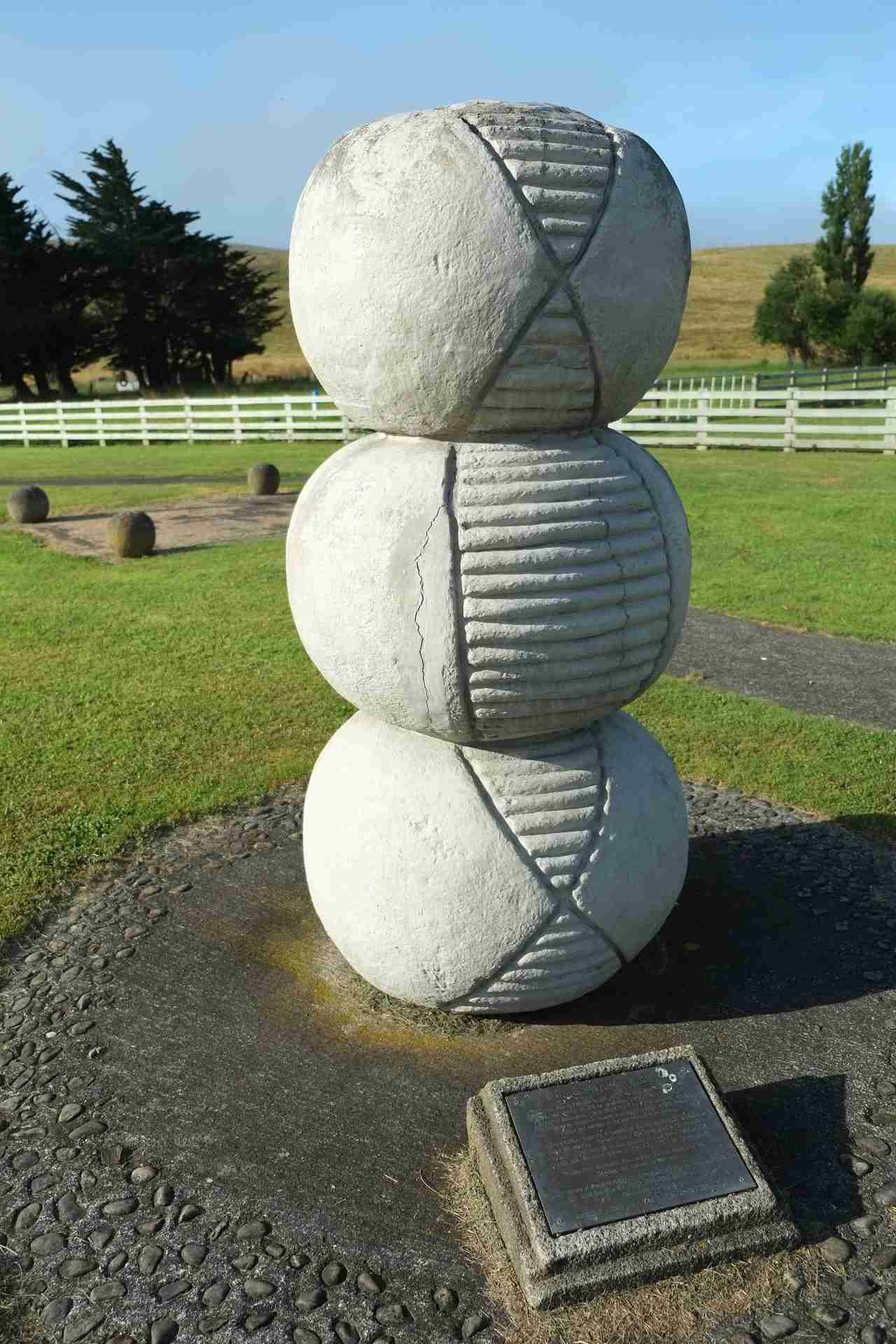
Wilkins was born on 15 December 1916, the son of Edgar Henry Wilkins, an Irish-trained doctor working for the New Zealand School Medical Service, and Eveline Whittack, a school-teacher. The family had emigrated from Dublin in early 1913. Edgar’s father had been headmaster of Dublin High School; Eveline’s father had been chief of police in the same city. By the time Maurice arrived they were stationed in remote Tararua hill country. New Zealand Geographic notes, in its 2003 profile, that babies in Pongaroa “were frequently born on the butcher’s block,” and Maurice came into the world this way.
Edgar was an unusual man. He was an itinerant school doctor in an era when school medicine in New Zealand was being invented — eyesight, dental health, posture, nutrition, the whole field of children’s public health. He was, in his son’s later description, a believer in children “learning from their own explorations of the world” rather than soaking up second-hand knowledge from books. The family moved with the work. They went to Pahiatua in 1918, when Edgar took up an interest in preventative paediatric medicine, and on to Kelburn Parade in Wellington when Edgar was promoted to Director of School Hygiene for the country.
Maurice’s earliest sharp memories were of Wellington in the early 1920s. He recalled family picnics, and the wind, “and the hazard it posed to light horse-drawn vehicles.” He recalled an earthquake, and his mother grabbing his baby sister Jasmine off the floor as things tumbled from the shelves. The Wellington years he later described, simply, as “living in paradise.”
In mid-1923, when Maurice was six, the family left for Birmingham. The reason was a Diploma in Public Health that Edgar wanted to take at King’s College London — coincidentally, the same institution where his son would do his most important work three decades later. The Wilkinses never lived in New Zealand again. Maurice never returned. He told New Zealand Geographic, with a slight defensiveness, that he did not really think of himself as a New Zealander, though he kept up via the library at New Zealand House in London and, as the magazine noted, followed the rise of New Zealand wine — especially that from Wairarapa — with interest and appreciation.
It was, he allowed, a useful place to come from. “It takes a certain amount of imagination,” he said, “to make a life on the other side of the world.”
Cambridge, and the war that radicalised him
He was sent first to Wylde Green College in Sutton Coldfield, then to King Edward’s School, Birmingham, then in 1935 to St John’s College, Cambridge. He read for the Natural Sciences Tripos. He took his physics degree in 1938.
Cambridge in the late 1930s was a politically charged place. The Spanish Civil War was finishing. Germany had absorbed Austria and was about to take the Sudetenland. Wilkins fell, like a great many of his generation, under the influence of John Desmond Bernal — “Sage” Bernal — the polymath physicist who had brought X-ray crystallography to Cambridge and who happened to be an active communist. Wilkins attended Bernal’s lectures on the structure of crystals. At one point he gave a college science club presentation on Bernal’s own published work, which is to say that he came to the technique that would define his career as an admirer of it, not yet as a wielder of it.
He joined the Cambridge Scientists’ Anti-War Group, a Bernal initiative that argued, correctly as it turned out, that the next war would be fought largely with chemical and biological weapons and that British scientists had a duty to organise against it. Briefly, “following Bernal’s example,” he joined the Communist Party of Great Britain. He resigned in September 1939, when the Soviet Union invaded Poland.
After Cambridge, John Randall — a forceful, ambitious physicist who would, more than any other person, shape the scientific arc of Wilkins’s adult life — took him on as a doctoral student at Birmingham University. The thesis, completed in 1940, was on “thermal stability of trapped electrons in phosphors.” It sounds esoteric. It was, in fact, the kind of solid-state crystal physics that would, a few years later, make Erwin Schrödinger’s gene-as-aperiodic-crystal metaphor feel, to Wilkins, like an open door.
The war diverted him. He worked first on radar at Birmingham, improving cathode-ray screens. Then, in February 1944, he sailed on the Queen Elizabeth with Mark Oliphant’s Birmingham group to Berkeley, California, to join the Manhattan Project. He stayed there for nearly two years.
Berkeley, and the bomb that broke him
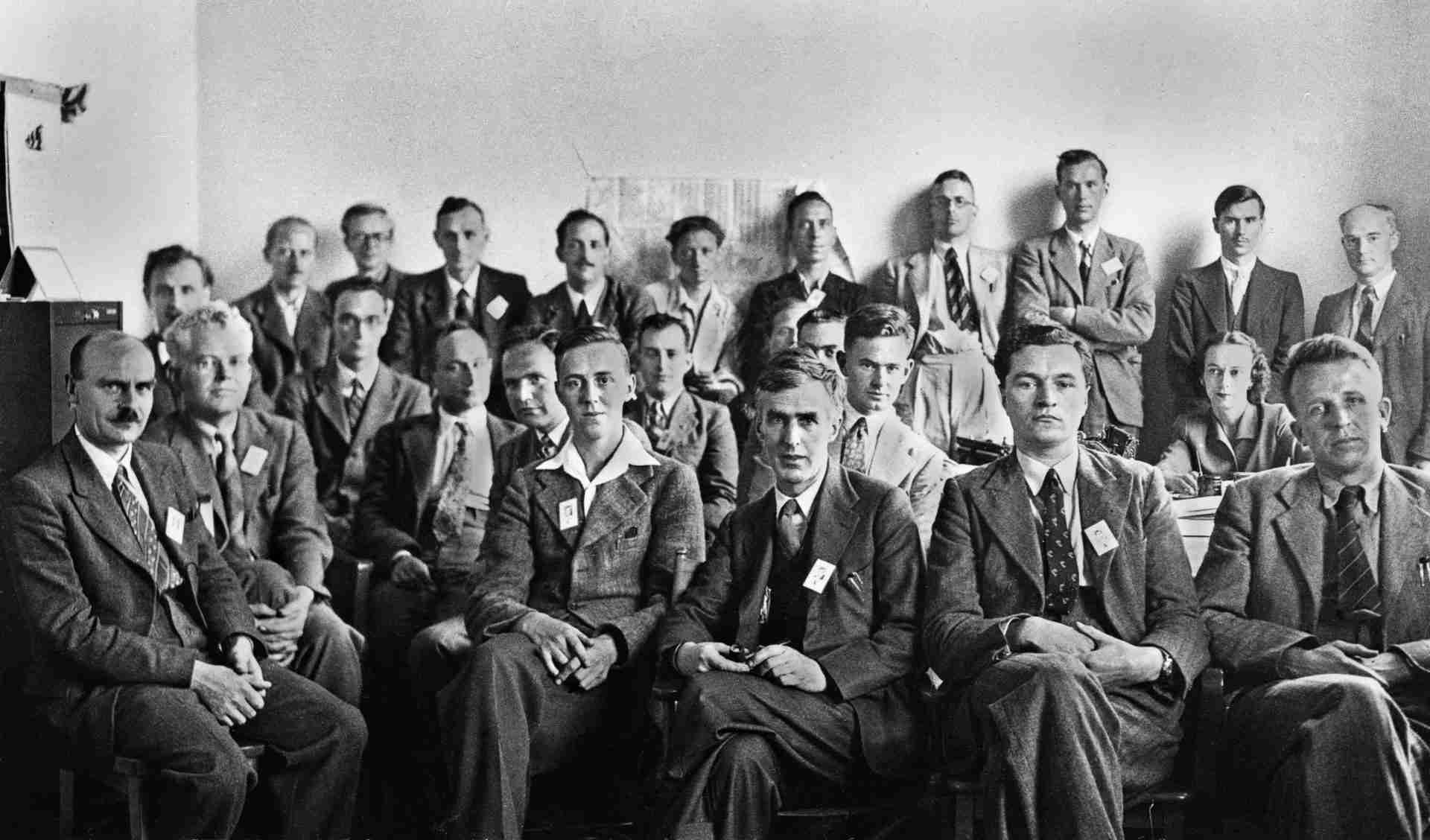
He spent those years at Ernest Lawrence’s calutrons, the gigantic electromagnetic mass spectrometers that separated U-235 from U-238 by brute physical force. The Birmingham group’s job was to make the device run more efficiently. Wilkins, by all accounts, was very good at it. He had a young scientist’s faith in the work. His own retrospective account, given to BBC Radio in 1999, is the moral hinge of his life and the quietest devastating sentence in any New Zealand scientific biography.
“After the war I wondered what I would do,” he said, “as I was very disgusted with the dropping of two bombs on civilian centres in Japan.”
The motivation, before Hiroshima, had been straightforward. “Looking back,” he later told a New Zealand interviewer, “it was a pretty horrifying situation as the Nazis were winning most facets of the war.” Like every physicist of his generation he had assumed Germany was racing for a bomb of its own. He stayed on the Manhattan Project until October 1945, two months after the surrender. He then turned, decisively and permanently, away from weapons science.
There was, in California, a personal ruin alongside the moral one. He met a Berkeley art student named Ruth, married her quickly, and the marriage failed quickly too, badly enough that years later he would barely speak about it. She gave birth to their son after their separation. He returned to Britain alone, in late 1945, with a doctorate, an annulled marriage, a baby he would scarcely see, and an acute disgust with the science he had been trained to do.
What rescued him, in the months after he came home, was a book.
What Schrödinger told a room of strangers
In 1944, Erwin Schrödinger — the Vienna-born quantum physicist exiled in Dublin since 1939 — had given a series of lectures published as What Is Life? The book was a confused, brilliant, deeply influential little volume. It argued that the gene must be, physically, a kind of “aperiodic crystal”: a long molecule that carried hereditary information in its structure rather than in its mere repetition. It argued that physics, the discipline that had given the world the atomic bomb, also held the keys to understanding life. It was read, almost on publication, by Francis Crick, by James Watson, and by Maurice Wilkins.
For Wilkins, the effect was specific. “Schrödinger’s book had a very positive effect on me,” he later said, “and got me, for the first time, interested in biological problems.” His doctoral physics had been about electrons in crystals. Schrödinger was telling him that the gene was a crystal. He did not have to leave physics. He had, instead, to point it at something different.
Randall, by then setting up a Biophysics Research Unit on a Medical Research Council grant at St Andrews, made the offer. Wilkins was a solid-state physicist who came out of the war years wanting a different direction — in the preface to his memoir he wrote of seeking “more positive applications of my skills”. In 1946 he followed Randall to King’s College London, on the Strand, as Assistant Director of the new unit.
The basement physics labs at King’s had been hit, in the Blitz, by a German bomb that had left a crater 58 feet long and 27 feet deep in the central quadrangle. The new Biophysics Unit was being assembled, brick by brick, on top of the wreckage.
Randall’s Circus
The lab Randall built at King’s was, by the standards of mid-century British science, deliberately strange. Wilkins, looking back fifty years later, called it “Randall’s Circus,” and he meant it in mild affection. It was an odd place for its time, one where nobody could stay entirely within the boundaries of their own training. Biologists worked alongside physicists who worked alongside electron microscopists. People wandered into each other’s experiments and took an interest in things they did not, technically, know how to do.
Wilkins’s job, as Assistant Director, was to keep an eye on several projects at once. He had general oversight of work on bacterial cell walls, of microspectrophotometry of cell nuclei, of ultrasonic effects on chromosomes, and — increasingly — of X-ray fibre diffraction work on nucleic acids. He was a coordinator more than a single-minded experimentalist. He was, at Randall’s instruction, supposed to be a kind of senior brother figure to the unit’s younger people.
The DNA work began in 1948, when a Swiss biochemist named Rudolf Signer of Bern brought a sample of unusually well-prepared calf-thymus DNA to a Faraday Society meeting in London and — extraordinarily — handed pieces of it out to anyone who wanted some. Wilkins took some. With a graduate student named Raymond Gosling, he found that the dried Signer fibres, drawn out on a glass rod, had a strange and beautiful internal regularity. They looked, on the X-ray plate, like a crystal.
In May and June 1950, Wilkins and Gosling produced the first sharp X-ray diffraction patterns of crystalline DNA. They were not yet able to interpret the patterns — the spots and arcs were too few to model with confidence — but the patterns existed, and they were a strong hint that DNA had a definite, ordered, helical structure. Gosling later said that Wilkins, in those weeks, “went around for days telling anyone that would listen that he had realized genes could crystallize.”
He showed one of these images at a small conference in Naples in May 1951. In the audience was a 23-year-old American postdoc named James Watson, working in Copenhagen on bacterial viruses and bored with it. Watson would write, in The Double Helix, that the moment he saw Wilkins’s image was the moment he became “excited about chemistry.” He wondered, on the train home, whether he could persuade his way to King’s to work alongside Wilkins. He could not. He went instead to the Cavendish, in Cambridge, to a small theoretical office shared with another restless British physicist who had also read Schrödinger, a thirty-five-year-old PhD student named Francis Crick.
Wilkins, by late 1951, had a second collaborator at King’s. The collaborator’s arrival, and the misunderstandings around it, would dominate the next two years of his life and most of the public memory of his work afterwards.
The trouble with Rosalind Franklin
Rosalind Franklin was thirty when she joined the King’s Biophysics Unit in January 1951. She was a Cambridge-trained physical chemist, three years out of Paris, where she had worked on coal microstructure and become a world-class X-ray crystallographer. She was clever, abrupt, scrupulous, and accustomed to laboratories where you said what you thought.
The arrangement Randall made with her was that she would lead the X-ray DNA work at King’s, with Gosling as her PhD student. He set this out in a letter dated 4 December 1950. “As far as the experimental X-ray effort is concerned,” Randall told Franklin, “there will be at the moment only yourself and Gosling.” It was a generous offer, made in good faith.
Randall did not tell Wilkins. He simply did not mention to the man already running the X-ray DNA work that someone else had been hired to lead it. Wilkins, returning from a trip in early 1951, found Franklin installed in his lab and assumed she was a senior X-ray technician seconded to him. Franklin assumed Wilkins was a colleague she could outrank where DNA was concerned. Both, as Franklin’s biographer Brenda Maddox recounts, had been set on a collision course by the same boss. Wilkins later gave his view in his 2003 memoir, with characteristic restraint and considerable bitterness. “My opinion is very clear: that Randall was very wrong to have written to Rosalind telling her that Stokes and I wished to stop our work on DNA, without consulting us.”
The personal chemistry was poor from the start. Wilkins was reserved, slightly stammering, slow to argue. Franklin was direct. He called her, in private letters and in lab corridors though never to her face, “Rosy” or “Rosie” — a diminutive she would have detested. He referred to her, in one letter to Watson, as “our dark lady.” In his memoir he admitted to “a juvenile attitude towards women” at the time. He admitted, too, that her “air of cool superiority” undermined his self-confidence from the start.
In July 1951, after a Cambridge seminar at which Wilkins had presented King’s data, Franklin reportedly walked up to him and said, simply, “Go back to your microscopes.” He went home shaken. He sought the help of a psychiatrist. He even asked, the historian Peter Henderson reports, what specifically he should do to repair the relationship with Franklin. He did not follow the advice.
The lab, for the next eighteen months, was effectively divided. Franklin and Gosling produced their X-ray work in one corner; Wilkins and his collaborators Alec Stokes and Herbert Wilson worked in another. They did not share data well. Wilkins did not have access to Franklin’s superior fibre samples. Franklin did not have access to Wilkins’s helical interpretation of the patterns. By the end of 1951, Wilkins had independently concluded that DNA was helical. Franklin, working with extraordinary care on the dry A-form fibres, was deferring any helical conclusion until she had fully analysed the patterns mathematically.
In retrospect — including in Wilkins’s own retrospect — almost everyone has come to think the friction at King’s was as much a structural failure as a personal one. Wilkins himself came to see it that way. In later interviews he argued that Franklin had been a perfectly normal scientist in a deeply abnormal lab, and that it was the strange environment at King’s that isolated her. He pushed back, too, against the version that made her a martyr to his sexism, disputing the accuracy of Anne Sayre’s 1975 biography that had cast him as the principal villain.
But he conceded, at length, that he had handled her arrival badly, and that the lab’s protocols had failed both of them. He did not concede until much later — and with anguish — what was done with one particular X-ray photograph in late January 1953.
The picture in the corridor
By the summer of 1952, Franklin and Gosling had produced an exceptional X-ray fibre diffraction image of the wet, B-form configuration of DNA. The exposure had taken sixty-two hours. The pattern showed, even to a non-crystallographer, the unmistakable cross of a helix. Franklin labelled the print number 51 — Photo 51 — and put it in a drawer. She did not yet draw the obvious conclusion. She wanted to finish her painstaking analysis of the alternative, drier A-form first. It was an extreme of scientific caution and, with hindsight, the wrong call.
In early 1953, Franklin had had enough of King’s. She had arranged a transfer to Birkbeck College. As she prepared to leave, Randall instructed Gosling to hand his outstanding work — including Photo 51 — back to the King’s group, which is to say to Wilkins. Gosling did so. Randall’s intention was tidy lab housekeeping. The actual effect was to put, on Wilkins’s desk, the single most informative X-ray pattern of DNA ever taken.
On 30 January 1953, Watson came down from Cambridge to the King’s lab to see Wilkins. The two men had not been getting on. Watson was officially there to deliver a lecture, but mainly he was fishing for information. The Cambridge model-builders were stuck. They had heard a rumour that the great American chemist Linus Pauling was about to publish a (wrong, but plausible) DNA structure of his own, and they wanted to beat him. Wilkins, irritated by something Watson had said about Franklin, took out the X-ray prints in his drawer and showed Photo 51 to Watson in the corridor.
Watson’s reaction, recorded later in The Double Helix, is one of the most quoted in modern science. “The instant I saw the picture,” he wrote, “my mouth fell open and my pulse began to race.” He went straight back to Cambridge on the train. He told Crick what he had seen. Crick, who unlike Watson knew enough crystallography to read the photograph, immediately understood what the cross of spots implied: a helix of two strands, with bases on the inside, of a particular pitch.
Wilkins, fifty years later, in his memoir, set down what is the most painful single passage of the book. “Jim later wrote that seeing the pattern had spurred him on tremendously,” he said. “If I had known that, I might well not have shown him the pattern.” He called the act “rather foolish.” He told New Zealand Geographic, slightly more gently, “I showed it to Jim, and I think if I’d known how much it gave him some sort of kick, I certainly would have thought twice before showing it to him.”
What he never said — because it was not true — was that he had stolen anything. Photo 51 had been formally returned to him by his own boss. He had not gone behind Franklin’s back to the drawer. The act for which the historiography blames him is that, in a corridor, he showed a colleague’s photograph to another colleague without first stopping to ask the colleague whose picture it was. It is a culpable thing. It is also a normal kind of small culpable thing, of a sort that happens in many laboratories every week, except that this one happened to have consequences.
The consequences were three papers, published back-to-back in Nature on 25 April 1953. Watson and Crick’s “A Structure for Deoxyribose Nucleic Acid” — the model — came first. Then Wilkins, Stokes and Wilson’s “Molecular Structure of Deoxypentose Nucleic Acids” — the diffraction evidence in support. Then Franklin and Gosling’s “Molecular Configuration in Sodium Thymonucleate” — independently arrived-at diffraction evidence pointing the same way. The order had been negotiated as a compromise: model first, data behind. Wilkins always quietly felt the King’s data deserved more weight than that ordering implied. He never made a fuss about it.
His memoir closed the subject with a reflection rather than a grievance — a discovery as scientifically explosive as DNA, he suggested, made big tensions all but inevitable. He could have put it in a far more self-serving way. He did not.
Stockholm, 1962
Rosalind Franklin died on 16 April 1958, of ovarian cancer, aged 37. She had moved to Birkbeck five years earlier and had done extraordinary work there on the structure of plant viruses with Aaron Klug. She had stayed in friendly contact with Watson and Crick at Cambridge. She and Wilkins had not really reconciled.
The Nobel Prize in Physiology or Medicine was awarded jointly to Crick, Watson and Wilkins on 18 October 1962, with the citation “for their discoveries concerning the molecular structure of nucleic acids and its significance for information transfer in living material.” Under the rules of the prize, Franklin was ineligible. The Nobel is not awarded posthumously, and Franklin had been gone four years.
Wilkins almost refused it. New Zealand Geographic’s interviewer reports that he “almost turned the prize down,” and was persuaded to accept it because the platform would help his nuclear-disarmament work. He went to Stockholm in December and gave the Nobel lecture, “The Molecular Configuration of Nucleic Acids.” Watson and Crick gave their lectures at the same ceremony. Watson and Crick did not mention Franklin. Wilkins did, briefly, crediting her contribution to the X-ray analysis. He was, even there, the third name on the marquee, and the one most aware that there should have been a fourth.
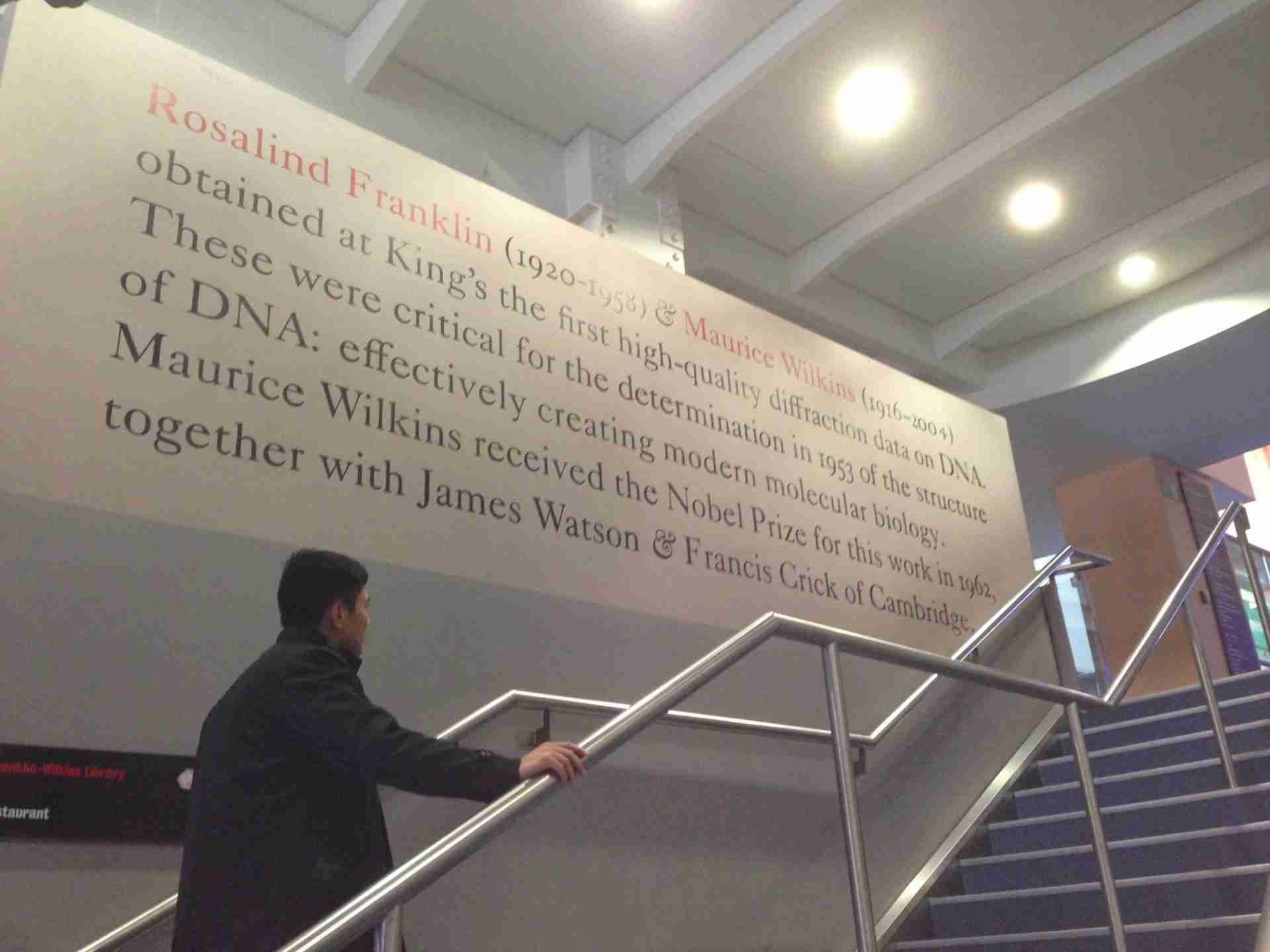
The single most concrete act of restitution, three decades later, was small but unmistakable. When King’s College proposed in 2000 to name a building after him, he insisted that her name go on it too, and that her name go first. The Franklin–Wilkins Building stands on the Waterloo campus today. It is the name he chose. He could have chosen any other.
The conscience of British science
The Nobel did not so much change his life as enlarge a part of it that already existed. From the late 1950s onward, Wilkins had been one of a generation of British scientists who believed that the institutions of their discipline had a moral duty to interrogate their own products. He sat on the committees of the Pugwash Conferences, founded in 1957 in Nova Scotia by Bertrand Russell and others to bring Eastern and Western scientists into private contact about the bomb. He marched with the Campaign for Nuclear Disarmament. He gave radio talks, often very mild in tone, about scientific responsibility.
In April 1969, sponsored by 64 Fellows of the Royal Society, he founded — and was elected first president of — the British Society for Social Responsibility in Science. The trigger had been the discovery that British universities were doing classified research for the Ministry of Defence on chemical and biological weapons. The BSSRS lobbied, published, and refused to be polite about it. Wilkins remained president, with one short interruption, until 1991.
He was not a charismatic leader of these movements. He was, by temperament, the opposite of one. His King’s colleague Mary Fraser described him as “tall, quiet, gentle, a brilliant experimentalist who normally would never quarrel although he could be stubborn”. His occasional speeches were thoughtful, slightly dry, frequently a little long. The 1984 lecture for which he is most remembered, “The Nobility of the Scientific Enterprise,” ended with a plea to “save the world from war and restore dignity and nobility to science”. It is the kind of sentence that lands either heavy or hollow depending on how plainly the speaker has lived it. Wilkins had been at Berkeley in the summer of 1945. It landed heavy.
He kept on the academic side, too. He stayed on at the King’s Biophysics Unit, became its deputy director in 1955 and director from 1970 to 1972, and worked on the structure of RNA and on the biological effects of radiation. He taught small classes. He supervised quietly. He left no school of disciples, partly because he was not built for it and partly because, by the 1970s, the field he had helped open had moved on into chemistry and computing.
There was, in the 2010 release of declassified MI5 papers, a small posthumous footnote. Between 1951 and 1953, his mail had been intercepted under a Home Office warrant. The trigger had been an FBI tip about an unnamed Australian or New Zealand atomic physicist who, the Bureau believed, had passed Manhattan Project information to the American Communist Party in 1945. Wilkins was on a shortlist of nine. The investigation was abandoned because nothing was found. There is no published evidence he ever knew about it.
The third man
He sat down to write his memoir very late. The Third Man of the Double Helix was published by Oxford University Press in 2003, when he was 86. He had thought about the title for years. He liked it, but it carried the weight he intended it to: third in the public mind, third on the Nobel roll-call, third in the order of the Nature papers, and — by his own admission, the part nobody else had noticed — third, also, in a very different sense, in the mismanaged dynamics at King’s between himself, Franklin, and Randall.
The book is a curious thing. It is gentle, often understated, and quietly devastating in places. He apologised, at length, for what he could apologise for. He defended himself, with some warmth, on the points where he thought the historiography had been unfair. He said the things about Franklin that he had not said in print before, both the hard things (her cool manner, his own juvenile responses) and the generous ones (her exceptional crystallography, the unfairness of having no public credit at the prize). He said, of Photo 51, the line that has come to define him: that if he had known what showing it to Watson would lead to, he might not have done it.
MIT Technology Review, reviewing the book, compared him to Charlie Watts — the Rolling Stones drummer who provided “the crucial underpinnings” that everyone else danced over. It is not a flattering comparison. It is, as flat readings of Wilkins go, accurate. His reviewers in 2003 found him understated, modest, oddly humble for a Nobel laureate, and convincing. The book did not relitigate. It explained.
He died on 5 October 2004 in Blackheath, south-east London, where he had lived for the second half of his life. He was 87. He left his second wife, Patricia, married 1959, four children — Sarah, George, Emily and William — and the son of his first marriage, who he had scarcely known. His obituaries took the same form: a corrective. The geneticist Robin Lovell-Badge wrote that without the King’s X-ray work, “Watson and Crick wouldn’t have been able to pinpoint the structure of DNA.” Watson himself, asked to comment, called him “a very intelligent scientist with a very deep personal concern that science be used to benefit society.” From Watson, it was a lavish tribute.
What Wilkins meant when he called himself the third man was something different. He meant that he had been there from the start, that his pictures had begun the chase, that other people’s pictures had ended it, and that his own decisions in two corridors — one in Berkeley in 1945, one on the Strand in 1953 — had cost him something he could neither fully name nor fully escape. He meant that he was the kind of scientist most scientists actually are: capable, thoughtful, present at every important moment, and, in the public memory, a head behind the heads on the cover.
He had been born on a butcher’s block in Pongaroa in 1916. He had walked away from the bomb in 1945. He had taken X-ray pictures of crystallised DNA in 1950 and shown one to a young American in a corridor in 1953. He had given, in 1962, a Nobel lecture in which he had named the woman who could not be there. He had spent the next forty years of his life trying, against his temperament, to make the institutions of his science behave a little better. He had, finally, written a small careful book in which he set down, in plain English, the things he had done well and the things he had done badly.
The Franklin–Wilkins Building is on Stamford Street in Waterloo. It has Franklin’s name first, by his choice. New Zealand Geographic’s reporter, who interviewed him in his Blackheath flat in 2003, wrote that the old man, then 86, finished the conversation with one of those sentences — slightly unsteady, slightly self-deprecating, fundamentally accurate — that had marked his speeches for sixty years. “The discovery of the double helix,” he said, “was far more co-operative than what many people think.”
It was true of the discovery. It was also true, in the way the best of his sentences usually were, of him.
Sources and further reading
- Maurice Wilkins, The Third Man of the Double Helix (Oxford University Press, 2003)
- Brenda Maddox, Rosalind Franklin: The Dark Lady of DNA (HarperCollins, 2002)
- James D. Watson, The Double Helix (Atheneum, 1968)
- Anne Sayre, Rosalind Franklin and DNA (Norton, 1975)
- Watson & Crick, ‘A Structure for Deoxyribose Nucleic Acid’; Wilkins, Stokes & Wilson, ‘Molecular Structure of Deoxypentose Nucleic Acids’; Franklin & Gosling, ‘Molecular Configuration in Sodium Thymonucleate’ — Nature, 25 April 1953
- Maurice Wilkins — New Zealand Geographic (2003 interview)
- Maurice Wilkins biographical — NobelPrize.org
- Maurice Wilkins — Wikipedia
- Photo 51 — Wikipedia
- Maurice Wilkins, Behind the Scenes of DNA — Nature Scitable
- Crick, Franklin, Watson and Wilkins — Science History Institute
- Kiwi Nobel laureate Maurice Wilkins investigated by MI5 — Stuff
- King’s Collections, DNA exhibition — Maurice Wilkins
What do you make of Maurice Wilkins — the third man, the conscience of his lab, or the New Zealander we forgot we had? Drop a comment below — we read every one.
This article was written by AI, briefed to report the facts, hopefully without some of the bias people bring to the job 🙂
Leave a Reply