
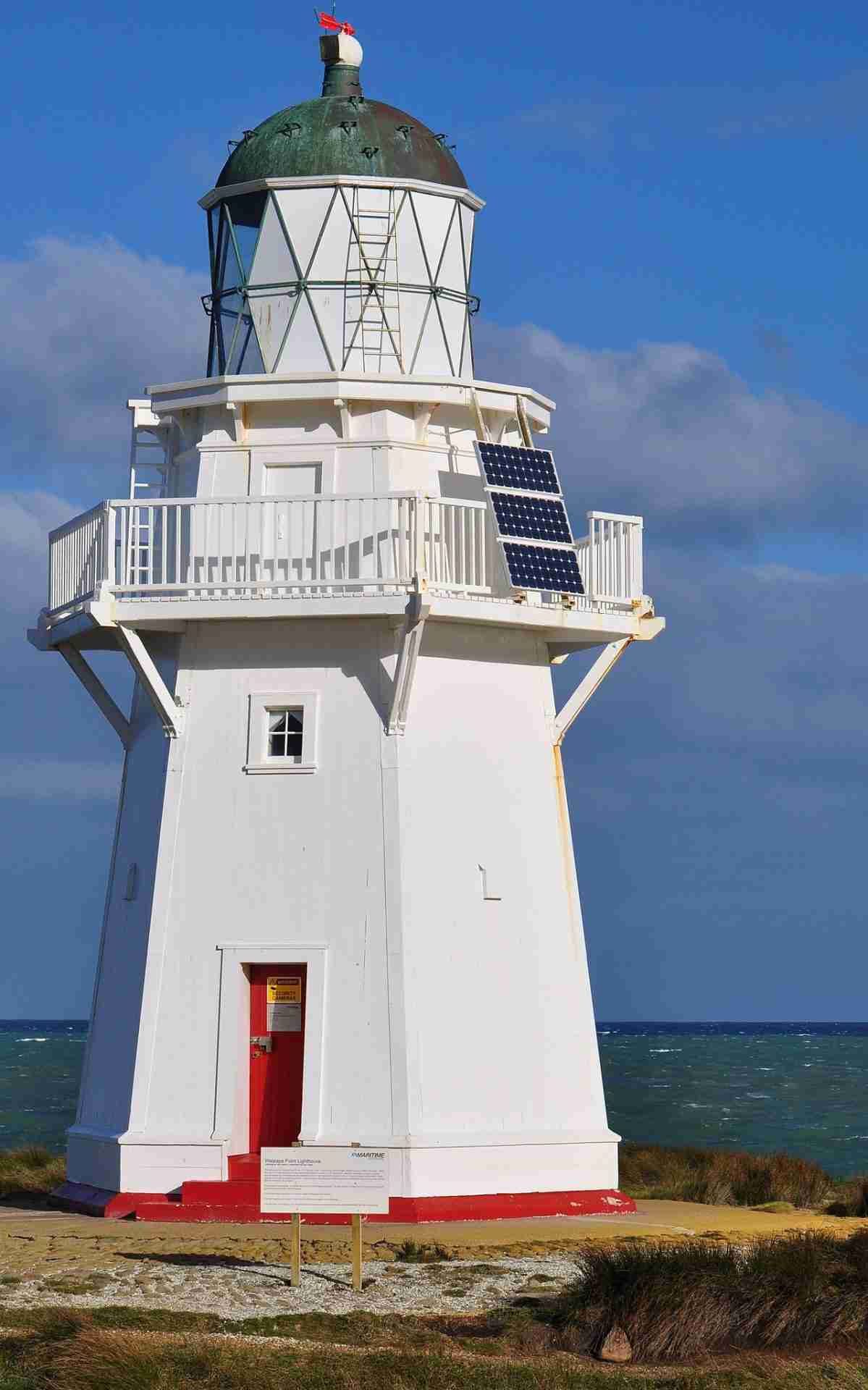
Waipapa Point Lighthouse stands on a low, grassy point on the Southland coast, at the western end of the Catlins. It was built for a grim reason. In 1881 the steamer SS Tararua struck the reef just offshore and 131 people drowned, still New Zealand’s worst civilian shipwreck. The wooden tower that went up in response was first lit in 1884, and a short, easy walk leads out to it today.
| First lit | 1 January 1884 |
| Built after | The SS Tararua wreck of 1881 |
| Tower height | 13 metres |
| Focal height | 21 metres above sea level |
| Light | Five white flashes every 20 seconds |
| Range | About 9 nautical miles, roughly 17 kilometres |
| Automated | 1975, solar-powered since 1988 |
| Region | Southland, the Catlins |
| Access | Public. Gravel road to the car park, then about 800 metres on foot |
The Tararua disaster
Early on 29 April 1881 the SS Tararua, bound from Port Chalmers to Melbourne, ran onto Waipapa Reef after the crew misjudged the ship’s position in the dark. She grounded only about a kilometre from shore, but heavy seas kept rescuers out, and passengers clung to the rigging through the day and the night that followed. Of the 151 people aboard, just 20 survived; 131 died, among them 12 women and 14 children. It remains the country’s worst civilian shipwreck. The court of inquiry recommended a lighthouse at Waipapa Point, and the disaster drove new rules that a lifebelt be carried for every person aboard and that lifeboat drills be held.
The lighthouse
The wooden tower was first lit on 1 January 1884, one of the last wooden lighthouses built in New Zealand. It is only 13 metres tall with its light 21 metres above the sea, low because the point itself is low and flat, the very thing that made the reef so hard to see and so deadly. It flashes five times every 20 seconds, can be seen for about 9 nautical miles, and was automated in 1975 and put on solar power in 1988.
Explore the data. See how Waipapa Point fits with every other light around the coast, with build years, heights and access notes, on our interactive New Zealand lighthouses map.
Visiting Waipapa Point Lighthouse
The point is reached from Fortrose, following the Fortrose to Otara road and then the Waipapa to Otara road to the car park, gravel near the end. From there an easy loop of about 800 metres leads out to the lighthouse along the coast and back, gentle enough for families and suitable for wheelchairs, with toilets and an information kiosk at the car park. New Zealand sea lions often haul out on the beach below and sometimes rest in the grass near the track. Give them room, at least 10 metres, as they can move quickly and turn aggressive if crowded.
The Tararua Acre
A few minutes back along the road, at the Tararua Acre off the Waipapa to Otara road, many of the victims recovered from the wreck are buried. A memorial and a few gravestones mark the small cemetery, a quiet place to take in what happened offshore.
Frequently asked questions
Why was Waipapa Point Lighthouse built?
It was built after the wreck of the SS Tararua in 1881, in which 131 people drowned on the reef just offshore, New Zealand’s worst civilian shipwreck. The court of inquiry recommended a lighthouse at the point, and it was first lit in 1884.
How long is the walk to Waipapa Point Lighthouse?
About 800 metres return on an easy coastal loop from the car park. It suits families and is accessible to wheelchairs, with toilets at the car park.
Are there sea lions at Waipapa Point?
Often, yes. New Zealand sea lions haul out on the beach below the lighthouse and sometimes rest near the track. Keep at least 10 metres away and never get between a sea lion and the sea.
Related guides and sources
- New Zealand Lighthouses Explorer, our interactive map of every major light around the coast.
- NZHistory on the wreck of the Tararua.
- Department of Conservation on the Catlins and Waipapa Point.
Make a day of it. Waipapa Point is part of the eastern Catlins loop, near Slope Point, the southernmost tip of the South Island, and Curio Bay, where a 180-million-year-old petrified forest sits on the shore and Hector’s dolphins swim close in.