
Kuaka — the longest flight
Every September a small flock of bar-tailed godwits leaves the Alaskan tundra and flies non-stop to New Zealand. No food. No water. No rest. Eight to eleven days in the air over open Pacific. It is the longest non-stop flight of any animal on Earth — and it ends, every year, on the mudflats of the upper North Island and Te Waipounamu’s southern bays.
What you’ve just watched
That eight-day flight, compressed into ninety seconds. The flock leaves the Yukon-Kuskokwim Delta on the western edge of Alaska, climbs to around 3,000 metres, picks up a tail wind from the dying remains of a Bering Sea storm, and turns south. They cross the equator on day five. They sight New Zealand on day seven. The first arrivals settle onto the shell banks of Pūkorokoro Miranda on the Firth of Thames in the early morning of day eight, half their body weight gone, and immediately fall asleep.
They’ll spend the southern summer here — September to March — feeding twice a day on the mudflats as the tide ebbs, building up reserves for the return trip. In late March they leave again, this time via the Yellow Sea on the China-Korea coast, where they refuel for a month on shrinking mudflats before pushing on to Alaska to breed. Then in September, they do it all again.
Where and when to see godwits in Aotearoa
The best months are October through February, when the largest flocks have arrived and the birds are feeding intensively before the next migration. Plan your visit around the incoming high tide — godwits feed on exposed mudflats at low tide, then are pushed up onto shell banks and roost sites as the tide rises. The two hours either side of high tide are usually the best viewing window, with binoculars or a spotting scope essential.
Pūkorokoro Miranda
The country’s most famous shorebird site, with thousands of godwits each summer. The Pūkorokoro Miranda Shorebird Centre runs hides and field trips. About 90 minutes south-east of Auckland.
Manukau and Karaka
Karaka shellbank on the southern Manukau is one of the largest godwit roosts in the country. Easy access from Karaka township; check tide tables before going.
Farewell Spit
A 26-kilometre sand spit at the top of the South Island that hosts large godwit flocks summer and autumn. Vehicle tours available from Collingwood; restricted access protects the bird population.
Awarua Bay
The southernmost regular wintering site for godwits, near Bluff. Access is from Tiwai Road; a quiet, atmospheric place to see them at the very end of their flyway.
Pauatahanui Inlet
A reliable spot near the capital with easy walking tracks and hides maintained by Forest & Bird. Smaller flocks but excellent close viewing.
Tauranga Harbour
Look from the Matua Saltmarsh boardwalk or the Bowentown end of the spit. Smaller numbers than the Firth but very accessible, with excellent shorebird signage along the harbour edges.
Whichever site you pick, the etiquette is the same: stay back, move slowly, and never put a flock to flight. A spooked godwit burns precious fat reserves she’ll need for the next migration. The Birds New Zealand regional groups run free guided shorebird walks at most major sites between October and March; their websites have current trip schedules.
The kuaka in te ao Māori
The kuaka has long held a particular place in Māori cosmology. Because the birds vanished completely from these islands in autumn and reappeared in spring without any of them ever being seen breeding here, they came to embody mystery, distance, and the spirit world. The whakataukī kua kite te kohanga kuaka? — “who has seen the nest of the kuaka?” — is asked of anyone claiming impossible knowledge.
The arrival of the godwits each spring was one of the cues that organised the harvest year for many iwi, particularly along the Bay of Plenty coast and the upper North Island. Their reappearance signalled the end of the cold months and the start of the season of plenty. For the iwi of Tāmaki Makaurau and Hauraki, the godwit flocks that gathered each summer on the Manukau and Firth of Thames were both an indicator of the harbour’s health and a part of the seasonal map of the year.
The Yellow Sea and the conservation story
The southbound Alaska→NZ flight is non-stop. The northbound flight, which happens in March and April, is not. Godwits leaving New Zealand fly first to the Yellow Sea — the great enclosed bay between China, North Korea and South Korea — where they spend roughly a month refuelling on the intertidal mudflats before pushing on to Alaska to breed. The birds eat shellfish and crustaceans on tidal flats they have been using for thousands of years.
The Yellow Sea mudflats have been shrinking for decades. Reclamation for industrial and urban development around Shanghai, Tianjin, the Yalu River estuary and the Saemangeum project in South Korea has removed huge areas of intertidal habitat. The total area of intact tidal flat around the Yellow Sea has fallen by more than two-thirds since the 1950s. Without these mudflats godwits cannot complete the northbound migration. International conservation work — including Korea’s recent decision to halt some reclamation projects, and the inscription of several Yellow Sea sites as UNESCO World Heritage in 2019 and 2024 — has slowed the loss but not stopped it. The bird’s long-term future depends on protecting habitat in countries thousands of kilometres from where it spends most of its life.
If you want to support that work, the Pūkorokoro Miranda Shorebird Centre runs a long-running godwit research and education programme funded almost entirely by donations and centre visits. They also fund the satellite tags that produce the data we know about these flights from in the first place.
The science of the longest flight
A bar-tailed godwit weighs about 250 grams at rest, but doubles its body weight to around 600 grams in the weeks before migration by gorging on shellfish at staging grounds. Roughly half of that gain is fat, the densest fuel a body can carry. The bird’s organs not needed for flight — including parts of its digestive system — temporarily shrink to lighten the load. The flight muscle, by contrast, grows.
Once airborne, a godwit cruises at altitudes between 2,000 and 3,000 metres, occasionally as high as 5,000. Their average speed on the southbound flight is around 60 km/h, although they can sustain over 80 km/h with a tail wind. They fly through the night as well as the day; like other long-distance migrants, they appear to sleep with one cerebral hemisphere at a time, never fully unconscious. They navigate without landmarks across thousands of kilometres of empty ocean by some combination of magnetic sense, star position, and possibly polarised-light cues at sunset.
The tracking that produced almost everything we know about these flights began in 2007, when a female bar-tailed godwit known by her leg-band code E7 was tagged at Pūkorokoro Miranda before her northbound flight to the Yellow Sea, then her flight from the Yellow Sea to Alaska, and then her southbound flight back to New Zealand — a continuous nine-day, 11,680-kilometre journey that became the longest non-stop bird flight ever measured. In October 2022 a juvenile male called 4BBRW broke that record with a 13,560-kilometre Alaska-to-Tasman crossing in eleven days. Records will keep falling as tracking technology improves; the birds have presumably been doing this for thousands of years.
Kuaka in New Zealand
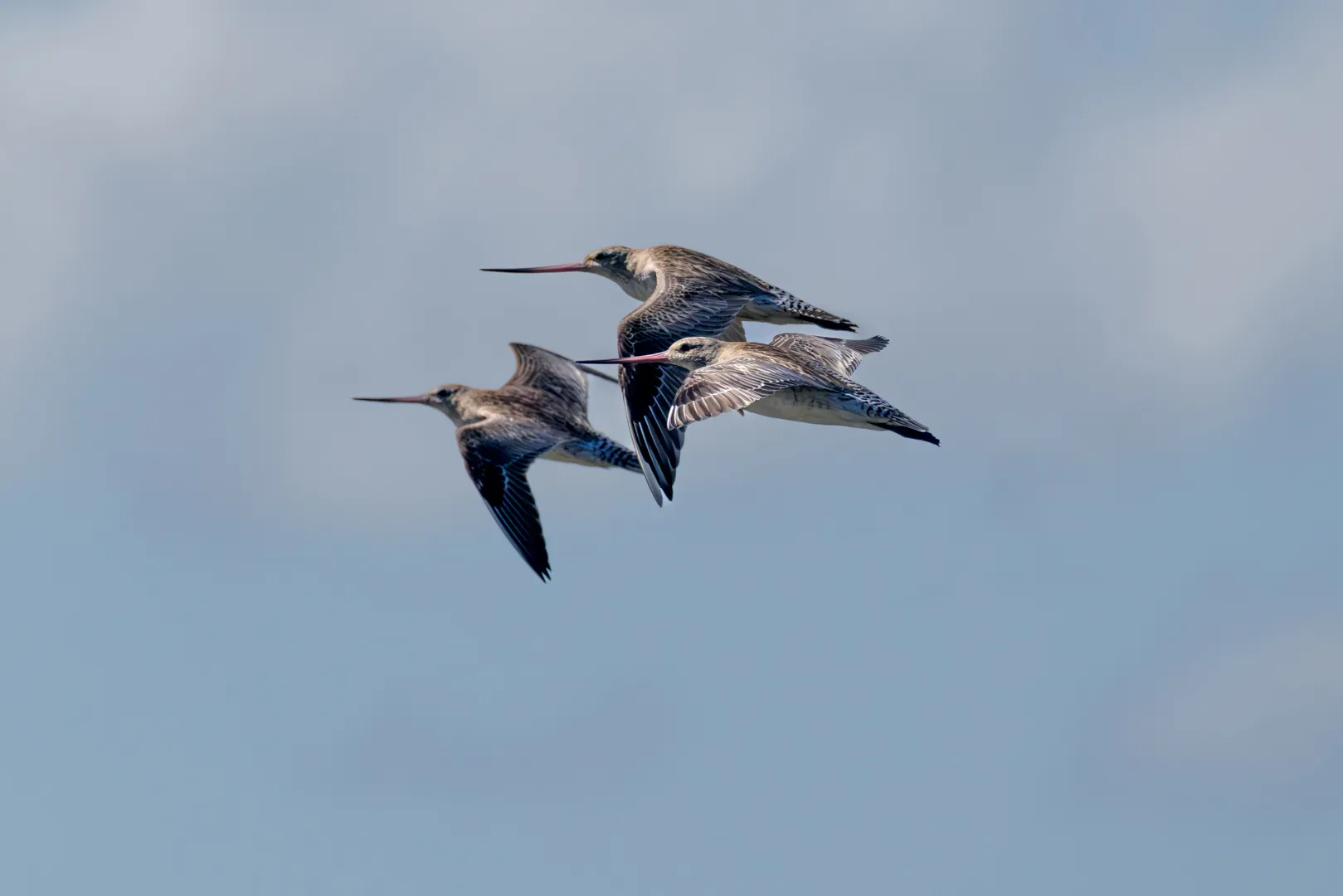
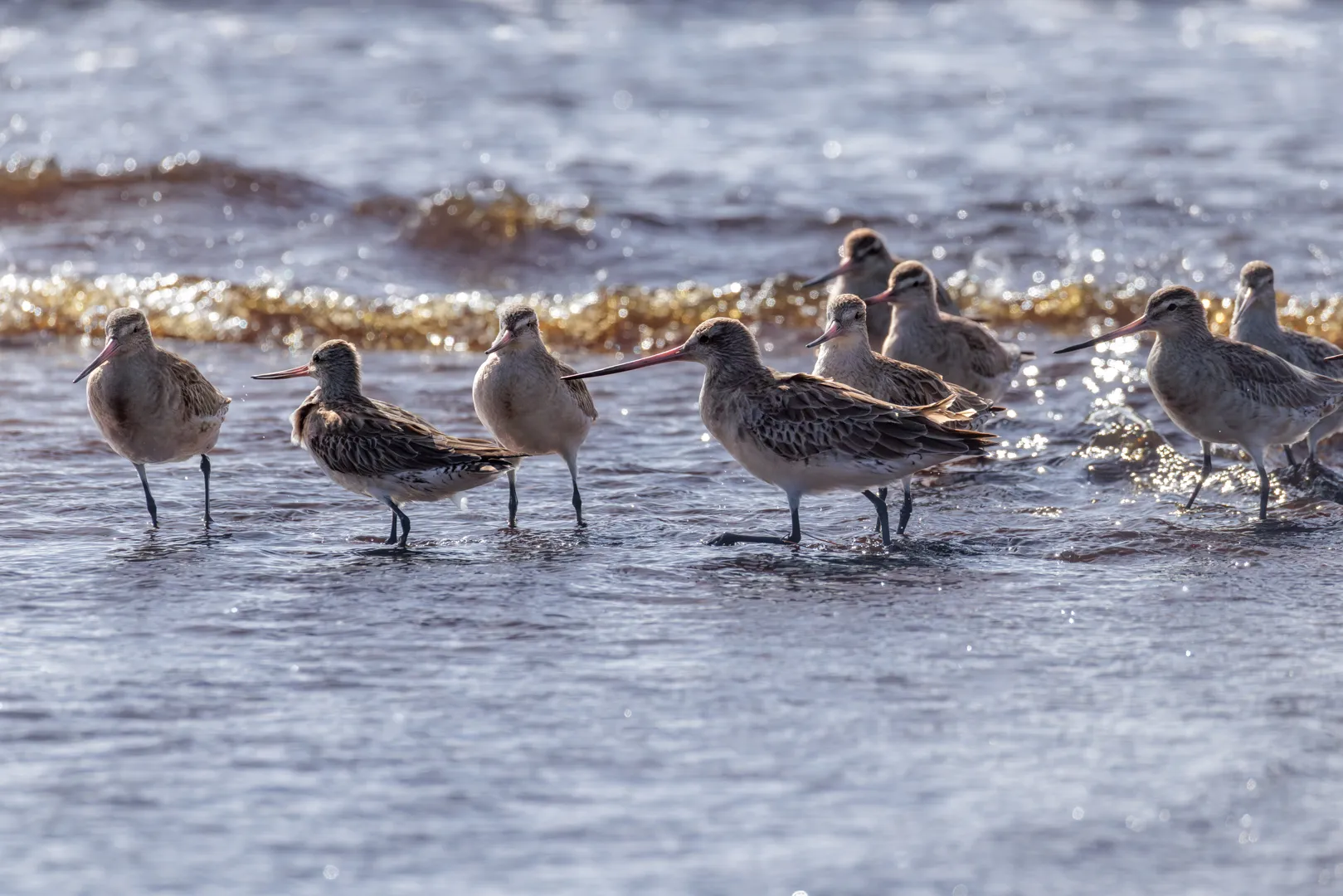
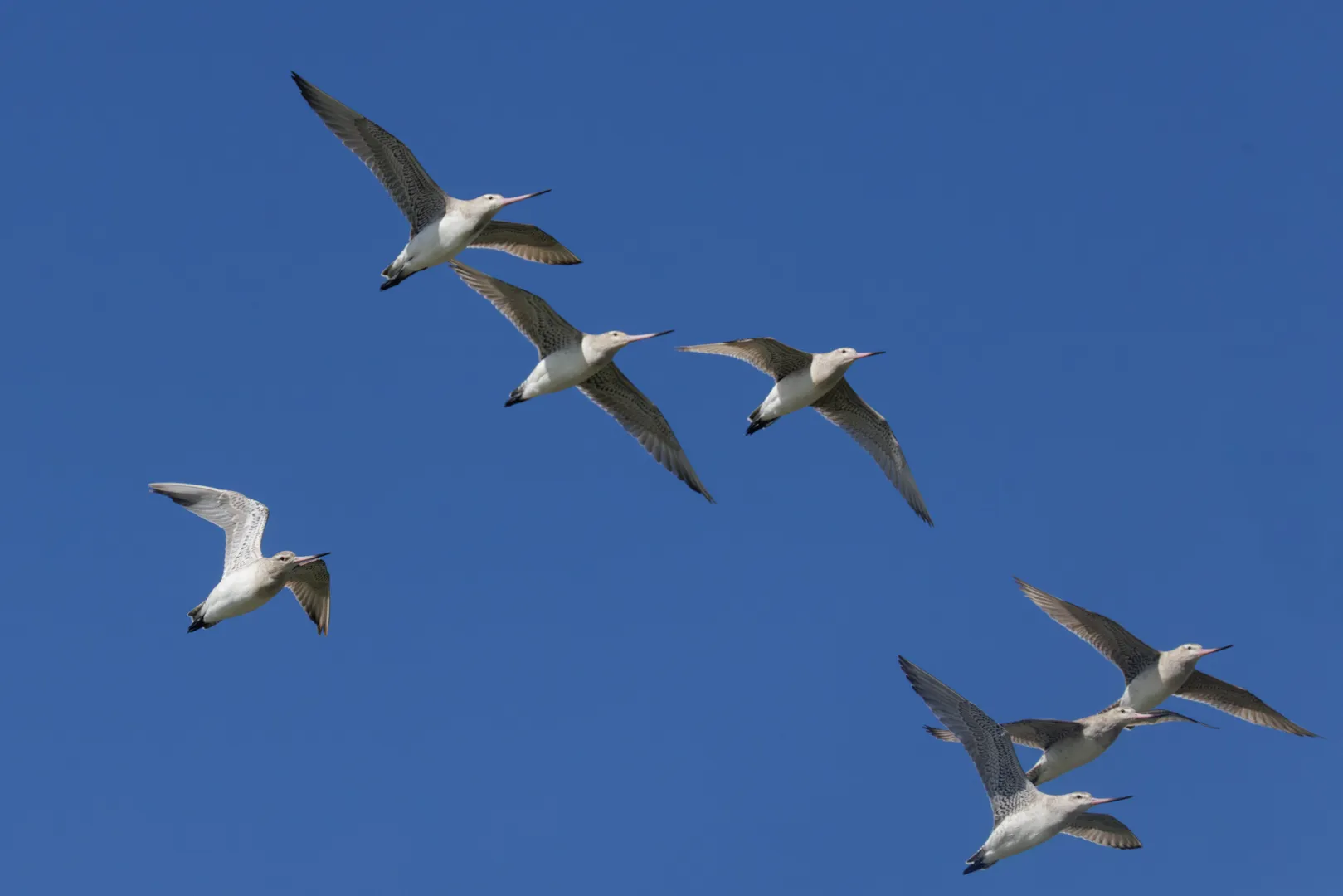
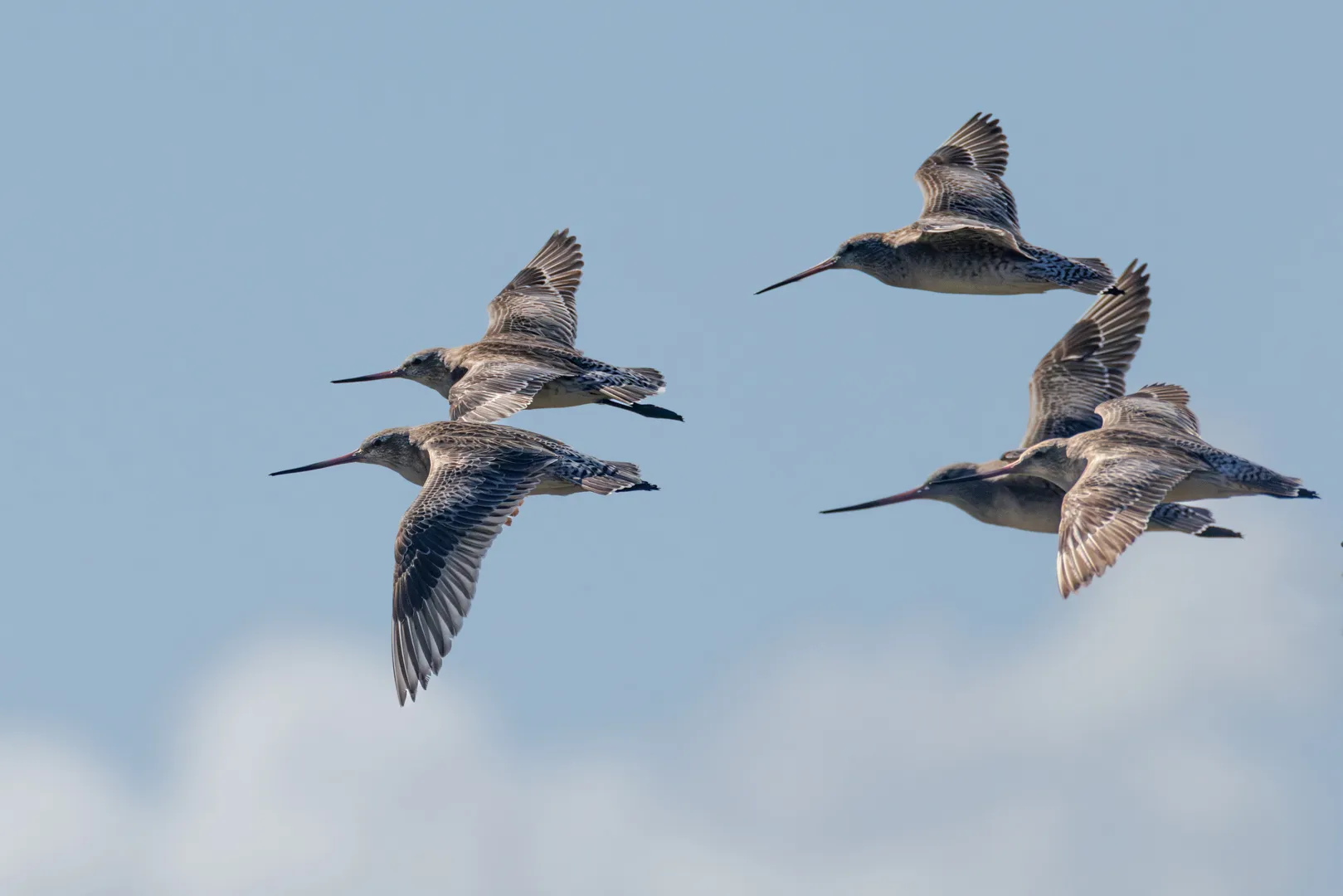
For most of the year these are the birds New Zealanders see — muted, undemonstrative, browsing the tideline in their thousands. The brick-red breeding plumage is moulted in Alaska before they fly south; we get the worn, travel-light version. The photographs below are from a season’s watching by Shona Kebble.
All photographs on this page by Shona Kebble Photography, used with permission.