
On 28 September Shopify quietly made a change that reaches every one of its online stores, including the thousands run from New Zealand. Its developer changelog announced that AI agents working inside a shopper’s web browser can now read a Shopify checkout, change the delivery address or shipping option, apply a discount code and, once the shopper agrees, place the order. Until then an agent could search a store and fill a cart. Now it can finish the job. In Shopify’s words the new tools “don’t expose a new API or require merchant configuration.” Nobody had to turn anything on, and the documentation does not describe a way to turn it off.
The timing is not accidental. A week earlier, on 21 September, Amazon began blocking Meta’s new personal agent Muse from its store. Muse users were met with a notice that read “Continued access by an unauthorized AI agent violates Amazon’s Conditions of Use, to which our customers have agreed.” Amazon’s complaint was that Meta had not told it Muse was coming, that the agent does not identify itself while browsing, and that it appeared to be storing customer credentials. The same day Shopify’s chief executive Tobi Lütke announced the opposite. “We are excited to announce we are partnering deeply with Muse to enable agentic checkout with Shop Pay on all Shopify stores,” he wrote. The two biggest forces in Western online retail now disagree on whether a shopping robot is a customer or an intruder, and every store owner sits on one side of that line whether they chose it or not.
I wrote in July about the first wave of this shift, where assistants such as ChatGPT compare products from machine-readable feeds without loading a web page. The September change is different and more intimate. These agents sit in the shopper’s own browser tab, on your storefront, operating your checkout. The mechanism is a proposed web standard called WebMCP, drafted by engineers at Google and Microsoft and running as a trial in Chrome since June. Instead of an agent guessing from a screenshot where the add to cart button is, a website publishes a short menu of named actions the agent can call directly. Shopify has written that menu for every store on its platform, from catalogue search through to order confirmation.
Shopify’s case is speed and reliability. Gil Greenberg, a product manager on its agentic commerce team, put it bluntly. “Shopping with an agent shouldn’t feel like watching paint dry.” In figures he shared, which Search Engine Journal noted came from Shopify’s own test shops, an agent using the structured tools completed all 60 test checkouts in around ten seconds each, while an agent clicking through the page as a human would took nearly three times as long and failed four times. It is Shopify marking its own homework, but the direction is believable.
There are real guardrails. The agent cannot change what is in the order once it reaches checkout, and it cannot type in a new credit card. Payment runs only through a card already saved with Shop Pay, Shopify’s one-tap wallet, or through a guest billing address where the shopper then picks the payment method themselves. Shopify’s documentation tells agent developers that before placing an order they must “show the buyer the current order and total, and get their permission to place it.” Bank security challenges such as 3D Secure are handed back to the human. The tools do not appear on the older three-page checkout unless the shopper uses Shop Pay, nor on business-to-business, embedded or in-app checkouts. Shop Pay comes bundled with Shopify Payments, which is available in New Zealand, so most local stores on the current checkout are already in scope.
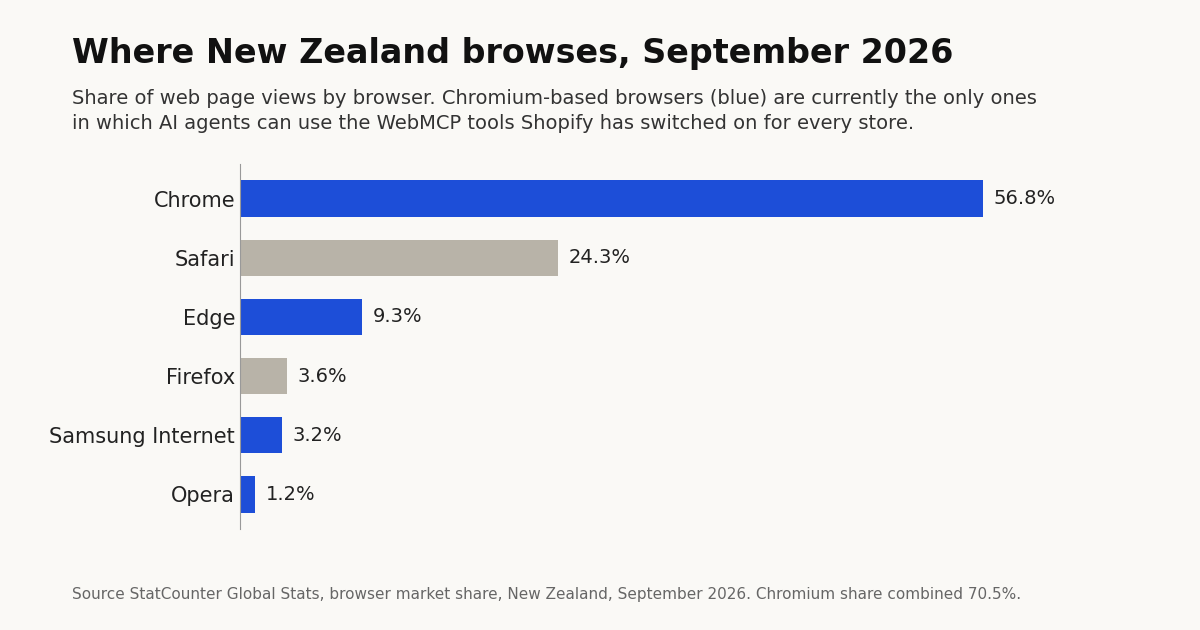
The shopper’s side in this country is thinner than the announcements suggest, which is the good news. Agent support for WebMCP is limited to Chromium-based browsers, and Google’s own agent, auto browse in Gemini for Chrome, has so far been announced only for paying subscribers in the United States and India. Muse launched in the United States. Chrome held 57 per cent of New Zealand browsing in September according to StatCounter, so the pipe is there, but the agents that would use it have not reached New Zealand shoppers in numbers. That gives local retailers something rare with platform changes, a few months to decide what they think before it touches their sales.
First, work out how your store behaves when a machine is driving it. Shopify’s cart tools fire the same events your theme already listens for, so if a cart drawer slides open with an upsell on every add to cart, it will do that for the agent too. Newsletter pop-ups, spin-to-win wheels and age gates were designed to interrupt a human. An agent either ignores them or gets stuck, and Shopify is explicit that anything a checkout app insists the buyer do is handed back to the human. Each of those interruptions is now a point where the sale might stall. Developers can test this today by enabling the WebMCP testing flag in Chrome and watching which tools the store registers.
Second, look at your bot defences. TechCrunch reported on 6 October that Walmart, which is a Muse partner and wants agent orders, was nevertheless turning them away at a human-verification button, and a spokesperson said the blocks “weren’t intentional.” Cloudflare changed its default crawler settings on 15 September in a way some suspect is catching personal agents along with scrapers. Shopify’s answer is that legitimate agents sign their requests with a scheme called Web Bot Auth so the platform can tell them from scrapers, but the firewall in front of a custom-built store does not know that. If you have spent the past year hardening your site against AI crawlers, as many rightly have, you need to know whether your rules can tell a thief from a customer’s assistant.
Third, treat your plain-text content as part of the checkout. One of the storefront tools answers questions about returns, shipping and opening hours straight from your policy pages and FAQs. If those pages are vague, out of date or missing, the agent will say so to the customer, or decline to proceed. Honest, current policy pages have become a conversion feature.
Fourth, ask Shopify the question its documentation does not answer. Can a merchant see which orders an agent placed, and can a merchant choose not to take them? Search Engine Journal looked and found neither answer. Retailers who want a say should ask now, while the feature is weeks old and the agents are mostly offshore.
A storefront used to be a persuasion machine aimed at a person. Shopify has just made every storefront on its platform a control panel that software can operate as well, and it did so with a changelog entry rather than a launch. The question of whether you want that is still open. The question of whether it has already happened to your store is not.
Roger McSaveney is General Manager of Forge Creative, an Auckland web design and development agency.
Would you let an AI agent place orders on your store, or would you rather it was blocked as Amazon has done? Tell us in the comments below.
This article was written by AI, briefed to report the facts, hopefully without some of the bias people bring to the job 🙂
Leave a Reply