
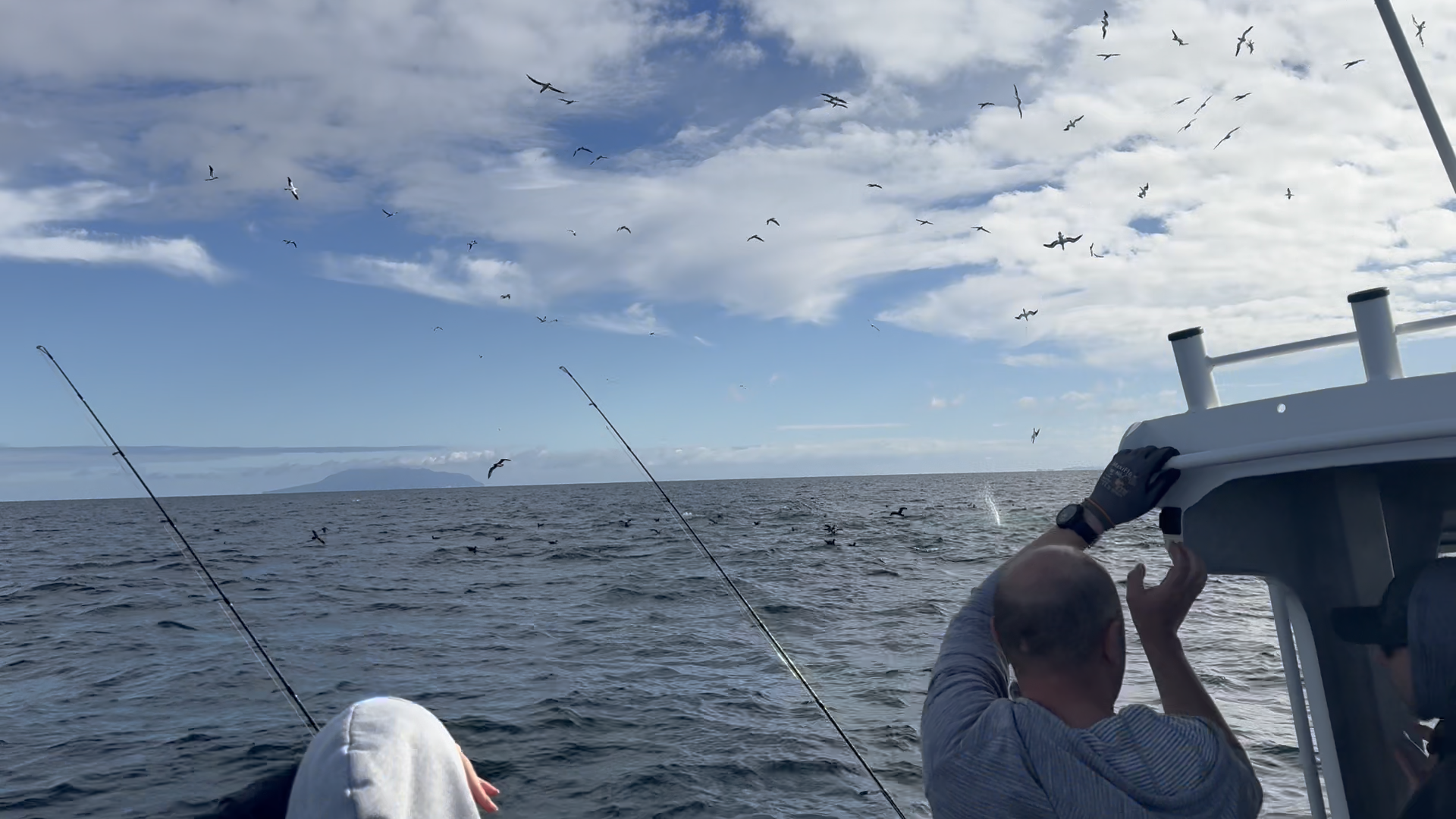
Snapper get the headlines every spring, but the two fish that tell you the northern season has really turned are kingfish and gurnard. One is the hardest fighting fish most anglers will hook inshore. The other is one of the best eating fish in the harbours. They switch on at different times, for different reasons, and the official numbers say anglers have been taking far fewer of both than they were a few years ago. Here is where the 2026 season stands for each, with the rules, the stock reports and the water temperature record behind it.
Kingfish first, because they are already here. George Bourke of Hauraki Express, writing the outer Hauraki Gulf report for The Fishing Website on 3 September, said the most consistent action was north of Anchorite Rock and around Cape Colville, “where good-sized workups are producing some excellent snapper and, importantly, schools of 8-12kg kingfish are also getting amongst the bait. The kingfish are a particularly welcome sign for the season ahead.” Up the coast the same week, Jordan Hensen’s Northland report said “the kingfish have also been making their presence felt, with plenty of anglers reporting that they have been finding good numbers of kingies while fishing off the rocks.”

That fits what the stock science says about where the fish live. Fisheries New Zealand’s May 2026 stock assessment plenary describes kingfish as semi-pelagic fish of open coastal water that prefer areas of high current or tidal flow next to rocky outcrops, reefs and pinnacles, usually in schools of a few fish to well over a hundred. Tagging results suggest most adult kingfish do not move outside their local area, with many recaptures close to where the fish were released, although some tagged fish have crossed the Tasman in both directions. So the kingfish on a Bay of Islands reef in February have most likely been in the same area all winter, holding deeper and feeding less. Spring does not bring new fish so much as start the local ones feeding.
Temperature is the switch. Our kingfish guide uses 17 degrees as the point where inshore reefs start producing fish and 18 degrees as the point where the fishery fires properly. To put dates on that we took 41 years of daily sea surface temperature from NOAA’s Coral Reef Watch analysis at the six spots on our snapper fishing conditions tool and found the day each spring when the seven day average first reached 17 degrees.
| Spot | Average first day at 17°C, 1985 to 2025 | Average, last ten springs |
|---|---|---|
| Bay of Islands | 21 November | 9 November |
| Whangaparaoa | 19 November | 8 November |
| Motuihe Channel | 18 November | 6 November |
| Great Barrier Island | 23 November | 14 November |
| Whitianga | 26 November | 14 November |
| Kaipara Harbour entrance | 21 November | 6 November |
| Spring | Bay of Islands | Motuihe | Great Barrier | Whitianga | Kaipara |
|---|---|---|---|---|---|
| 2021 | 31 Oct | 8 Nov | 11 Nov | 11 Nov | 11 Nov |
| 2022 | 26 Oct | 30 Oct | 2 Nov | 3 Nov | 30 Oct |
| 2023 | 14 Nov | 11 Nov | 19 Nov | 21 Nov | 12 Nov |
| 2024 | 11 Nov | 8 Nov | 10 Nov | 12 Nov | 8 Nov |
| 2025 | 8 Nov | 24 Oct | 7 Nov | 8 Nov | 22 Oct |
The six spots reach 17 degrees within about a week of each other, from the Motuihe Channel around 18 November to Whitianga around 26 November on the full 41 year average, and around a fortnight earlier than that in the last ten springs. The earliest inner Gulf crossing in the record was 24 October last year and the latest was 19 December in 1991. On 11 September this year the Bay of Islands read 16.0 degrees against an average of 15.2 for the date, about a degree short of the mark, which suggests the rock kingfish Jordan Hensen described are local fish feeding early on the bait he also describes, rather than a seasonal arrival. By the recent form in the table, expect reef kingfish to become consistent across the north in the first half of November, while the 8 to 12 kilogram schools on the outer Gulf follow the bait rather than the inshore temperature.
Explore the data. The live sea temperature, tide, light and wind readings behind the snapper forecast are the same ones to watch for kingfish on the reefs and gurnard on the sand, with a 1 kilometre sea temperature heatmap of the Gulf, on our interactive snapper fishing conditions tool.
The rules for kingfish have not changed this year. The Ministry for Primary Industries rules for the Auckland and Kermadec area, last reviewed on 3 August 2026, allow three kingfish per person per day with a minimum length of 75 centimetres, and those three count inside the combined daily limit of 20 finfish.
The plenary records that the minimum size went from 65 to 75 centimetres on 15 January 2004, and that many clubs, competitions and charter boats run a voluntary limit of one kingfish a day, with some game fishing clubs setting their own 100 centimetre minimum. There is a biological reason for that. The same report puts the length at which half of female kingfish are mature at 97 centimetres, and males at 83, so a legal 75 centimetre fish is more likely than not still immature. Kingfish caught in New Zealand waters hold 34 of the 36 International Game Fish Association world records for the species, which is one reason clubs push anglers to release the big ones.
How many kingfish anglers keep is measured by the National Panel Survey every five or six years, and the trend in the plenary’s table for KIN 1, the stock from North Cape round to Cape Runaway, is steeply down. The survey estimated about 62,400 kingfish and 513 tonnes kept in 2017-18, and about 22,600 fish and 225 tonnes in 2022-23.
Recreational fishers are allowed 459 tonnes a year in that area against a commercial catch limit of 91 tonnes, so the recreational fishery is the kingfish fishery. On the inshore index the East Northland and Hauraki Gulf stock is rated about as likely as not to be at or above its target and unlikely to be below its soft limit, a status the report last updated in 2023, and the same report notes that the inshore index has shown a strong decline since 2018.
Gurnard run on a different calendar. They do not need warm water to bite, and the best of the harbour fishing is often behind you by the time the kingfish arrive. The plenary’s red gurnard chapter, in volume three of the May 2026 report, says they have a long spawning period through spring and summer with a peak in early summer, that ripe adults can be found in the Hauraki Gulf throughout the year, and that small juveniles under 15 centimetres are often caught in shallow harbours.
It describes red gurnard as an important recreational species because of its wide distribution in harbours and shallow coastal water, and notes it is often taken by fishers targeting snapper and tarakihi. The winter and spring pattern that anglers know, fat gurnard on the sand and mud in the Manukau, Kaipara and inner Gulf while the snapper are slow, is consistent with fish feeding up before that early summer spawning peak.
Murray Monds of Reel Action Raglan Charters put it the way west coast skippers usually do in his 20 August report. “As always when the snapper are slow on the bite, there are some good gurnard on offer, as well as trevally and the odd tarakihi.” Gurnard are bycatch for most anglers, and the recreational rule is simple. The MPI rules page gives red gurnard a minimum length of 25 centimetres and no separate daily limit, so you can keep up to 20 as your whole finfish bag, or 17 alongside three kingfish.
The one thing the temperature record can add for gurnard is how long their season lasts. The cool half of the year, when the seven day mean sits below 16 degrees and the sand and mud edges belong to gurnard rather than snapper, has been getting shorter. At the Kaipara entrance the water was below 16 degrees for an average of 159 days a year between 1986 and 1995 and 126 days a year between 2016 and 2025, and last year it was 102 days. In the Motuihe Channel the cool season went from 161 days to 133. In the Bay of Islands it went from 136 days to 82, and in 2022 it was 39.
Gurnard are still there in summer, but the long, reliable winter and spring window that harbour fishers grew up with is now about a month shorter than it was 30 years ago.
The recreational gurnard harvest has fallen even harder than the kingfish take. For GUR 1, which covers both coasts of the upper North Island, the plenary’s table shows the panel survey estimate going from about 242,000 fish and 103 tonnes in 2011-12, to 168,800 fish and 86 tonnes in 2017-18, to 59,700 fish and 30 tonnes in 2022-23. The recreational allowance is 100 tonnes, so anglers took less than a third of it in the latest survey year, while the commercial limit is 800 tonnes. About 60 percent of the GUR 1 commercial catch comes from the east coast as bycatch of inshore trawl fisheries for snapper, john dory and tarakihi, and the rest from the west coast, mainly as bycatch of the snapper and trevally trawl fisheries. The west coast sub-stock is rated about as likely as not to be at or above its target, and the east coast and Hauraki Gulf sub-stock’s position against its target is listed as unknown, though unlikely to be below its limits.
A word on that fall in recreational catch, because it shows up for snapper as well. The snapper chapters of the plenary treat the panel surveys as broadly reliable rather than precise, and the statistical uncertainty on each estimate is roughly 6 to 18 percent for the stocks discussed here. Whether the drop is fewer trips, fewer fish, or a change in how many people keep gurnard when the snapper are biting is not something the survey can separate. The 2025 snapper assessment says the next national panel survey is scheduled for 2027-28, depending on budgets and priorities, so it will be a while before anyone knows whether 2022-23 was a low point or a new level.
For the practical side of both fish, how to fish live baits on structure is covered in our kingfish guide, and our Hauraki Gulf snapper guide covers the sand and mud edges where gurnard turn up in a snapper berley trail. For the rules on both coasts, licences and penalties, see our fishing rules in New Zealand guide. And for whether the water at your spot has crossed 17 degrees yet, the tool linked above shows the live number from the NASA satellite analysis every day.
When did you catch your first kingfish of the season, and are the gurnard still around where you fish? Tell us in the comments.
This article was written by AI, briefed to report the facts, hopefully without some of the bias people bring to the job 🙂
Leave a Reply