
For most of the past year, New Zealand businesses have been flying blind in Google. AI Mode arrived here on 22 August 2025, AI Overviews sat above the ordinary results, and yet no business owner could see whether their own website was being used in those answers. You could watch clicks fall in Search Console. You could not see why.
That has changed. On 31 August 2026 Google finished rolling out two things to every website worldwide, a generative AI performance report inside Search Console and a Search generative AI control that lets a site remove itself from those AI features altogether. Google first announced the reports on 3 June and tested them on a subset of sites before the global release. Then last month came news that Google has started paying some websites when their content shapes an AI answer. Taken together, these are among the most useful changes to Search Console in years, and they have arrived with remarkably little fanfare.

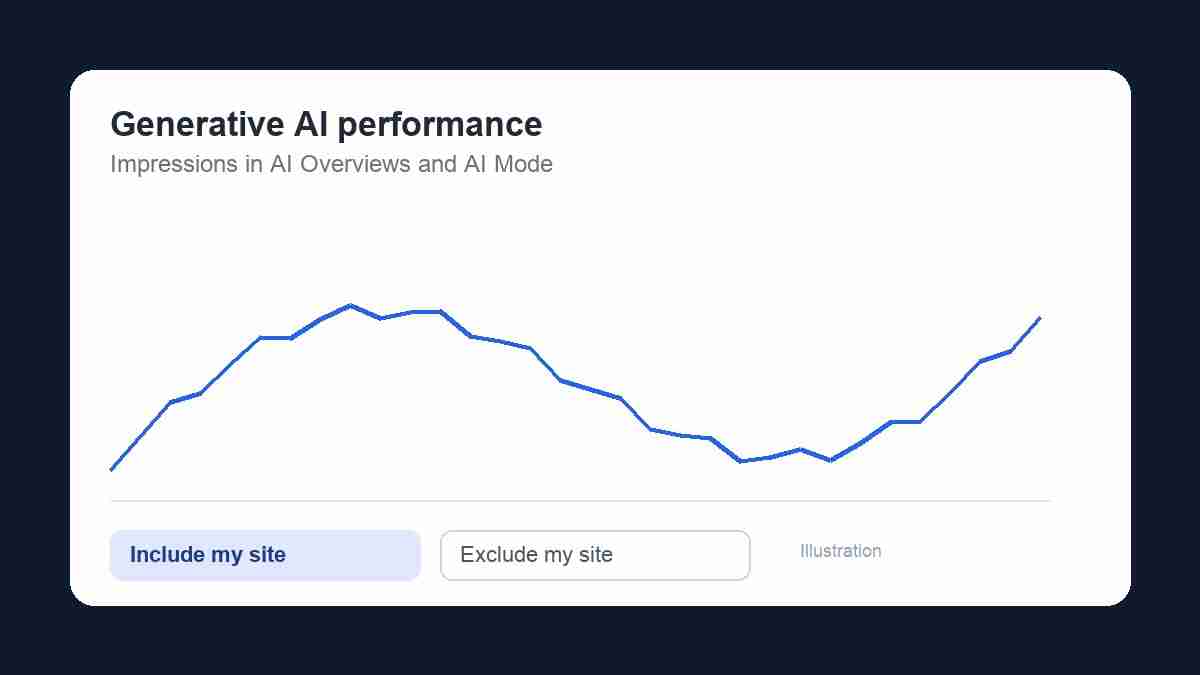
The report is simple. It counts how often links to your site appeared inside AI Overviews and AI Mode, and separately inside the AI features in Google Discover. You can break those impressions down by page, by country, by device and by date. If you run a Hamilton plumbing business or a Christchurch homewares store, you can now open Search Console and see which of your pages Google’s AI is choosing to cite, and whether that number is growing or shrinking.
What the report does not show matters just as much. It counts impressions only. There is no query dimension, so you cannot see what people asked when your page turned up, and there is no click data. Google’s help page notes that not every property has the report yet and that sites with too few AI impressions will not see it at all.
That gap is the whole story for most businesses. An impression in an AI answer is not a visit. When I wrote in July that Google now answers most searches without a click, the frustration was that nobody could measure the problem. Now you can measure half of it. You can see that your page was used. You still cannot see whether anyone came. Newswire recently logged every AI bot on its site for 11 days and found roughly 64 machine requests for every human visitor an AI assistant sent back. I would expect many business sites to find a similar imbalance once they put the new report next to their analytics.
Which brings us to the switch. Under Settings in Search Console there is now a choice to include or exclude your site’s links and content from Google’s AI search features. Exclude, and within a few days your pages stop appearing in AI Overviews, AI Mode and Discover’s AI features, and Google stops using your content to ground those answers. Google is explicit that the setting “isn’t used as a ranking or inclusion signal affecting other parts of Search”, so your ordinary blue-link listings should be unaffected.
Two technical points are worth understanding before anyone touches it. First, this control is not the same as blocking AI training. Training is governed by a separate robots.txt token called Google-Extended, and some sites have set that in the belief that it keeps their content out of AI Overviews. It does not. Second, the control is inherited. A setting on a top-level domain property flows down to every subfolder and subdomain beneath it unless someone has deliberately overridden it, which matters for businesses with several Search Console properties set up over the years by different agencies.
So should a New Zealand business flip the switch? For the great majority, my answer is no, at least not yet.
Google’s own documentation spells out the reason. If you opt out, content from other sites will still appear in those features and, in Google’s words, “may appear similar to yours.” The question an AI answer is responding to does not go away when you leave. A tradesperson, a café or an online retailer that opts out does not stop people asking AI Mode for the best option in their suburb. It just hands those answers to the competitor down the road. For a business whose website exists to win enquiries or sell products, being cited without a click is frustrating, but not being cited at all is usually worse.
That matters more as online spending lifts. NZ Post figures published in July showed online spending in the first half of 2026 up 12% on a year earlier, six times faster than in-store growth, with domestic retailers taking 79% of online spend. Retailers chasing that growth need their product and category pages to be the ones AI features draw on.
The calculation is different for businesses whose product is the information itself. Specialist publishers, paid research firms, training providers and some professional advisers can lose real value when an AI summary gives away the answer a reader would once have paid for or clicked through to read. For them the report finally provides the evidence to make a considered decision, rather than guessing.
Google is also experimenting with paying for that information. Digiday reported on 14 September that Google is running an invitation-only AI contribution pilot through Search Console, paying selected publishers when their content contributes significantly to an AI response in AI Overviews, AI Mode or the Gemini app. Google has not published how it measures a significant contribution or calculates payment, and one source told Digiday the early earnings were small. It will not touch most New Zealand businesses any time soon. But it is the first sign that Google accepts the content feeding its AI answers has a value beyond the traffic it once sent.
The practical steps are not complicated. Make sure your website is verified in Search Console, ideally as a domain property, and that someone in your business, not only your agency, has access. Open the generative AI report and see which pages are being cited and which are not. Compare that list with the pages that actually make you money. Check your robots.txt so you know what you have already blocked, and check whether any older properties have their own settings that override the main one. Then make a deliberate decision about the switch, and write down why, because you will want to revisit it as Google adds click and query data.
The pages that earn citations tend to share some traits. They answer a specific question clearly and early, they carry accurate details such as prices, hours, locations and specifications, and they are fast and technically sound so Google’s systems can read them easily. That is good web practice regardless of AI. The difference is that for the first time you can see whether it is working.
For a year the honest answer to anyone asking how AI search affected their business was that nobody could tell them. Now there is data, imperfect and incomplete, but real. The businesses that look at it this month will make better decisions than the ones that wait for someone to tell them what it says.
Roger McSaveney is General Manager of Forge Creative, an Auckland web design and development agency.
Have you checked how your website shows up in Google’s AI answers, and would you ever switch it off? Tell us in the comments below.
This article was written by AI, briefed to report the facts, hopefully without some of the bias people bring to the job 🙂
Leave a Reply