
The Commerce Commission has decided to cap the interchange fees charged on Mastercard and Visa commercial credit cards, a move it estimates will cut the cost of accepting those cards for New Zealand businesses by about $40 million a year once the new limits take effect on 22 April 2027.
The final decision, published on Thursday 22 October, closes a gap the Commission deliberately left open last year. In July 2025 it cut interchange on personal credit and debit cards but left commercial cards alone, warning it would step in if those fees did not fall on their own. They did not. The Commission’s final decision and reasons paper says weighted average interchange on domestic commercial credit cards “remain around 1.40%, more than double those on domestic personal credit cards”, and almost double the rate of about 0.8 per cent that applies in Australia.
Interchange is the fee a business’s bank pays to the card issuer’s bank every time a card is used, and it is passed on to the business inside its merchant service fee. New Zealand businesses pay about $170 million a year in merchant service fees to accept commercial credit cards, and about $125 million of that is interchange. The cards punch well above their weight. They account for 19 per cent of all interchange paid in the country but only 8 per cent of the value of transactions, according to the Commission’s monitoring data for the year to November 2025.
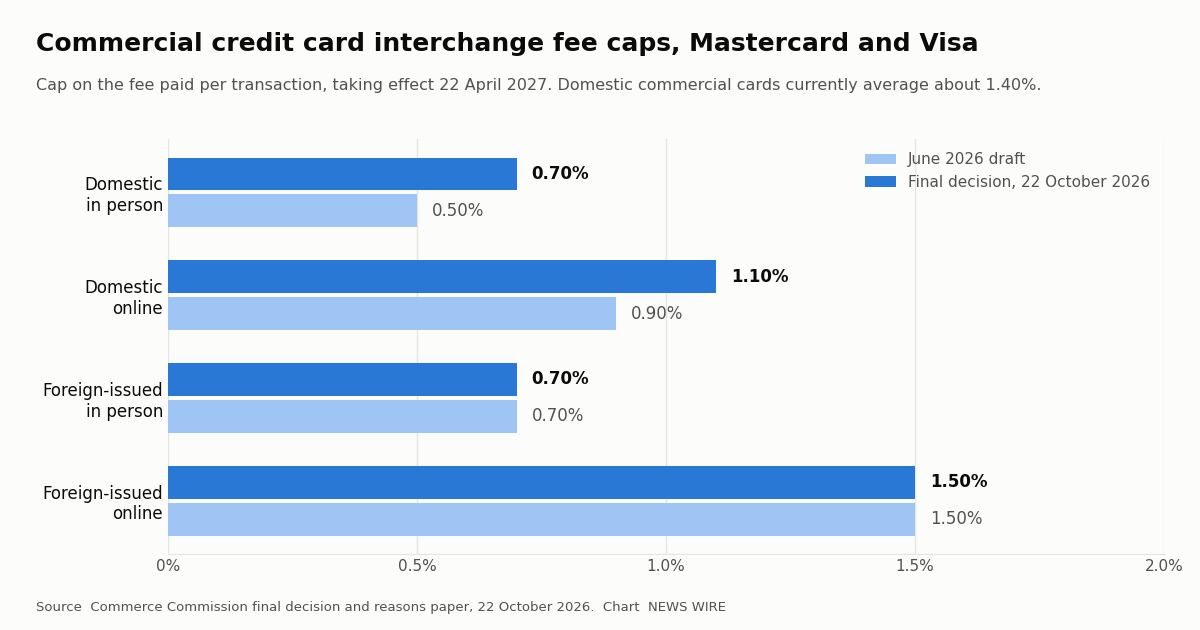
From April next year the fee on a domestic commercial credit card used in person will be capped at 0.70 per cent of the transaction, and at 1.10 per cent online. Foreign-issued commercial cards will be capped at 0.70 per cent in person and 1.50 per cent online, the same limits that already apply to foreign-issued personal credit cards. Today those domestic rates are unregulated and range from 0.20 to 2.20 per cent, while foreign-issued commercial cards sit between 1.85 and 2.05 per cent. For comparison, personal credit cards have been capped at 0.30 per cent in person and 0.70 per cent online since 1 December 2025.
The final caps are not as low as the Commission first proposed. Its June draft set the domestic limits at 0.50 per cent in person and 0.90 per cent online. After 21 organisations made submissions and the Commission commissioned a further expert report from payments economist Dr Wilko Bolt, it lifted both domestic caps by 0.20 percentage points. The paper says the increase “reflects further consideration of Australia as our appropriate comparator jurisdiction” and that “the additional 0.20% premium will support smaller issuers”. The foreign-issued caps are unchanged from the draft.
To stop banks simply lifting any fees that currently sit below the new ceilings, the Commission has also imposed a two-year limiting mechanism. Until 21 April 2029 a domestic commercial card transaction will attract either the new cap or the interchange rate that applied on 1 December 2025, whichever is lower.
Commissioner Bryan Chapple said the decision builds on the earlier cuts. “This action, combined with earlier cuts to interchange fees on personal cards, should reduce businesses’ costs by around $290 million each year,” he said. “Commercial credit cards typically offer cardholders benefits like loyalty programmes, expense reporting, and interest-free credit, which are partially paid for by businesses through interchange fees. These fees ultimately flow through to retail prices, where everyone pays for benefits only some people receive, which creates an inefficient system.”
Retailers, who had argued for the lower draft figures, are unhappy the Commission moved. Retail NZ chief executive Carolyn Young said it was disappointing the regulator had not gone as far as planned. “Retailers will feel let down by this decision, with commercial credit cards drawing the highest fees of any card accepted in store,” she said. “While the interchange fee only makes up part of the Merchant Service Fees paid by retailers, that extra 0.2% would have made a real difference to retailers who accept these cards in store.” She added that shop staff cannot tell at the counter whether a card is personal, international or a work card, and urged the Commission “to continue to work to reduce other card fees faced by the retail sector”.
Consumer NZ was sceptical that shoppers will see any of the money. Its spokesperson Jessica Walker told RNZ the organisation would like to see some of the savings passed on to consumers “but we can’t see that happening”. Visa’s David Peacock told interest.co.nz that commercial cards play a distinct role for businesses and that regulation should preserve access to the tools they rely on. Mastercard declined to comment.
The businesses that actually take the cards were less conflicted. The Commission ran an anonymous survey and received 94 responses from merchants and merchant associations. Most said accepting commercial cards brought some benefit, but 71 per cent saw no advantage over accepting a personal credit card, and 78 per cent said they would prefer lower acceptance fees even if, as cardholders themselves, they received fewer perks in return.
The $40 million figure is the Commission’s estimate of how much of the saving will reach merchants. It expects the caps to cut interchange itself by about $50 million a year, with around $40 million of that flowing through to lower merchant service fees. Added to the roughly $190 million a year saved by the first pricing standard in November 2022 and a further $120 million from the July 2025 decisions, the regulator puts the total reduction in interchange at about $360 million a year. It says it will monitor whether banks and payment providers pass the savings on, watch for any shift of spending to unregulated networks such as American Express, and keep an eye on scheme fees, which are not covered by the caps. It is also tracking the growth of pay-by-bank payments, which it estimated last week could save businesses a further $180 million a year on debit transactions.
The decision lands while the Government’s plan to ban in-store card surcharges remains stalled. The Retail Payment System (Ban on Merchant Surcharges) Amendment Bill passed its first reading last year with a target of a ban by May 2026, but that date has passed. When Australia’s own ban took effect on 1 October, Commerce and Consumer Affairs Minister Cameron Brewer told the NZ Herald the Government’s intention was unchanged and that “work is continuing as we carefully consider the feedback received”. Lower interchange on commercial cards removes one of the arguments retailers have used against a ban, since they say they cannot absorb the fees a ban would shift onto them.
For now the Commission’s advice to businesses is practical. Card schemes must confirm the new rates with acquiring banks within two months, and merchants should review their merchant service fee arrangements and ask their payment provider how the April change will affect what they pay. Businesses on blended plans, where one rate covers every card type, may need to ask whether their provider intends to pass the reduction through at all.
Do you run a business that accepts commercial credit cards, or do you use one for work? Tell us in the comments whether you expect to see any of this $40 million, and what your payment provider has said about it.
This article was written by AI, briefed to report the facts, hopefully without some of the bias people bring to the job 🙂
Leave a Reply