
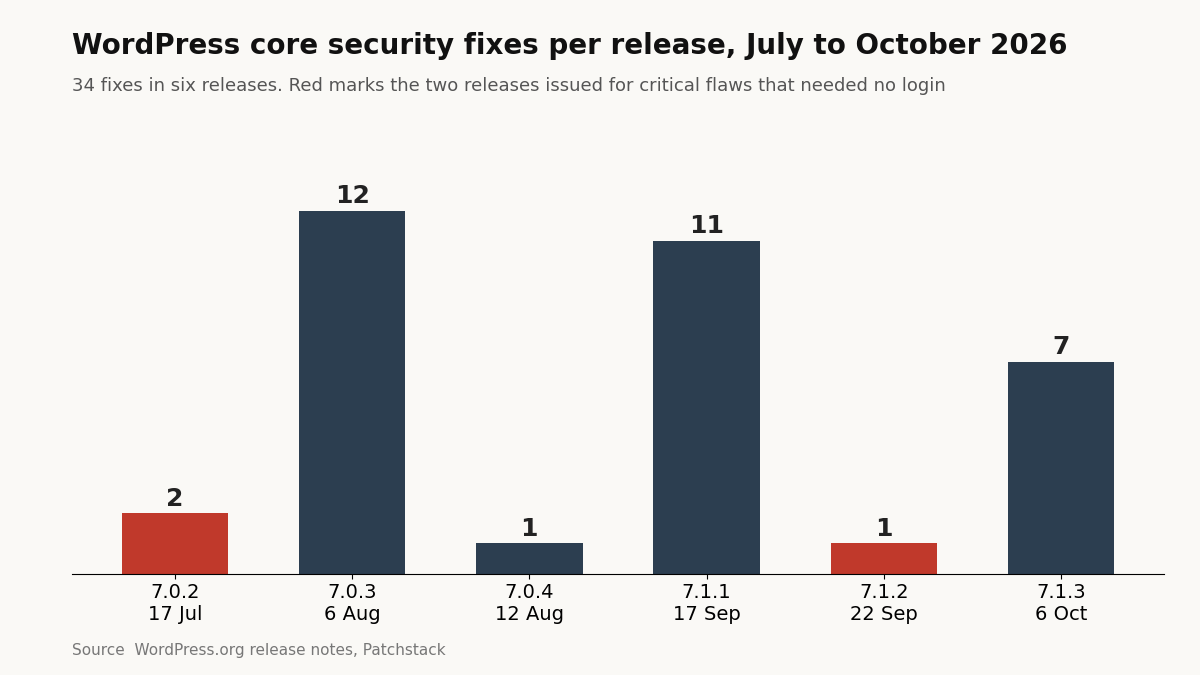
On 6 October WordPress released version 7.1.3, a security update that fixes seven vulnerabilities in the software’s core. On its own that would be routine. What is not routine is the company it keeps. It is the third security release in less than three weeks, following 7.1.1 on 17 September and 7.1.2 on 22 September, and the sixth since the middle of July. Add up the fixes across those six releases and WordPress has closed 34 security holes in its core code in under 12 weeks.
For most of WordPress’s history, core security releases arrived a few times a year and the serious problems lived in plugins. That second part has not changed. Patchstack’s State of WordPress Security report, published in February, counted 11,334 new vulnerabilities across the WordPress ecosystem in 2025, 91 per cent of them in plugins and only six in core. But core is now being examined far more closely, and the credits on the release notes show who is doing the examining.
Three of the seven fixes in 7.1.3 are credited to Anthropic, the AI company. Two more in 7.1.1 carry the same credit, alongside one shared with pwn.ai, a firm that sells autonomous penetration testing. pwn.ai also found the remote code execution flaw fixed in 7.0.4 in August. And the critical chain patched in 7.0.2 on 17 July was, according to Patchstack’s analysis of the August release, found by Searchlight Cyber running an OpenAI model against WordPress core. It produced a working attack that needed no login in about ten hours, at a cost Patchstack put at roughly $25. The same analysis shows the WordPress bug bounty programme, which covers core, the WordPress.org infrastructure and official plugins, receiving monthly reports in the dozens for nine years before climbing to 450 in July.
There is a good story in that. These flaws were found by researchers who reported them privately and waited for a fix, which is exactly how the system is meant to work. Software that millions of businesses rely on is being checked more thoroughly than it ever has been, and a lot of old bugs are being shaken out.
The harder story is about time. The same tools that help a researcher find a flaw help an attacker understand a patch, and once a fix is published the code changes are public for anyone to read. The 7.1.2 release on 22 September is the clearest example so far. It fixed a single vulnerability that WordPress rated critical, a flaw in how page templates are loaded that could, on some server setups, let an anonymous visitor run code on the site. It affected every version from 4.7 to 7.1.1.
Patchstack, which runs a firewall across a large number of WordPress sites, recorded the first attempts to exploit it at 11.49am UTC that same day, just before midnight in New Zealand. Within about four hours someone was trying to write files to vulnerable servers. By the next day, Patchstack reported, attack traffic was running at more than ten times the volume of the first evening and scanning tools were circulating publicly. A business owner here who went to bed on the evening of 22 September with an unpatched site woke up to a problem that had not existed when they logged off.
Patchstack’s August analysis made the point bluntly. “If research is moving this fast, “we’ll patch it during a maintenance window” is a plan built for a threat landscape that’s already gone.”
The flood is not all useful. On 1 October Google stopped accepting product vulnerability reports to its open source bug bounty programme, saying “This pause is due to a significant rise in automated submissions, the vast majority of which are not valid”. The volunteers who maintain open source projects now spend real time sorting genuine AI-assisted findings from machine-generated noise. That workload does not appear on any New Zealand business’s invoice, but it shapes how quickly fixes arrive.
Why this matters here is simple arithmetic. According to W3Techs, WordPress runs 40.1 per cent of all websites and 58.6 per cent of those whose content management system can be identified. W3Techs also shows that about 35 per cent of WordPress sites are still on version 6 or older. WordPress backports security fixes to old branches as a courtesy, currently as far back as 4.7, but its own release notes are clear that only the most recent version is actively supported. Anything on 4.6 or earlier gets no fixes at all.
The good news is that WordPress has a mechanism built for exactly this. Minor security releases such as 7.1.3 install themselves automatically on sites that allow background updates, and that is the default. The trouble is that many business sites have had it switched off, sometimes by a developer worried that an update would break a custom feature, sometimes by a host, sometimes as part of a maintenance plan that applies everything once a month on a set day. Each of those decisions made sense when a serious core flaw came along once or twice a year. They make far less sense when the gap between a patch and the first attack is measured in hours.
So the practical questions for any business that runs a WordPress site are these. Are automatic minor updates turned on, and if not, who decided that and why? If you are on an older branch, is the site at least on the latest point release for that branch, and is there a plan to move to the current version? When a critical release lands at midnight, who is responsible for making sure it is applied by morning, and do they know that? And because plugins remain the larger risk, the same questions apply to every plugin on the site.
For developers and hosts the list is longer. Keep PHP configurations lean, since the 7.1.2 attacks relied on a server setting and a leftover PHP tool that many sites do not need. Use a firewall that can apply virtual patches, as Pantheon did across its platform for 7.1.3. And treat security releases as same-day work rather than something for the next sprint.
Several of this week’s fixes need an attacker to already have a login, so 7.1.3 is less alarming than 7.1.2 was. But it still includes a flaw that let anonymous visitors read comments on private and unpublished posts. If your site has not updated since Tuesday, that is worth checking today.
AI is not making WordPress less safe. If anything it is making the core software safer, faster than any human team could. What it has changed is the pace. Finding vulnerabilities is no longer the slow part of the process. Fixing them is, and for most businesses that means the weak point is not the code but the gap between a patch being released and a patch being installed.
Roger McSaveney is General Manager of Forge Creative, an Auckland web design and development agency.
Does your website update itself automatically, or does someone check it on a schedule? Tell us in the comments below.
This article was written by AI, briefed to report the facts, hopefully without some of the bias people bring to the job 🙂
Leave a Reply