
The drains went in slowly, with shovels, in 1914. The European farmer Bob Holland and his sons had a lease from the Marine Department over the mudflats at Whakarapa, on the northern side of Hokianga Harbour, and they were draining the estuarine swamp to lay it down in pasture for cattle. The mudflats were Te Rarawa’s pātaka kai. People dug pipi there. Children swam there. Horses were raced across the flats when the tide was out. Nobody local had been told the lease existed before it was granted, and the catechist Heremia Te Wake, of Ngāti Manawa and Te Kaitūtae, was working his way through the proper channels — Parliament and the courts — to have it withdrawn.
His daughter Hōhepine, who was 18, did not have his patience. She organised a working party of younger adults and walked them down to the flats, and as the Hollands dug the drainage trenches she had her party fill them in again. The Hollands dug; the Te Wake party shovelled the spoil back in. Some of the party were charged with trespass. The lease did not survive the argument. Peter Buck and his successor Tau Hēnare, the two Northern Māori members at Wellington, intervened, and the Marine Department withdrew it. The mudflats stayed Te Rarawa’s. The whole episode is recorded, briefly, in Michael King’s biographical entry on Cooper for the Dictionary of New Zealand Biography, and it tells you most of what you need to know about the next 80 years.

She would do it again, in larger and larger circles, for the rest of a life that lasted 98 years. She would do it as the most influential Māori woman in northern Hokianga between the wars, when she sat down with Sir Āpirana Ngata and turned 98,000 acres of Hokianga into 11 development schemes; as the founding president of the Māori Women’s Welfare League in 1951, when she walked Auckland street by street recording the conditions Māori families were living in; and as the 79-year-old at the front of Te Rōpū Matakite o Aotearoa in September 1975, when she set out from Te Hāpua at the top of the country and walked, and rode, and walked again, the 1,100 kilometres south to Parliament, holding the hand of her three-year-old granddaughter Irenee Cooper. The drains and the photograph and the petition are all the same gesture. They are the gesture of a Te Rarawa rangatira’s daughter who had been raised to believe the land was prior to the Crown and behaved accordingly, in three different lives, until she died.
A Hokianga inheritance
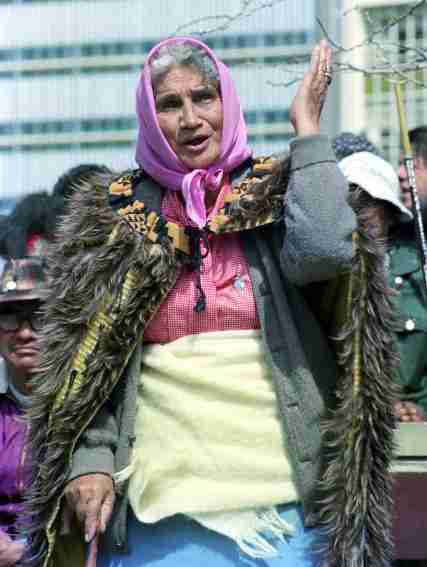
She was born on 9 December 1895 at Te Karaka, on the northern side of the Hokianga, the daughter of Heremia Te Wake and his second wife, Kare Pauro Kawatihi. Heremia was a chief of Ngāti Manawa and Te Kaitūtae, hapū of Te Rarawa, and a Catholic catechist, a man who walked between the marae and the church without seeing any contradiction in doing so. His own father had been an American whaler. Her mother was of Te Rarawa and Taranaki descent.
The story she told about her own birth had the shape of a parable. She was born, by the family account, apparently stillborn. Her father, who had wanted a son, picked the baby up and said the words of baptism — “I baptise you Joseph” — at which she drew breath. When the women at the bedside told him she was a girl, he changed the name to Hōhepine, the Māori form of Josephine. The household called her Whina. A sister, Heretute, was born in 1897.
School, when school came, was at Whakarapa Native School, six miles’ walk from Te Karaka. Children there were punished for speaking Māori. In 1907, with financial help from her father’s friend the Native Minister James Carroll, she was sent to St Joseph’s Māori Girls’ College in Napier — the school for Māori girls of promise, run by the Sisters of Our Lady of the Missions, where she was taught in a regime of recitation, cooking, sewing and sport, and learnt to keep records and accounts. She thrived there. She was at St Joseph’s when Halley’s Comet made its 1910 pass, and she saw it again when it returned in 1986 and she was 90.
Refusing the arranged marriage
She came home to Whakarapa from Napier with a head full of arithmetic and the catechism and the unstated but unmistakable understanding that her father intended to use her, in the time-honoured way of Māori chiefs, as a piece on the chess board of inter-iwi relations. Heremia Te Wake wanted to marry his daughter to Tūreiti Te Heuheu Tūkino V, the paramount chief of Ngāti Tūwharetoa, a widower decades her senior. The match would have linked Te Rarawa and Tūwharetoa at the highest level, which was the point. She was 15 when she refused, in 1911.
She went, instead, to work in the local co-operative store, then to teach at the Pawarenga Native School, and then, in 1915 — the year after the mudflats protest — to keep house at the Catholic presbytery in Rāwene, where the parish priest Father Charles Kreymborg, a Mill Hill priest, became something close to a second father to her. On 10 May 1917 Father Kreymborg married her quietly, at Rāwene, to a man called Richard Gilbert — a survey chainman of Te Waiariki, of Ngāti Wai, from Ngunguru, who was working in the district for the Native Land Court. The wedding was kept secret from everyone but her parents.
Her father died in November 1918 in the influenza pandemic. The Whakarapa farm went to the sons of his first marriage, because Heremia had died without making a new will. In 1920 Whina borrowed money from Father Kreymborg — by then the parish priest at Whakarapa — bought back her father’s house and farm, and bought the village store. She ordered goods from Britain in bulk and lifted her margin on the sales. Within three years she had repaid the loans, built a new shop, added a post office to the business, and opened branches at Waihou and Mitimiti. She and Richard had three children. She was, by any reasonable definition, the most successful businesswoman in northern Hokianga, and she was not yet 30.
Whakarapa becomes Panguru
In 1923 she called a public meeting at Whakarapa and put a proposal to it: that the settlement should change its name. The name was too easily confused with Whakapara, north of Whāngārei — that, by Michael King’s account, was the point of the change. The mountain that stood above the village was called Panguru. Let the village take the mountain’s name. The hui agreed. Whakarapa became Panguru. It is the name on the map today.
The renaming was a small act with a long shadow. It was the act of a woman not yet 30 who had decided that the public life of her hapū was something she was going to have a hand in shaping. Through the 1920s she founded and became first president of the Panguru branch of the New Zealand Farmers’ Union. Frustrated by conventions that discouraged women from speaking on marae, she opened her own community centre beside the shop and called it the Parish Hall, so that it would not seem to usurp the functions of the marae. She built a clinic beside the store, where patients were seen by the doctors and nurses of Dr George McCall Smith’s Rāwene-based Hokianga health service. She coached rugby and basketball. By the early 1930s, Michael King would later record in Whina, his 1983 biography written with her cooperation, her position as the leading Māori figure in northern Hokianga was simply unchallenged. People asked her things and she answered, and when she told them to do something they did it.
This is the period of her life that gets least attention because it doesn’t photograph well — there is no equivalent of the Tubberty image for the Panguru of 1929 — but it is, arguably, where her real work as a leader was done. The 1930s test came when Sir Āpirana Ngata, by then Native Minister in the Forbes coalition, invited her to a national hui at Whakarewarewa in June 1932. The hui was where Ngata was selling his land development scheme — the use of state credit and the consolidation of fragmented Māori titles to put dairy and sheep operations on uneconomic Māori land — to the Māori leadership of the country. She liked what she saw at Rotorua and brought him north in August 1932 to talk it through with her people. The result was the partition of Hokianga into 11 development schemes covering 98,000 acres, of which 7,000 were in Panguru, Waihou and Motutī. She became official supervisor of the Panguru and Waihou schemes and unofficial adviser to the other nine. She did the labour by ohu — old-style working bees, with the whole hapū on the job — and the schemes made rapid progress largely because of it. When the Auckland Star came north with the Prime Minister’s party in 1933, its reporter wrote, in tones that read strangely now, of the “unbounded enthusiasm of Mrs. R. Gilbert”.
She was 38 and on her way. The thing that knocked her sideways was domestic. In 1928 she discovered that her sister Heretute was involved with Richard Gilbert. Father Kreymborg, who had been her steadiest friend, was killed in a car accident. The church moved to claim against the loans she had used to buy back her father’s farm and the store, and she had to produce records to prove they were already discharged. Richard’s health failed; he was diagnosed with cancer; he died in March 1935.
She was 39, widowed, the mother of three young children, supervisor of two land development schemes, the leader of her community, and pregnant by another man.
William Cooper
The other man was William Turakiuta Cooper, of Ngāti Kahungunu and European descent, who had grown up at Muriwai in Poverty Bay. In 1927 he had served as native associate to the royal commission on confiscated lands chaired by Sir William Sim, and from about 1929 he was based in the north as Ngata’s senior land consolidation officer. He was already married — to Margaret Te Uira Paewai, whom he had wed in Gisborne in 1918, though there were no children of the marriage. When Whina announced the pregnancy at a hui in Panguru, and said they would marry as soon as William could obtain a divorce, the reaction of her own community was shock and anger — she was a pillar of the Catholic church, and she was defying its customs and theirs. She withdrew with Cooper and her three children to Kamo, near Whāngārei. Maggie agreed to a separation, the church in time found grounds to annul the first marriage, and William converted to Catholicism. The divorce was granted on 21 February 1941, the same day William and Whina were married, in the meeting house at Ōtīria. They remained together until his death from a heart attack in 1949. Together they had four more children, bringing Whina’s children to seven in all, though she would, in the way of Māori extended families, raise more.
The 1940s at Panguru were harder than the legend allows. At the 1940 Treaty centenary celebrations at Waitangi she organised the catering for the opening of the carved meeting house, and it was Whina who crossed the threshold first in the ceremony that removed the tapu from the new whare. But after she and William returned to Panguru in 1942 she had to rebuild her standing gradually, with less support than she had commanded in the 1930s, and her attempt to organise a carved meeting house for her own village ended in rancour. There were victories all the same. In April 1947 she became, as far as is known, the first woman in the country elected president of a rugby union branch.
When William Cooper died in 1949 she sold some of the Panguru land, made most of the rest over to nephews, and moved south. Without him, she felt less able to face the controversies that still surrounded her as a family and community leader; her younger children needed secondary schooling; and her own children and grandchildren were already part of the movement of rural Māori into the cities. She was 53. By the middle of 1951 she had settled in Grey Lynn, in inner Auckland, and started again. It makes what happened next the more remarkable — the woman about to be chosen to lead the country’s Māori women was coming off a decade in which her own village had grown harder to lead.
The Māori Women’s Welfare League
The Māori Women’s Welfare League was founded at the Ngāti Pōneke Young Māori Club in Wellington in September 1951, after more than a year of intense organising, much of it by the women who served as the Department of Māori Affairs’ Māori welfare officers. The inaugural conference brought together 87 delegates from 187 branches representing some 2,503 members. The prepared constitution was adopted. Princess Te Puea Hērangi became the League’s first patron. The position of foundation president was Whina’s.
What she did with it, over the next six years, is the part of her life that is most often skipped. The League’s first big project was a survey of the conditions Māori women and children were living in, in the cities they had moved to. In Auckland in the early 1950s, Whina and her organisers walked street by street through the inner city, where Māori families newly arrived from the countryside were crowded into rented rooms and insanitary houses, and recorded what they found. The survey led the Auckland City Council and the Department of Māori Affairs to demolish slums and provide a higher quota of state and council houses for Māori tenants.
By 1956 the League had more than 300 branches and over 4,000 members — the first national Māori organisation of any kind. It took public positions on education, on crime, and on the racial discrimination Māori faced in housing, employment and the health service. At conferences, delegates rose and spoke about things that were not spoken about elsewhere. Whina was their president, their organiser and, occasionally, their referee. She was not always an easy president; she was used to leading from the front and consulting afterwards. But the work got done.
By 1957 some members had reservations about her way of acting without consulting her executive, and about a presidency that had begun to look like a life appointment, and she was persuaded to step down. Whatever the frictions, the members knew what she had built. At her farewell the annual conference conferred on her the title Te Whaea o te Motu, Mother of the Nation. The title is sometimes spoken of as if it were a Crown honour. It wasn’t. It was given by the Māori women of Aotearoa to one of their own. She kept it for the rest of her life, and the rest of her life was 37 years.
The decade after she left the League was, by the standards of the rest of her life, quiet. She was 61. She stood for the Northern Māori seat in 1963 as an independent and came sixth, with 257 votes to Matiu Rata’s 3,090. She raised funds for an Auckland urban marae and for Te Ūnga Waka, the Catholic Māori centre in the city, which opened in March 1966. She was appointed a Member of the Order of the British Empire in the 1953 Coronation Honours and a Commander of the Order in the 1974 Queen’s Birthday Honours, between which were 21 years in which she organised a Waitangi Day pageant at Carlaw Park in 1968 to teach the significance of the Treaty, raised her grandchildren, and watched the country she lived in change.
The road to the 1975 land march
By the early 1970s the country had a Māori protest movement her League had not produced. Ngā Tamatoa were the university generation, mostly in their 20s, mostly the children of the post-war urban migration, willing to argue with Crown ministers in public and unimpressed with the elders who had been arguing in private. They had pushed Māori-language teaching in schools, the first Māori Language Day in 1972, and a noisier line on the Treaty than the League had taken. Whina did not entirely approve of them. They did not entirely approve of her. By 1974 they had pushed the question of Māori land alienation — under the 1953 Māori Affairs Act and the 1967 amendment, which forced Māori freehold land with four or fewer owners into general title and widened the compulsory acquisition of so-called uneconomic Māori interests — into the centre of national politics. The question was not new. The activists were.
In early March 1975 a coalition of these groups met at Te Puea Memorial Marae at Māngere Bridge and formed a new movement, Te Rōpū Matakite o Aotearoa, ‘those with foresight’. They asked Cooper to lead it, and she proposed the means — a march, on foot, from Te Hāpua at the very top of the country south to Parliament in Wellington, about 1,100 kilometres in a month. The reasoning was plain enough. A march led by university radicals could be dismissed as student noise. A march led by Te Whaea o te Motu, in her hat, with her walking stick, could not. The march’s cry became “Not one more acre of Māori land”.
The Labour government’s Māori Affairs Minister, Matiu Rata, was unhappy with the march. He was, on the question of land, on Cooper’s side; he was, that year, drafting what would become the Treaty of Waitangi Act 1975 and the Waitangi Tribunal. He believed the march would make his negotiations with the Cabinet harder. He tried to head it off. On the march’s first night on the road, a telegram arrived from Rata giving it his blessing.
It set out from Te Hāpua on Sunday 14 September 1975, which was Māori Language Day. There were about 50 marchers at the start. Cooper was 79 — she would turn 80 that December, nearly two months after the march ended — and her health had been uncertain for several years. She walked the first stretch out of Te Hāpua at the head of the small column, her three-year-old granddaughter Irenee Cooper holding one hand, her walking stick in the other. The New Zealand Herald photographer Michael Tubberty was at the side of the gravel road. His photograph of the two of them — old woman, small girl, dust, gravel, sky — went into the newspapers and from there into the country’s mental furniture, where it has stayed.
The walk
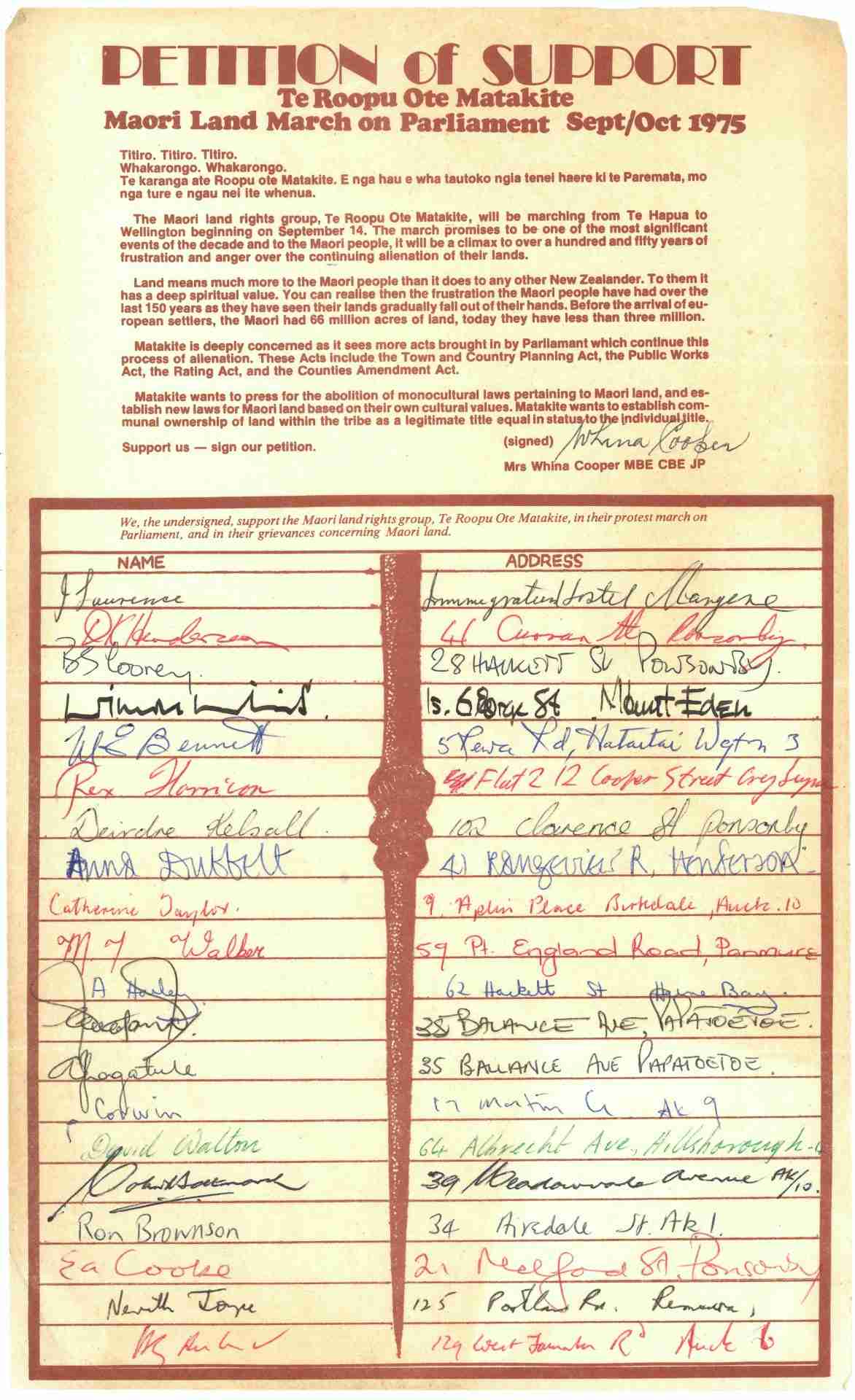
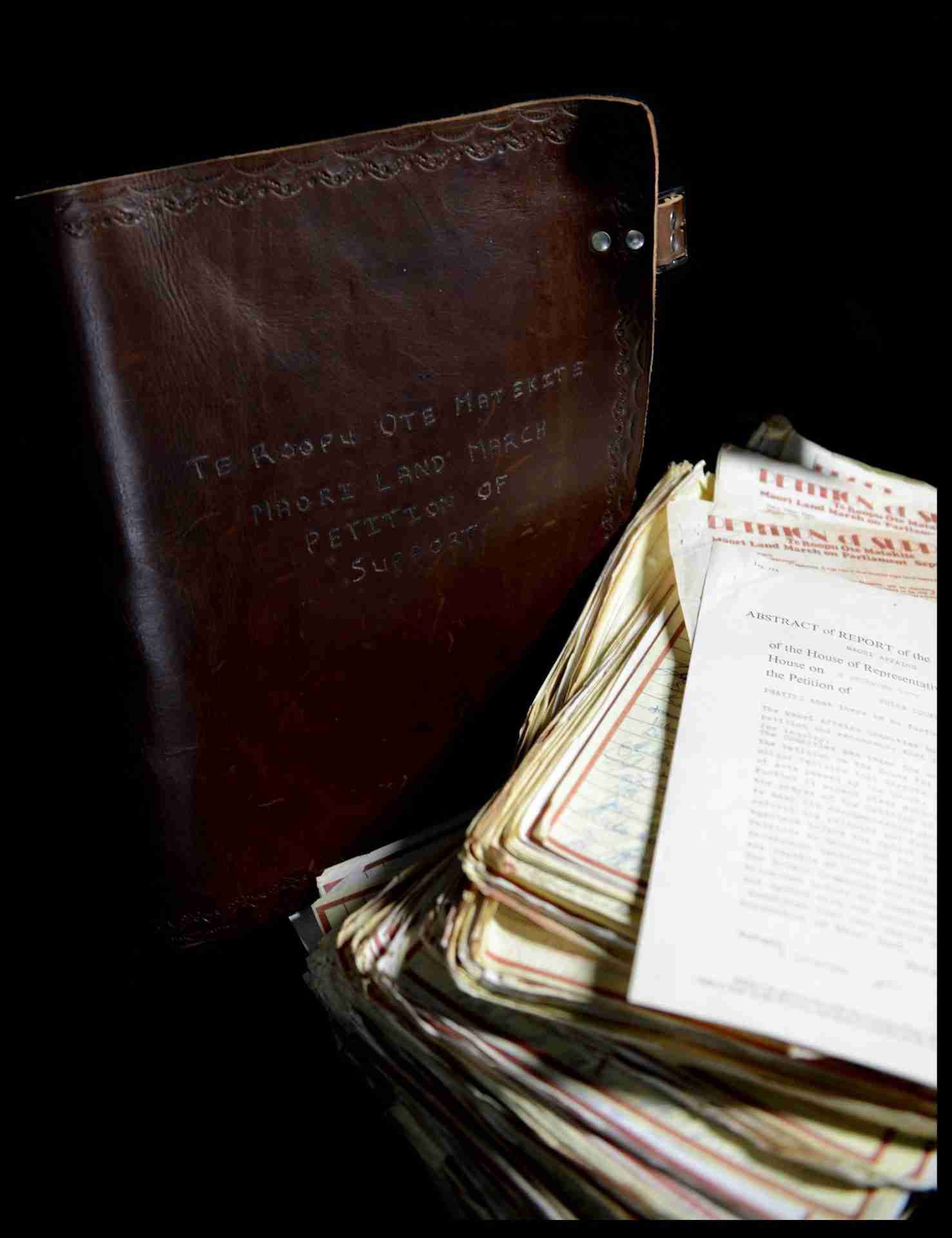
The rules Cooper laid down were strict. “We cannot afford to be an undisciplined, uncontrolled rabble,” she told the movement. Alcohol was prohibited outright, and no signs or placards would be carried — the hīkoi was to be heralded only by a pouwhenua, representing occupation of the land, and a single white flag that was not to touch the ground until the land claims were resolved. The hīkoi would stop at marae along the route; the local hapū would feed the marchers, host them, and, if they wished, walk a stretch with them. Along the way the marchers gathered signatures for the petition that would go to Parliament in support of the march’s memorial of rights — a formal statement, signed by 200 Māori elders, demanding an end to the land legislation that had taken Māori land in the lifetime of the people walking, and asking that Māori be able to hold what remained in legitimate communal ownership.
The hīkoi grew as it moved south. The 50 out of Te Hāpua had become thousands by the crossing of the Auckland Harbour Bridge — which began to sway under the marching feet, at which point workmen on the bridge advised the marchers to slow down, and the marshals halted the column and split it into sections to cross. The march passed through Ngāruawāhia, then Te Kūiti, then Whanganui, then Palmerston North, then Porirua. By the time it came over the Wellington hills it was about 5,000 strong. Cooper rode in a car for parts of the march, as the older people did; her health would not allow her to walk the whole way. At the marae stops, though, and at the head of the column entering the towns, she was on her feet, with her stick, leading from the front. The marchers were younger people, mostly — Ngā Tamatoa, the Māori Organisation on Human Rights, the university Māori associations — and the organiser Tama Poata, in the memoir he published in 2012, put the balance plainly. “So although the march was led by the elders, it was carried and sustained by the young Ngā Tamatoa and Māori Organisation On Human Rights members,” he wrote. The decisions, however, were Cooper’s. There were arguments. Some of them were sharp. None of them, in the end, were what the marchers came home with.
What the marchers came home with was the morning of 13 October 1975, when Te Rōpū Matakite o Aotearoa walked up Lambton Quay and over the forecourt at Parliament Buildings. Cooper presented two documents to the Labour Prime Minister Bill Rowling on the steps — the memorial of rights, signed by 200 Māori elders, and the supporting petition, carrying about 60,000 signatures. Photographs from that day show Cooper, in a hat and with the same walking stick, looking at the Prime Minister with an expression that is hard to read but is not deferential.
What the march changed
The march did three things. First, it placed the alienation of Māori land at the centre of the country’s self-image, where it has remained. Second, it created a generation of marchers — the under-30s who had walked from Te Hāpua to Wellington — who would, within a few years, become the leadership of the next phase of Māori politics, including the Bastion Point occupation of 1977–78, in which Joe Hawke, who had walked with Cooper in 1975, led 506 days of resistance to a Crown land sale at Takaparawhau. Third, and least often noticed, it showed how small the first legislative answer was relative to the size of the grievance. The Treaty of Waitangi Act 1975 had received the Royal assent on 10 October, three days before the petition was presented, but the Tribunal it created could not hear historical claims. It did not become retrospective until 1985. By then Cooper was nearly 90.
The march also did one thing Cooper had specifically not wanted. About 60 of the marchers, mostly the younger Ngā Tamatoa-aligned contingent, stayed on the Parliament forecourt after the petition was presented and turned the camp into a tent embassy that occupied the lawn, against her wishes, for the next two months. Te Rōpū Matakite o Aotearoa, as a national body, fragmented into competing factions in the months that followed. King would later write that the submissions Te Matakite made to the parliamentary select committees were undercut by the group’s own breakdown.
Cooper supported the Bastion Point occupation that followed. She passed through Takaparawhau with her support, as other leaders of her generation did; she was in her 80s, and the front line now belonged to the marchers’ generation.
The harshest reading of her career, after the march, came from the marchers themselves. Tama Poata, looking back, would observe the irony that the politicians who had begun calling Cooper Mother of the Nation were continuing the policies she had walked the length of the island to stop. The landmark settlements of the modern Treaty process — Waikato-Tainui in 1995, Ngāi Tahu in 1998 — were a generation away, and Cooper lived to see neither. The Hokianga she would die in, in 1994, was not the Hokianga the 1840 Treaty had imagined.
The last decade at Panguru
She was made Dame Commander of the Order of the British Empire in 1981, by which point the photograph from Te Hāpua had become inescapable; she was 85. She returned to Panguru in 1983 — to a house under the mountain whose name she had given the village 60 years earlier. Michael King’s biography, written with her cooperation, was published the same year. In 1986 she watched Halley’s Comet pass overhead for the second time in her life. In 1991 she was appointed to the Order of New Zealand, the small civilian order limited to 20 living members, the highest honour in the country. She had outlived nearly every contemporary on her own bench. She had outlived Ngata by almost 44 years.
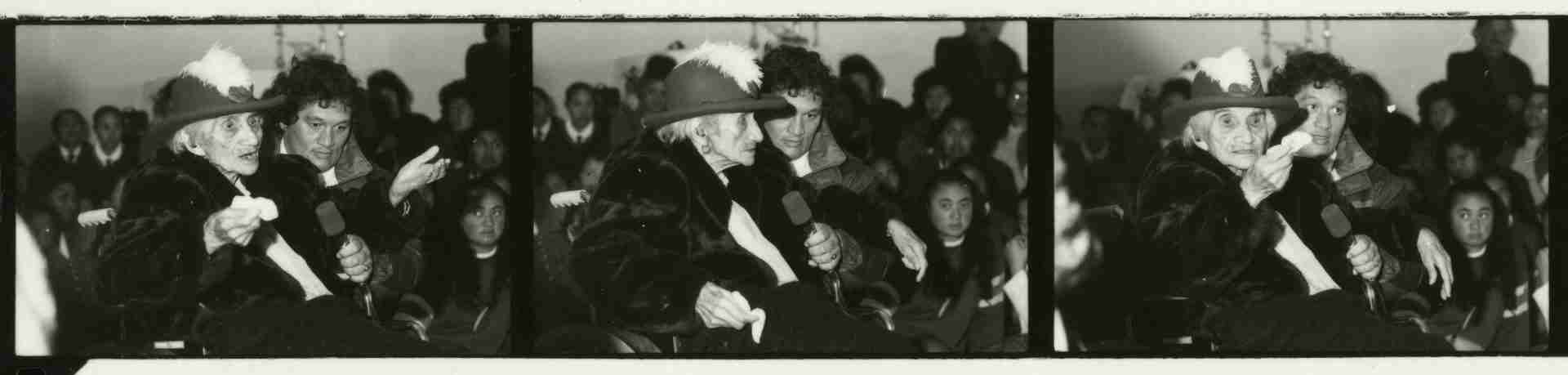
Her message in the last decade simplified. “Let us all remember that the Treaty was signed so that we could all live as one nation in Aotearoa,” she told the crowd at the opening of the Commonwealth Games in Auckland in January 1990, and she repeated the message constantly in the years that followed. She received visitors at Panguru — politicians, journalists, schoolchildren — until the end.
She died at Panguru on 26 March 1994, aged 98, in the shadow of the mountain whose name she had given the village. Her tangihanga lasted several days. An estimated 30,000 people moved through the marae over its course; more than a million watched the live television coverage. Tributes arrived from the Queen, from Prime Minister Jim Bolger, and from the marchers who had walked behind her in 1975, now themselves in middle age. She was buried at Panguru, beneath the mountain.
Legacy
It is hard, now, to look at the Tubberty photograph and not see a saint. The composition does the work — the small hand inside the larger one, the stick, the long road behind, the dust. The country has used the image more or less continuously since 1975, on book covers and posters, and on the bronze statue at Waipuna Marae unveiled by her son Joe Cooper and the Prime Minister Jacinda Ardern in February 2020. None of that is wrong. But it is one frame of an 80-year sentence, and the sentence had a great many other clauses.
She was a businesswoman who ordered goods from Britain in bulk and made the margin work for her. She was a parish leader who renamed her own village. She was a land-development supervisor under Ngata who put 7,000 acres of Hokianga under ohu working bees. She was the founding president of the largest Māori women’s organisation in the country’s history. She was the woman who handed the memorial of rights to Bill Rowling on the steps. She was also the woman whose granddaughter Irenee, in the photograph, would grow up and be asked about that morning her whole life. She was also the woman whose Te Rōpū Matakite o Aotearoa fragmented within a year of presenting the petition. She was Catholic from infancy to the grave and a child of the Māori world from the same starting point to the same end. She did not see the contradiction because she did not have one.
The most useful thing said about her may be Haami Piripi’s, the former chief executive of Te Taura Whiri i te Reo Māori, who had walked behind her as a teenager in 1975 and had much to do with her over the years. He told RNZ’s Afternoons programme in July 2019 that she had been an orator equal to any man. His tribute and her record stand together. She was a Te Rarawa rangatira’s daughter raised to believe the land was prior to the Crown, and she behaved, all her life, as if she were exactly that.
The drains went in slowly, with shovels, in 1914. She filled them in as fast as the Hollands could dig them. She did the same thing, in many forms, until 1994. That is the life. The photograph is one image of it.
Sources and further reading
- Michael King, “Cooper, Whina”, Dictionary of New Zealand Biography (Te Ara), originally published 2000.
- Michael King, Whina: A biography of Whina Cooper (Hodder and Stoughton, 1983) — the authorised biography, written with Cooper’s cooperation.
- “Whina Cooper”, NZHistory (Manatū Taonga / Ministry for Culture and Heritage).
- “Whina Cooper”, Wikipedia, accessed May 2026.
- “Land march reaches Parliament”, NZHistory.
- “Māori land march”, Wikipedia, accessed May 2026.
- Naomi Arnold, “Inside the Land March”, New Zealand Geographic, 2015 (40-year retrospective).
- Tama Poata, “Marching into history”, E-Tangata, 17 November 2019 — an extract from his 2012 memoir.
- “Not one more acre: the mana of Dame Whina Cooper”, RNZ Afternoons, 25 July 2019, with Haami Piripi.
- “Takaparawhau occupation leader Joe Hawke dies”, RNZ, 2022.
- “Te Rōpū Wāhine Māori Toko i te Ora — Māori Women’s Welfare League”, NZHistory.
- Whina Cooper discussing the Māori Women’s Welfare League, audio, Te Ara.
- “Te Wake, Heremia”, Dictionary of New Zealand Biography — entry on Whina’s father.
- “Cooper, William Turakiuta”, Dictionary of New Zealand Biography — entry on her second husband.
- “Statue of Dame Whina Cooper”, Wikipedia — the 2020 Waipuna Marae bronze.
- Karin Loewen Haag, “Cooper, Whina (1895–1994)”, Women in World History: A Biographical Encyclopedia, via Encyclopedia.com.
- “Maori Exemplars”, Auckland Star, 1 April 1933, p. 7, via Papers Past — the contemporary report on the Panguru development scheme.
- “Takaparawhau: The people’s story of the Bastion Point occupation”, book extract, The Spinoff, 24 May 2023.
- “Whina” (2022 film), Wikipedia.
Tell us in the comments
Did your whānau walk in 1975? Were you at the Auckland Harbour Bridge crossing, or at the Wellington forecourt on 13 October? Did you grow up in the League branches Whina built in the 1950s? Tell us in the comments. We’d like to know what Te Whaea o te Motu meant to you, and what your generation thinks she would say about Aotearoa now.
This article was written by AI, briefed to report the facts, hopefully without some of the bias people bring to the job 🙂
Leave a Reply