
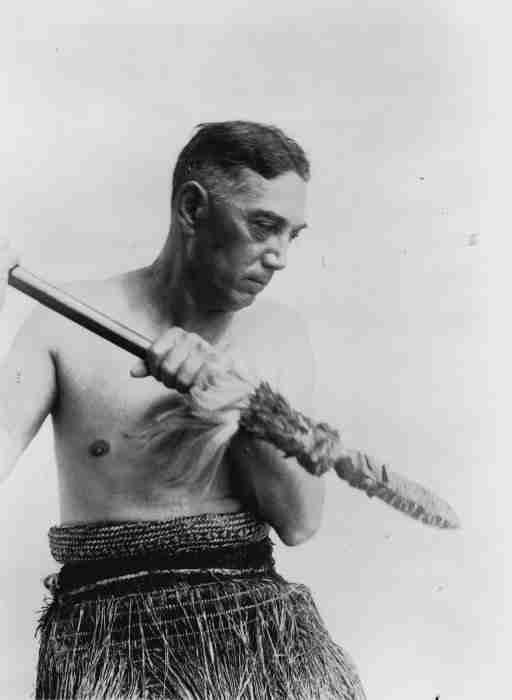
At Arorangi, on the western side of Rarotonga, the ariki Tinomana laid out a feast of welcome for a visiting doctor from New Zealand. The visitor was a Māori MP in his early thirties who had come north during the parliamentary recess to do medical work among people whose language was close kin to the Māori his great-aunt Kapuakore had spoken to him at Urenui. The chief’s orator, welcoming him, said that the visitor’s ancestors had “passed on their voyage to the South”. On his first day through the main village, two elders had steered him onto their verandah, and one of them, a descendant of a hereditary line of high priests, handed him a drinking coconut with words he would carry for the rest of his life. “In New Zealand you have drunk the water of the land, but here in the land of your fathers you will drink of the water of trees.” He retold both moments nearly thirty years later in the opening of Vikings of the Sunrise, an excerpt of which is republished by e-tangata.
The visitor was Peter Henry Buck. His father was an Anglo-Irishman who had served in the Armed Constabulary and settled at Urenui in north Taranaki; his birth mother, Rina, was Ngāti Mutunga; the woman who raised him, Ngārongo, was his father’s wife and Rina’s near relative. The name he is also known by, Te Rangi Hīroa, belonged to an illustrious ancestor, an uncle of Ngārongo’s; it was conferred on him by his elders in later life, and he used it on everything he published. By 1910 he had been dux of Te Aute, captain of athletics, the national long jump champion in 1900 and 1903, the first Māori graduate of a New Zealand medical school, medical officer to the Māori under Māui Pōmare, and, since 1909, the Liberal MP for Northern Maori. Ahead of him lay Gallipoli and a Distinguished Service Order, second-in-command of the New Zealand (Māori) Pioneer Battalion, the directorship of Māori Hygiene in the new Department of Health, and a second career in Honolulu that would make him, in the judgement of his colleagues, the most important Polynesian anthropologist of his generation. He had, although he didn’t know it, 41 more years to live.

The second half of his life became a patient, twenty-five-year project of describing Polynesian material culture before the older generations who remembered it died — pursued from the Bernice Pauahi Bishop Museum in Honolulu, and threaded through with the great friendship of his life. From 1925 to 1950 Buck and Āpirana Ngata wrote to each other across the Pacific — the surviving letters, collected by M.P.K. Sorrenson into three volumes as Na To Hoa Aroha, from your dear friend. Buck’s side of that correspondence is half the spine of his New Zealand life. The other half is the books.
He has not been forgotten in this country, but he is mostly remembered as a footnote to Ngata, or as the name on a college at the University of Otago. The fuller picture is that by his death in 1951 he was, in the judgement of his American colleagues, the most important Polynesian anthropologist of his generation, and one of the most important museum directors anywhere. His ashes lie, by his own wish, on a hilltop near Urenui he had left as a teenager and seen again only on visits. And the United States, where he did his greatest work and directed one of its great museums, never allowed him to become a citizen; its naturalisation law barred Polynesians by race until the year after his death. This is who he was.
A Taranaki farm
Buck’s birth date is not absolutely settled. He himself gave the year as 1880; the Urenui primary school register records October 1877. Te Ara, following the DNZB entry by M.P.K. Sorrenson, settles on c. October 1877 and that is the date carried by most modern reference works. He was born on a small farm just outside Urenui, on land that had been part of the great mid-1860s confiscation and the unhappy decades that followed. His father, William Henry Buck, had married Ngārongo-ki-tua, of Ngāti Mutunga, in the early 1870s. When it became clear the marriage would be childless, Rina, a young near relative of Ngārongo, came into the household under Māori custom. Rina was Peter’s birth mother. She died not long after he was born. Ngārongo raised him as her own.
He grew up bilingual but English-first, with poetry from his father and language and tikanga from Ngārongo and his great-aunt Kapuakore. Kapuakore was the formative figure. She taught him whakapapa and waiata, and she ferried him across the Urenui River in her canoe. When she died in 1908 he took from her sleeping hut, after the tangi, the paddle she had used on those crossings. He later called it “my most precious family heirloom”. Ngārongo died in 1892, when Peter was around 14. His father took him to the Wairarapa, where the two of them worked on J. C. Andrew’s sheep station. It was Andrew who encouraged the boy towards Te Aute, where he enrolled in 1896.
Te Aute and the Young Māori men
John Thornton ran Te Aute as a kind of secular monastery for clever Māori boys. He pushed Latin, Greek, mathematics, and a strict standard of academic ambition. The young men who passed through his school in the 1890s included Māui Pōmare, Rēweti Kōhere, Tūtere Wī Repa, Frederick Bennett, Paraire Tomoana, Āpirana Ngata, and Buck. In 1897 they formed the Te Aute Students’ Association, the body usually remembered now as the Young Māori Party. Their programme was practical: better houses, sanitation, English literacy, Māori-language literacy, agricultural improvement, the slow recovery of mana. Their context was bleak. The Māori population recorded in 1896 had fallen to around 42,000 and was assumed by every demographic projection of the period to be dying out. The weight of that era carried a long way; in 1940, in a speech preserved by Ngā Taonga Sound & Vision, Ngata reflected that Māori had approached the Centennial year with much misgiving.
Buck was dux of Te Aute in his final year and captain of athletics, and passed the medical preliminary that qualified him for Otago. He spent the next five years at the Otago Medical School in Dunedin, qualifying MB ChB in 1904. He was also the national long jump champion in 1900 and 1903 (an oddly consequential detail — he carried the athleticism into the Pioneer Battalion, into long fieldwork hikes on Mangareva and Manihiki, and into the kind of stamina that let him write from a hospital bed forty years later). On 4 October 1905 he married Margaret Wilson, who had been born in the north of Ireland, at Greymouth. The marriage was childless. It endured for 46 years, and she was fiercely loyal to him throughout.
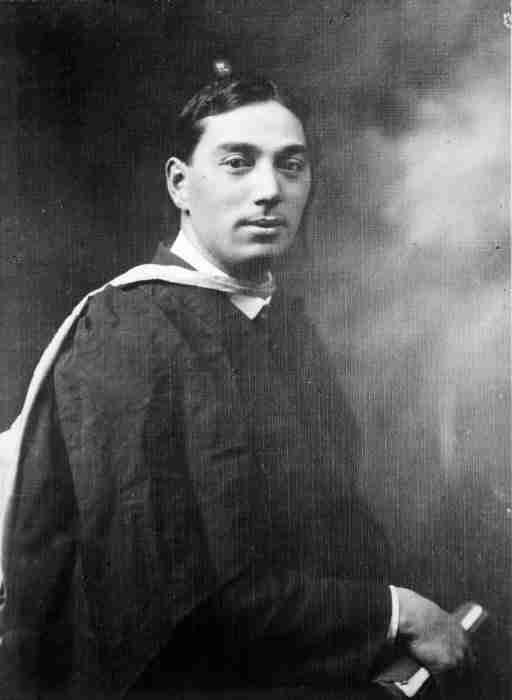
Buck was, on graduation, the second Māori medical graduate in the country’s history — the first was Māui Pōmare, who had qualified in the United States in 1899 — and the first Māori to graduate from a New Zealand medical school. Tūtere Wī Repa followed in 1908, and Edward Pohau Ellison in 1919. Buck spent a year as house surgeon at Dunedin Hospital and some months at Sunnyside, then in November 1905 was appointed medical officer to the Māori under the new Department of Public Health, joining Pōmare’s campaign — working first in the southern North Island and, from 1907, across Te Tai Tokerau. The job was a long, slow, unglamorous round of sanitation surveys, condemned wells, and tactful public meetings. It was Pōmare’s programme: a public-health-led recovery of Māori demography, framed in the Edwardian language of self-improvement. The Māori population had in fact begun to recover around the turn of the century, and the campaign was part of how that recovery was consolidated. Buck spent a little over three years on it before taking a different fork in the road.
Member for Northern Maori
When the Liberal Party MP for Northern Maori, Hōne Heke Ngāpua, died in early 1909, the native minister James Carroll picked Buck as the government’s candidate, and he won the by-election despite the intervention of several local candidates. He was 31. He served as the MP for Northern Maori in two parliaments, 1909 to 1914, on the government benches under Sir Joseph Ward and Thomas Mackenzie, and in opposition after Bill Massey’s Reform government took office in July 1912. He seldom spoke in debate, Sorrenson records, unless roused by something that threatened Māori. He was a member of the Native Affairs Committee. In 1912 he sat on the Executive Council in the brief Mackenzie ministry. Twice he used the parliamentary recess to return to medicine in the islands New Zealand had annexed in 1901 — the Rarotonga trip of 1910, when the Arorangi welcome happened, and a longer stint on Niue in 1912–13.
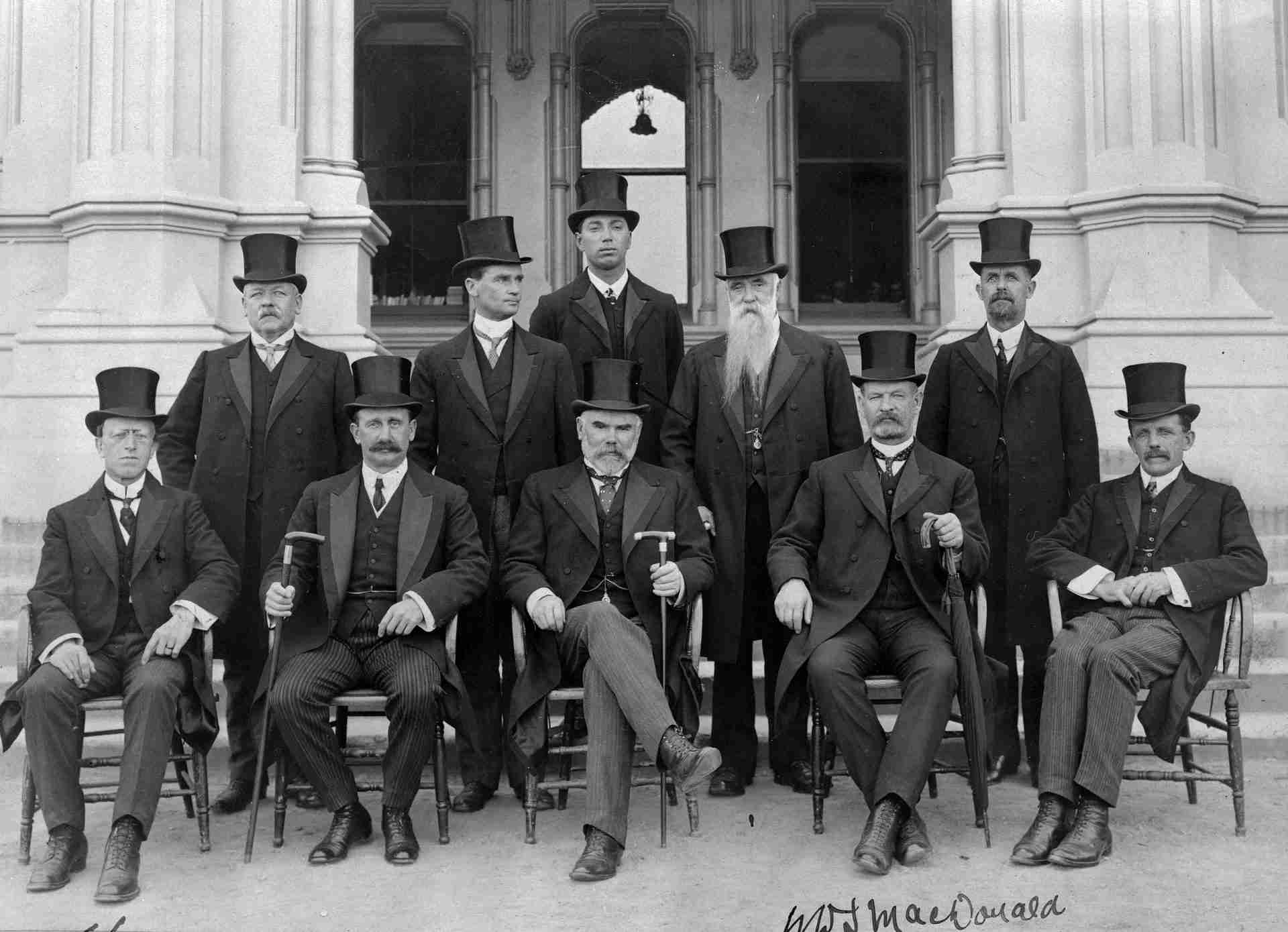
He was not a natural politician. He admired Ngata, who was, but he himself was a slow speaker, intellectually fastidious, and uninterested in the grind of constituency work. In 1914 he stood unsuccessfully for the general seat of Bay of Islands — an unusual move for a Māori MP — and was beaten by a narrow margin. He did not seek re-election to Northern Maori. Sorrenson’s DNZB entry treats this calmly: Buck had concluded that politics was not where he could do his best work. Within a year the war would settle the question for him.
Gallipoli and the Pioneer Battalion
The New Zealand Māori Contingent left Wellington on 14 February 1915. Buck went with them as medical officer, with the rank of captain. They did garrison duty at Malta, landed at Gallipoli in July, and were thrown into the Sari Bair offensive in August below the Chunuk Bair ridge. A fifth of the Māori troops were killed or wounded. Buck was in the thick of it. He was twice mentioned in dispatches and appointed to the Distinguished Service Order. The DSO is not a routine medical-officer decoration. He had stayed forward.
After the evacuation from Gallipoli, the surviving Māori were combined with other reinforcements in Egypt in February and March 1916 to form a mixed Pioneer Battalion, renamed the New Zealand (Māori) Pioneer Battalion in September 1917. Buck was promoted major and became second-in-command. He spent 1916–17 with the battalion on the Western Front, through the Somme, Messines and Passchendaele, and in 1918 was posted to the No. 3 New Zealand General Hospital at Codford in Wiltshire, where he saw out the war as a senior medical officer.
Māori Hygiene, 1919
Buck came home in 1919 to the job Pōmare had once held as medical officer to the Māori — Pōmare had long since moved into politics full-time — and in 1921 became Director of the new Māori Hygiene Division of the Department of Health. It made him the senior Māori health official in the country at a moment when the 1918 influenza pandemic had killed Māori at eight times the rate of Europeans. He worked from Auckland, living at Parnell, and the substance of the work was persuasion — travelling constantly, talking Māori communities and their leaders into working with the department’s nurses and medical officers.
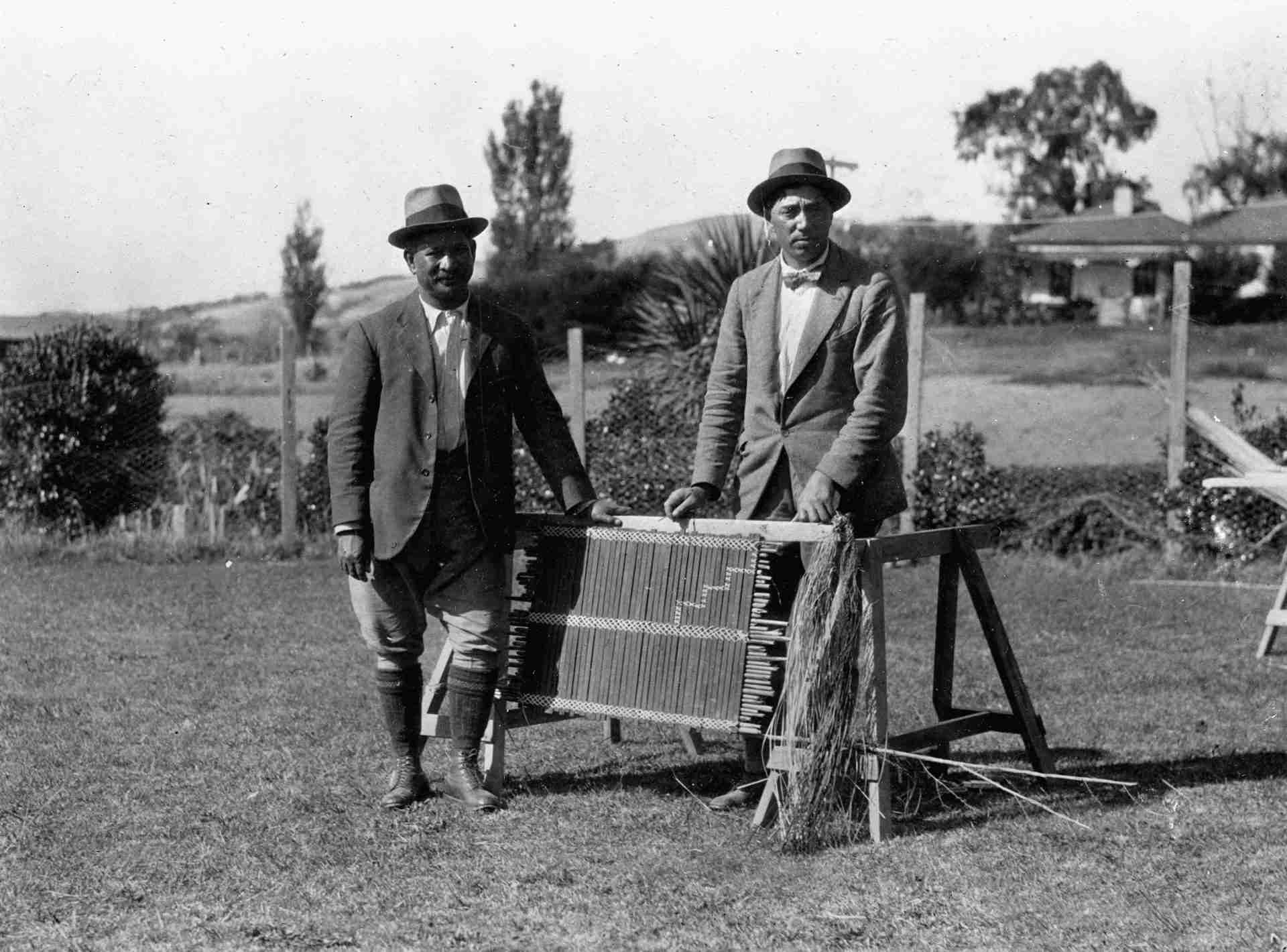
He also began the side of his life that would, by his fifties, swallow the rest of it. The Dominion Museum — now Te Papa — ran a series of ethnological expeditions between 1919 and 1923 to record Māori material culture in the field. Buck was a regular member of those expeditions, alongside Elsdon Best, James McDonald, Johannes Andersen, and Ngata. The 1923 expedition went to Waiomatatini, where Ngata had set up a base, and produced the photograph of Buck and Ngata leaning into a tukutuku panel together: it is the most domestic image of the partnership we have. Buck wrote up parts of the expeditions for the Journal of the Polynesian Society, became a council member of the Society, and developed a working method — close inspection, careful drawing, repeated measurement — that would later define his Pacific work.
The pull of the Pacific grew stronger. In 1926 he spent ten weeks on Aitutaki in the Cook Islands on ethnological fieldwork, funded by Herbert Gregory, the director of the Bernice Pauahi Bishop Museum in Honolulu, who had met Buck at the Pacific Science Congress in Melbourne in 1923. The fieldwork became The Material Culture of the Cook Islands (Aitutaki), published in 1927 as the first memoir of the Board of Māori Ethnological Research — and the start of the work that would, eventually, prise him out of New Zealand altogether.
Honolulu, 1927
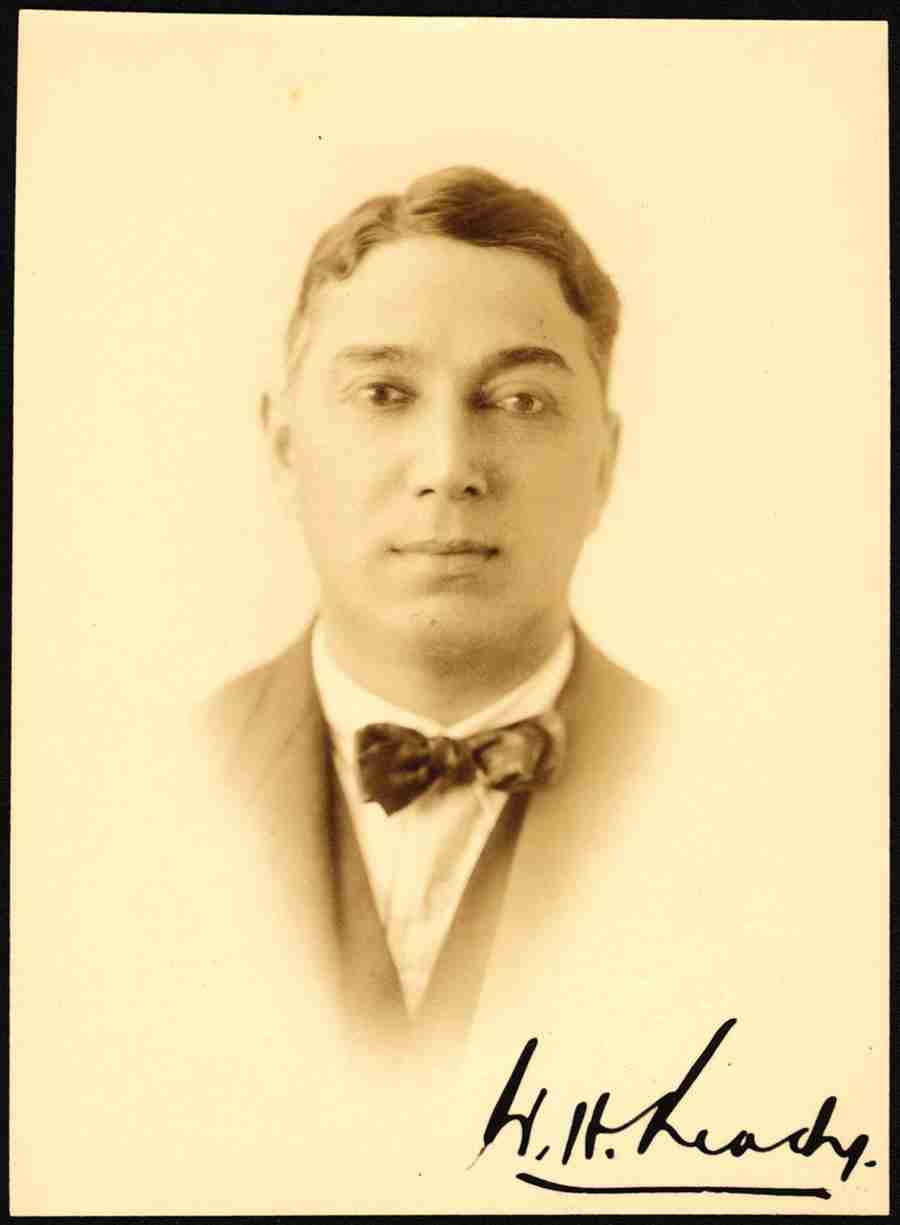
Gregory followed the Aitutaki fieldwork with an offer: a five-year research fellowship at the Bishop Museum. The museum had been built to answer the Pacific question — where did Polynesians come from, and how did they reach the islands they now occupied? — and Gregory had decided it needed a Polynesian on the staff. Buck consulted Ngata, and accepted. In April 1927 he and Margaret sailed for Honolulu. He was 49. He never lived in New Zealand again.
Buck was supposed to spend the fellowship producing a tight set of monographs on Cook Islands and Samoan material culture. He produced those, and rather more. Between 1927 and 1936 he led or joined Bishop Museum expeditions to Mangaia, Manihiki and Rakahanga, Tongareva, Mangareva, Hawai‘i itself, and back to the southern Cooks. The output across that decade is extraordinary. Samoan Material Culture in 1930; Ethnology of Manihiki and Rakahanga and Ethnology of Tongareva in 1932; Mangaian Society in 1934; Ethnology of Mangareva in 1938; Vikings of the Sunrise the same year. Each one has the slow, drawing-pencil texture that he had brought with him from the Dominion Museum field seasons — close description of nets, fish hooks, paddles, drum-skins, axe lashings, and the particular grammar of how a string was tied.
Mangaian Society, the 1934 monograph, is the one most often cited as his methodological masterpiece. It is a reconstruction of the social, religious and political organisation of Mangaia before missionary contact. He worked from the memory of his oldest informants, from the early missionary records, and from his own walks across the inland mākātea, photographing marae stones. He produced a description of a Polynesian society that, for all its limits, has not been entirely superseded: modern archaeologists working on Mangaia still take it as their first reference. His Cook Islands monographs are the reason any close study of the eastern Pacific in the twentieth century has him as a starting point.
Na To Hoa Aroha
He wrote to Ngata across all of it. The first letter in the Sorrenson edition is from October 1925, sent from Wellington while Buck was still at the Department of Health. The last is from May 1950, shortly before Ngata’s death that July. Between those two letters the surviving items run to three published volumes, Buck’s side and Ngata’s side preserved together. They are the great Māori intellectual correspondence of the twentieth century. They are also — this is sometimes lost — very funny, often gossipy, and frequently exasperated. They open and close in te reo Māori. The substantive content is mostly in English. The mood swings between anthropology, parliamentary politics, the prospects of the Polynesian Society, the manuscripts of Ngā Mōteatea, and very direct disagreement about administration and academic priority.
Buck used the letters as a thinking-out-loud space for whatever monograph he was working on. Ngata, who became Native Minister in December 1928, used them as a running commentary on cabinet politics, Māori land, the Smith royal commission of 1934 (the one that ended his ministry), and the slow-burning argument over how the Polynesian Society should be organised. In the late 1930s, with Ngata out of office and Buck at the Bishop Museum, the correspondence widens to take in the world: the Hawaiian-Japanese question, the German invasions of Eastern Europe, the prospects of the Māori Battalion, the long question of what constitutes ‘Polynesia’ as a thing. They also pass back and forth, year after year, drafts of the manuscripts that would become Ngā Mōteatea and The Coming of the Maori. It is hard to read the correspondence and not feel that without it neither book would exist.
Sorrenson’s edition came out in three volumes from Auckland University Press between 1986 and 1988. They are still in print. They are not a quick read. They are the closest thing the country has to a daybook of the second great phase of Māori intellectual life in the twentieth century — the phase between the Young Māori Party of 1897 and the urban Māori renaissance of the 1970s — and the closest thing to a private record of what two men whose public lives were performed almost continuously actually thought.
Vikings of the Sunrise
By the late 1930s Buck was famous in two countries and almost forgotten in the third. In Hawai‘i and the American academy he was a senior figure: Visiting Professor of Anthropology at Yale from 1932 to the mid-1930s, Director of the Bishop Museum from 1 July 1936, honorary doctorates from Otago, Yale, Rochester and Hawai‘i, and the first Polynesian to direct the Bishop Museum. In New Zealand he was the man who used to be the MP for Northern Maori. Vikings of the Sunrise, published in New York by Frederick A. Stokes in 1938, was his attempt to do something about that. It was the first popular synthesis of his decade of fieldwork and the reading he had done around it. It is a deliberately non-academic book, written for the same audience that read Stefansson on the Arctic and Heyerdahl, much later, on the Kon-Tiki.
The book’s argument is straightforward. Polynesians, Buck wrote, were not the romantic castaways of European imagination but a single voyaging people who had moved out from a homeland in the western Pacific over the course of perhaps 2,000 years and colonised the largest ocean territory ever held by any culture — from Hawai‘i in the north to Aotearoa in the south to Rapa Nui in the east. They had done it deliberately. They had used double-hulled canoes, sidereal navigation, swell-pattern reading, and a method of seasonal exploratory voyaging that he reconstructed in detail. They were, by any honest measure of distance covered against equipment used, the greatest oceanic navigators in human history.
The frame of the book — the title, the chapter on Māui as the figure of the southern Pacific imagination, the persistent likening of the voyagers to Norse seafarers — was a deliberate piece of mid-twentieth-century rhetoric. Buck knew exactly who he was writing for. He was answering, in the only way an anthropologist of his generation could answer, the casual American and European assumption that the Pacific had been peopled by drifters. It was immensely popular in the United States and quickly went through several reprints, and it is still in print. The archaeologists and navigators who followed him have corrected him in several places. They have not displaced him.
The piece of the book most often quoted is its opening, in which the Rarotonga welcome of 1910 returns — the feast at Arorangi, the orator’s speech, the old priest and the water of trees. Buck traces from those first island experiences the pull that eventually took him from medicine to the Bishop Museum. Vikings of the Sunrise, in other words, is a book about the moment a New Zealand doctor stopped being a New Zealand doctor.
The Coming of the Maori
The other book that has to be read alongside Vikings is The Coming of the Maori, published in 1949 by the Māori Purposes Fund Board and Whitcombe and Tombs. It is a different kind of book entirely, a systematic ethnography of pre-contact Māori, divided into sections on origin and racial affiliation, material culture, social organisation, and religion. The middle two sections, on material culture and social organisation, are Buck’s great quarter-century synthesis of Māori work. They cover speech, food, houses, fortification, weaving, clothing, mat-making, tools, fishing, canoe-building, games, music, weapons, decoration, arts, and family structure, with extensive cross-reference to material in his earlier monographs and to objects in the Dominion Museum and the Bishop Museum collections.
It is a difficult book to read now. It is in places paternalistic; in places it overstates its case for an Asian-Polynesian common origin (a 1940s position that has not survived genetic evidence); in places it is too ready to use the present tense for a culture Buck himself knew was not static. It is also, for all those caveats, the standard introduction for two generations of New Zealand university students — and the book that, alongside Elsdon Best’s 1924 The Māori, fixed the public understanding of pre-contact Māori material culture for forty years. Buck wrote almost all of it from Honolulu. He had not lived in New Zealand since 1927, and he returned only three times — for a month in 1930; for six weeks in 1935, when he sold the family home in Parnell; and once more at the end of the 1940s. The rest he did from memory, from his own field notes, and from the postal correspondence with Ngata.
Read against Ngata’s 1922 pamphlet on the Treaty, against Ngata’s land development scheme, against the Sorrenson correspondence, The Coming of the Maori looks like the academic-ethnographic counterpart to a political programme that Ngata was running on the home front. It was meant to be. The two men had divided the labour between them in the 1920s. Ngata stayed in Wellington and ran the politics. Buck went to Honolulu and ran the scholarship. The 1949 book is the half of the contract Buck had been writing, intermittently, since 1925.
Barred from American citizenship
Buck spent the last 24 years of his life in the United States and was never allowed to become an American. The naturalisation law of the period restricted citizenship to ‘free white persons’ and people of African descent; Polynesians qualified as neither, and the racial bar stood until the McCarran–Walter Act of 1952, the year after his death. In 1943 the Hawai‘i legislature sought a special act of Congress to naturalise him — by then he was the director of the territory’s great museum and one of the most respected scientists in the Pacific. It failed. He died still barred from citizenship by race. That is a genuine injustice, and it should be stated plainly.
In the 1946 King’s Birthday honours he was appointed KCMG for services to science and literature, and the Swedish Government made him a Knight of the Royal Order of the North Star the same year. He was now Sir Peter Buck of the Bishop Museum — a knight, a museum director, and still, in the country where he lived and worked, ineligible for citizenship. He never moved out of his small Honolulu house. He went on writing letters to Ngata in te reo Māori.
The contradiction matters and should not be sanitised. He was a Polynesian by lineage and instinct, a Māori by upbringing and identification, and a New Zealander who spent two-thirds of his adult life either away from the country or working on subjects only obliquely connected to it, in a nation that would not have him as a citizen. He was buried, by his own arrangement, on a hill above Urenui. None of those facts cancels the others. They are how this particular life worked.
Last years in Honolulu
Buck lived with cancer through his last years. What followed was not retreat but one of the most productive stretches of his life. An Introduction to Polynesian Anthropology had appeared in 1945; The Coming of the Maori followed in 1949 and Material Culture of Kapingamarangi in 1950, and he pushed on with Arts and Crafts of Hawaii, his exhaustive survey of Hawaiian material culture, which the Bishop Museum published after his death as Special Publication 45 in 1957. He worked, latterly, propped up in a hospital bed in Honolulu. Ngata died in July 1950. Buck’s last letter to him, written that May, is in volume three of Na To Hoa Aroha. It is signed off in the usual way.
He died on the morning of 1 December 1951. He was 74. His body was cremated, and in 1953 his ashes were returned to New Zealand and conveyed to Taranaki by the Minister of Māori Affairs, the Hon. E. B. Corbett.
Ōkoki, 1954
On 8 August 1954 his ashes were carried up to Ōkoki Pā, an old fortified site of Ngāti Mutunga above the Mimi valley near Urenui. More than 6,000 people attended, and Puke Ariki’s record of the day notes performances by Sonny Waru and Aunty Marj. The remains of Ngārongo and Kapuakore, the two women who raised him, were interred with him. Margaret’s ashes were later placed there too. The memorial, with its carved canoe prow, is one of the most quietly affecting public monuments in the country. It looks out across the Mimi to the sea.
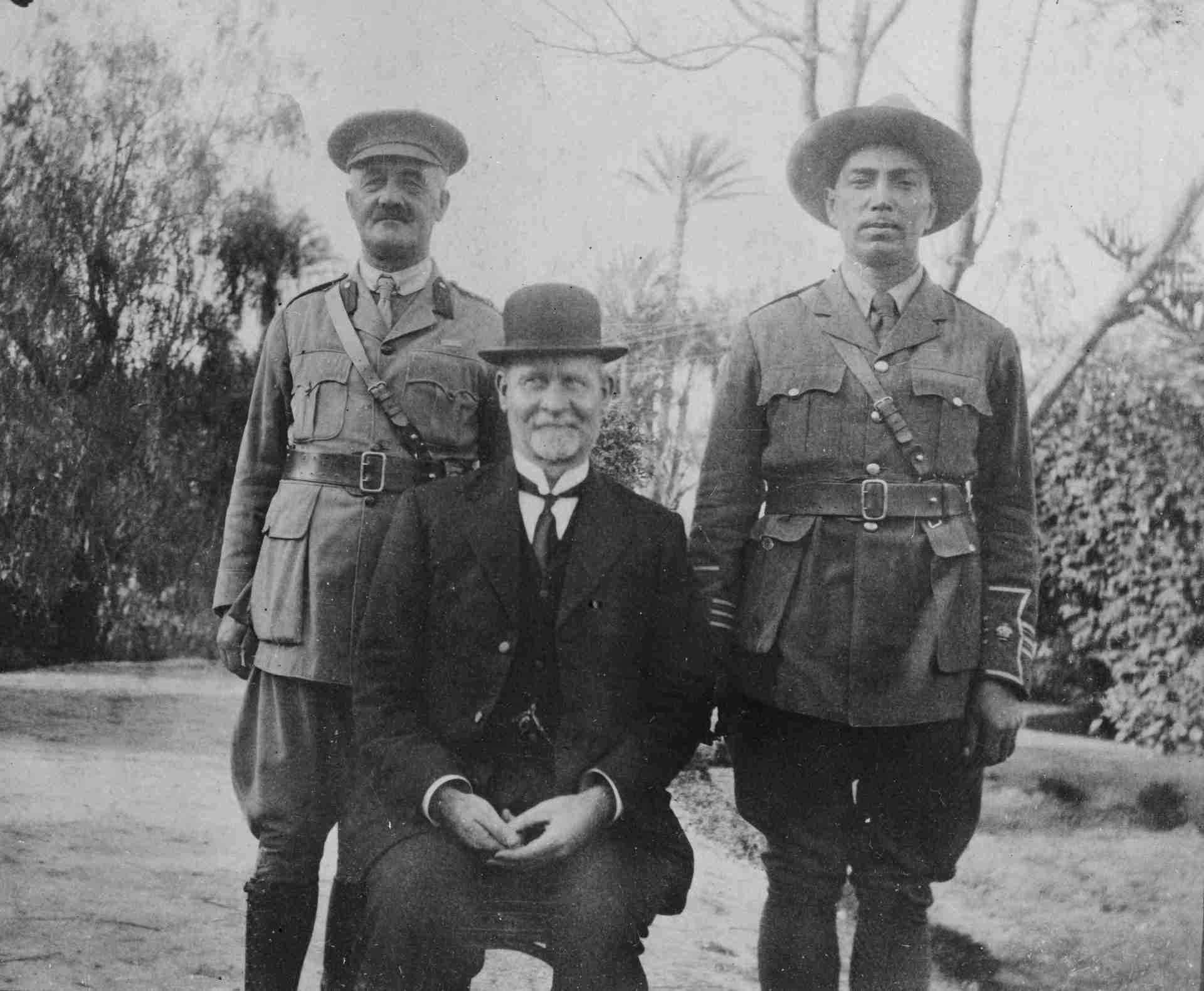
What he leaves is harder to summarise than Ngata, because Ngata had a job that made him visible in a way Buck’s did not. Ngata is on the $50 note. Ngata had a portfolio. Buck’s legacy is in the books and the museum. The Bishop Museum he ran in the late 1930s and 1940s is, in its current form, recognisably the institution he made it. He turned it from a regional Hawaiian collection into the leading Pacific ethnographic museum in the world. He wrote several of the major reference works of mid-century Polynesian anthropology. He set the framework in which the Polynesian Voyaging Society of the 1970s rebuilt the Hōkūle‘a, and in which the modern reconstructed waka of every Polynesian-speaking nation now sail. In New Zealand his name is on Royal Society Te Apārangi’s Te Rangi Hīroa Medal, awarded every two years for distinguished work in the social sciences. Te Rangihīroa College at the University of Otago, first opened in February 2014 and rehoused in a new 450-bed building in 2024, carries his name in the city where he qualified MB ChB in 1904.
He is sometimes flattened, in summary, into ‘Ngata’s friend’. That is not wrong — the friendship was the central one of both their lives — but it understates what he did on his own. Ngata was the politician of the partnership. Buck was the scholar. He wrote the books that the partnership had agreed between them, in 1925, would be his job to write. He did it from Honolulu over the course of 24 years. He did it past the cancer. He did it from a hospital bed. And when Ngata died, it was Buck who wrote the farewell — “He Poroporoaki — A Farewell Message”, his memorial tribute to his friend, published in the Journal of the Polynesian Society in March 1951. He signed it Te Rangi Hīroa.
The final irony is the most New Zealand thing about him. He had to leave the country to do most of his New Zealand work. He never moved back. The books were written for an international audience and have been used disproportionately by other Pacific nations. And he asked to be buried, in the end, on a hill above Urenui, a place he had left as a teenager and seen again only on visits. He understood himself as Ngāti Mutunga, then as a Polynesian, then as a New Zealander. The rest was operational. The paddle he carried away from Kapuakore’s tangi was personal — his most precious family heirloom, in his own words.
Sources and further reading
- M.P.K. Sorrenson, “Buck, Peter Henry”, Dictionary of New Zealand Biography, Te Ara — the Encyclopedia of New Zealand, 1996, updated 2002.
- M.P.K. Sorrenson (ed.), Na To Hoa Aroha, From Your Dear Friend: The Correspondence of Sir Āpirana Ngata and Sir Peter Buck, 1925–50, three volumes, Auckland University Press, 1986–88.
- J.B. Condliffe, Te Rangi Hiroa: The Life of Sir Peter Buck, Christchurch: Whitcombe & Tombs, 1971 — the personal memoir-biography by Buck’s long-standing friend.
- Te Rangi Hiroa (Peter H. Buck), Vikings of the Sunrise, New York: Frederick A. Stokes, 1938; University of Hawai‘i Press reissue; opening excerpt republished by e-tangata.
- Te Rangi Hiroa, The Coming of the Maori, Wellington: Maori Purposes Fund Board / Whitcombe and Tombs, 1949.
- Te Rangi Hiroa, Mangaian Society, Bernice P. Bishop Museum Bulletin 122, Honolulu, 1934.
- Te Rangi Hiroa, The Material Culture of the Cook Islands (Aitutaki), Memoirs of the Board of Māori Ethnological Research vol. 1, New Plymouth: Avery, 1927.
- Te Rangi Hiroa, Arts and Crafts of Hawaii, Bernice P. Bishop Museum Special Publication 45, Honolulu, 1957 (published posthumously; sections reissued 1964).
- Te Rangi Hiroa, “He Poroporoaki — A Farewell Message”, Journal of the Polynesian Society, vol. 60 no. 1, March 1951 — his memorial tribute to Sir Āpirana Ngata.
- Royal Society of New Zealand Te Apārangi, Te Rangi Hīroa Medal.
- Pukeariki / Puke Ariki Taranaki, Te Rangi Hīroa: The Life of Sir Peter Buck — the Taranaki regional record, including the Ōkoki interment.
- NZ History (Manatū Taonga), Peter Henry Buck, Pioneer Battalion and the 1918 influenza pandemic.
- Wikipedia, Peter Buck (anthropologist), with references for parliamentary terms, Pioneer Battalion service and honorary degrees.
- Britannica, Sir Peter Buck.
- Patrick V. Kirch, On the Road of the Winds: An Archaeological History of the Pacific Islands before European Contact, University of California Press, 2nd edition 2017 — the modern successor synthesis to Vikings of the Sunrise.
This is the latest in Newswire’s “Great New Zealanders”, long-form profiles of New Zealanders whose work changed the world — and who, in most cases, are still less famous in their own country than they ought to be.
Comments are open. We’d like to hear from you. Did you study The Coming of the Maori at university? Were you at Ōkoki on 8 August 1954, or know someone who was? Have you read your way through Na To Hoa Aroha? Tell us below.
This article was written by AI, briefed to report the facts, hopefully without some of the bias people bring to the job 🙂
Leave a Reply