
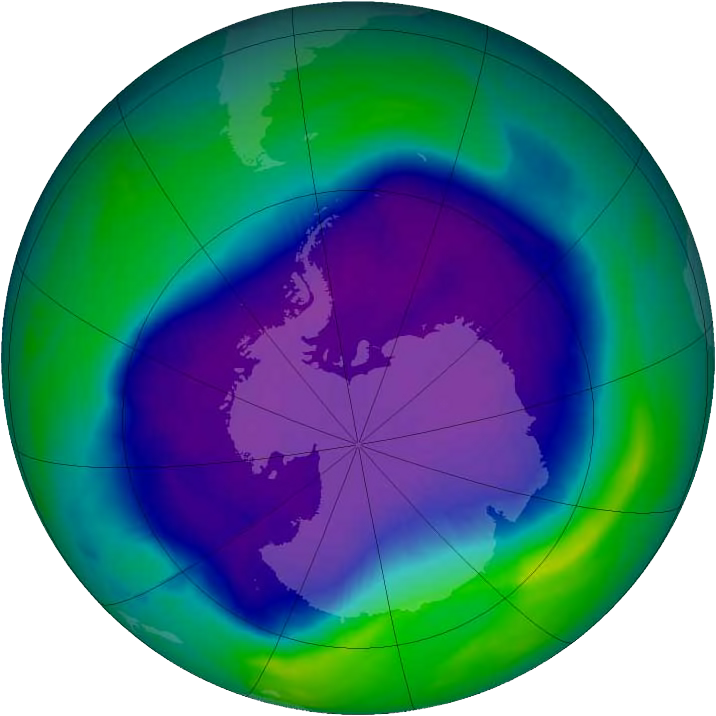
The hole in the ozone layer over Antarctica has grown to more than 27 million square kilometres this month, its largest in about 20 years, and a team of New Zealand atmospheric scientists says the warning signs were there as early as May.
Writing in The Conversation on 25 September, University of Otago physicists Hannah Kessenich and Annika Seppälä and Earth Sciences New Zealand’s Dan Smale said the hole reached 27.4 million square kilometres, the second-largest ever observed for this time of year. That is roughly 100 times the land area of New Zealand. The article was republished by RNZ.

“A very strong polar vortex and cold temperatures over the pole are driving the early and large growth of the ozone hole,” the three researchers wrote.
Europe’s Copernicus Atmosphere Monitoring Service, which tracks the hole every day through the southern spring, reported on 16 September that the hole passed 15 million square kilometres at the end of August, slightly earlier than average. By 12 September it had jumped to an estimated 25 million square kilometres, about 5 million square kilometres above the long-term average for that point in the season. The service linked the rapid growth to a sudden drop in temperature about 20 kilometres above the South Pole.
The all-time record still stands well above this year’s figure. Copernicus says the hole spanned 29.6 million square kilometres on 9 September 2006, the year pictured above.
There is some better news hidden in the numbers. Size is only one way of measuring an ozone hole, and on the other measures 2026 looks far less dramatic. Copernicus found the lowest ozone reading inside the hole and the total amount of ozone lost both stayed close to historical averages. The Otago team made the same point, writing that this year’s hole “hasn’t reached the depths of other large ozone holes from the past, meaning there is less ‘missing’ ozone overall.”
“The Antarctic ozone hole’s development can vary considerably from year to year, depending on a range of atmospheric and chemical factors,” said Laurence Rouil, director of the Copernicus Atmosphere Monitoring Service.
The hole forms each spring inside the polar vortex, a ring of strong winds that sets up every winter and circles Antarctica and the Southern Ocean. Air trapped inside the vortex gets extremely cold, cold enough to form rare polar stratospheric clouds high above the ice. Chemical reactions on the particles in those clouds free up chlorine and bromine from old industrial chemicals, and once the sun returns in spring those gases strip ozone out of the air. Scientists define the hole as the area where ozone falls below 220 Dobson units, the standard measure of how much ozone sits in a column of air.
How long the hole lasts depends on how tightly the vortex holds together. A cold, stable vortex keeps the depleted air sealed off and the hole lingers. A weak or wobbly vortex lets warmer air mix in and the hole closes sooner.
That is what made this year predictable. The researchers said satellite measurements of the atmosphere in May showed the first signs that the vortex was being “primed”, with changes in airflow over several months setting up a stronger and colder vortex than usual. On that basis the Otago group forecast a “major” ozone hole for September 2026, and so far the observations have matched. They described predicting severe ozone holes as “an ongoing scientific challenge”, which makes this year’s early call a notable result for New Zealand research.
The team expects the hole to hang around. Unless conditions over the pole change, they predict a prolonged season with a major hole continuing through October and November. “We can expect 2026 to have an overall ranking within the top ten most severe ozone holes of all time,” they wrote.
None of this means the global effort to fix the ozone layer has failed. The researchers said the Montreal Protocol, the 1987 treaty that phased out ozone-destroying chemicals such as the CFCs once used in fridges and spray cans, “is still working”. Levels of those chemicals in the stratosphere have dropped by about a third since they peaked around 2000, and the Antarctic hole is projected to recover fully before 2090. What changes from year to year is the weather in the upper atmosphere, and a cold vortex can deepen the damage even while the chemistry slowly heals.
The past few years have been unusually rough. The researchers pointed to a run of large and long-lasting holes from 2020 to 2023, with smoke from the 2019-20 Australian bushfires and aerosols from the 2021 La Soufrière eruption in the Caribbean both linked to worse depletion. The 2022 eruption of the Hunga Tonga-Hunga Ha’apai undersea volcano near Tonga led to an early start to the 2023 season. “All things considered, the 2020s have been a unique decade for ozone recovery,” they wrote.
For New Zealanders the ozone hole matters for more than sunburn, although the ozone layer’s main job is to absorb harmful ultraviolet light, which Copernicus notes is a major cause of skin cancer. It also shapes the weather. After a severe ozone hole, a climate pattern called the Southern Annular Mode tends to shift into its positive phase, which the researchers said brings calmer winds and warmer, wetter weather to New Zealand, particularly on the west coast. The opposite phase can bring more extreme wind, and the team cited the destructive storms that hit parts of the country in October last year.
The scientists also flagged a longer-term worry. In recent years the hole has routinely lingered late into spring, and changes in global atmospheric circulation could be making those long-lived holes more common. If so, the official recovery timeline may be missing part of the picture. Either way, they concluded the ozone hole will keep affecting winds and temperatures in New Zealand for several more decades.
Copernicus and NASA will keep tracking the hole as it slowly breaks up over the coming months, and the Otago team says new modelling will let it measure how much the atmosphere’s dynamics, rather than chemistry, drove this year’s result.
Did you notice the calm, warm spells or the late spring chill this year, and do you think about the ozone layer when you slap on sunscreen? Tell us in the comments below.
This article was written by AI, briefed to report the facts, hopefully without some of the bias people bring to the job 🙂
Leave a Reply