
The thing to picture, before any of the rest of it, is the first morning.
It is Friday 8 November 1985 at the Brisbane Cricket Ground – the Gabba. New Zealand have won the toss and put Australia in. This is their seventh attempt at a Test win in Australia, twelve years after they first played a Test on Australian soil, and the man measuring out his mark is a 34-year-old Cantabrian at the height of his powers.

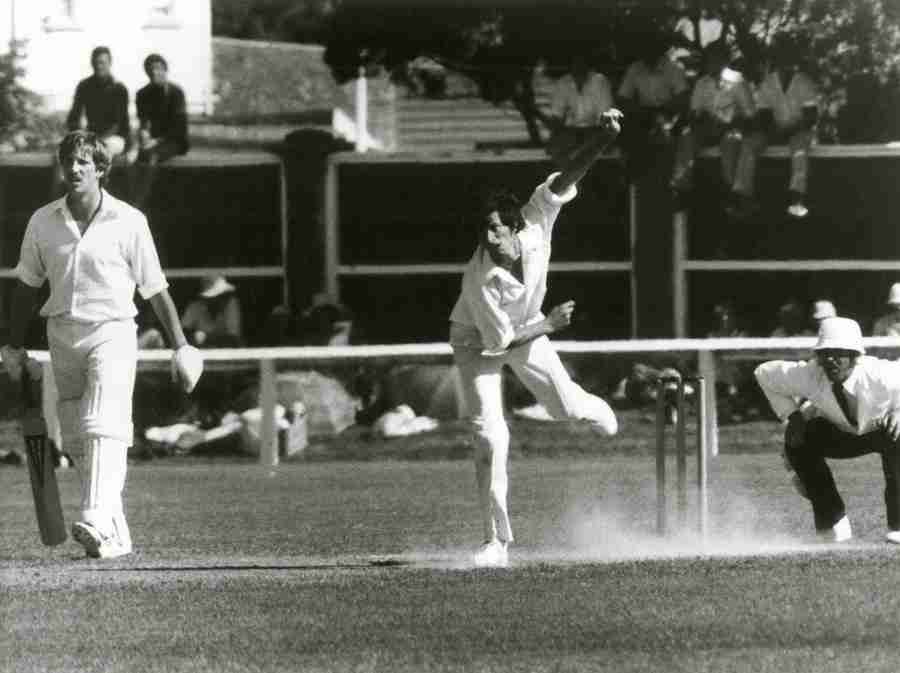
Richard Hadlee’s first wicket set the tone for everything that followed. Andrew Hilditch, the Australian opener and a compulsive hooker, took on the short ball and was caught by Ewen Chatfield of Naenae at deep square leg. By the time the innings ended early on the second day – the first had closed at 146 for four in bad light – Australia were 179 all out and Hadlee had taken nine for 52 from 23.4 overs.
Twenty-nine years after Jim Laker’s nineteen wickets at Old Trafford, it remains the most discussed single bowling performance any New Zealander has ever given. Hadlee took six for 71 in the second innings for a match haul of fifteen for 123, and Australia were beaten by an innings and 41 runs. New Zealand went on to seal the series 2-1 at Perth on 4 December 1985 – the first Test victory, and the first series victory, ever achieved by a New Zealand side in Australia. It is the moment in which New Zealand cricket grew up.
Hadlee was 34. He had been a Test cricketer for twelve and a half years and had four and a half years still to go. He would take his 400th Test wicket at Lancaster Park, take a wicket with the very last ball he bowled in Test cricket, be knighted while still a playing Test cricketer, have heart surgery at 40, serve New Zealand cricket as Selection Manager and board member, stand behind a sports trust for young Cantabrians for thirty years, recover from bowel cancer at 66, and arrive at his mid-seventies – he turned 75 in July – as the most decorated ex-cricketer this country has produced.
This is the longer story.
St Albans, and the family of cricketers
Richard John Hadlee was born on 3 July 1951 in the St Albans suburb of Christchurch, the fourth of five sons of Walter and Lilla Hadlee. Walter was already a famous man – he had captained New Zealand on the 1949 tour of England, a celebrated tour on which all four Tests were drawn, and he went on to give decades of service to the administration of the game, chairing New Zealand cricket’s governing body from 1973 to 1978.
Three of the five sons would represent New Zealand, though only two played Tests. Dayle was a fast-medium bowler who took 71 Test wickets across the 1970s – a useful and underrated career in the shadow of his youngest playing brother. Barry opened the batting in one-day internationals, including the inaugural World Cup in 1975. Richard, by some distance the most gifted, was the one who would carry the family name around the world.
The Hadlee household of the 1950s and 1960s was a cricket household in the way that other Christchurch households were rugby households, with older brothers to bowl at and a father who talked the game over the breakfast table. The nickname Paddles, which he carried for the rest of his life, was earned at Heaton Intermediate and referred to his disproportionately large feet. He went on to Christchurch Boys’ High School, where Walter had been a pupil a generation earlier.
He made his first-class debut for Canterbury in the 1971-72 season. The Test cap followed – on 2 February 1973, against Pakistan at the Basin Reserve in Wellington, the same ground his father had played his last Test on twenty-two years earlier. He took two for 84 in Pakistan’s first innings and scored a lively 46. He was twenty-one. He had not yet, by his own assessment in Rhythm and Swing sixteen years later, learned to bowl.
A long run-up, and a young man in a hurry
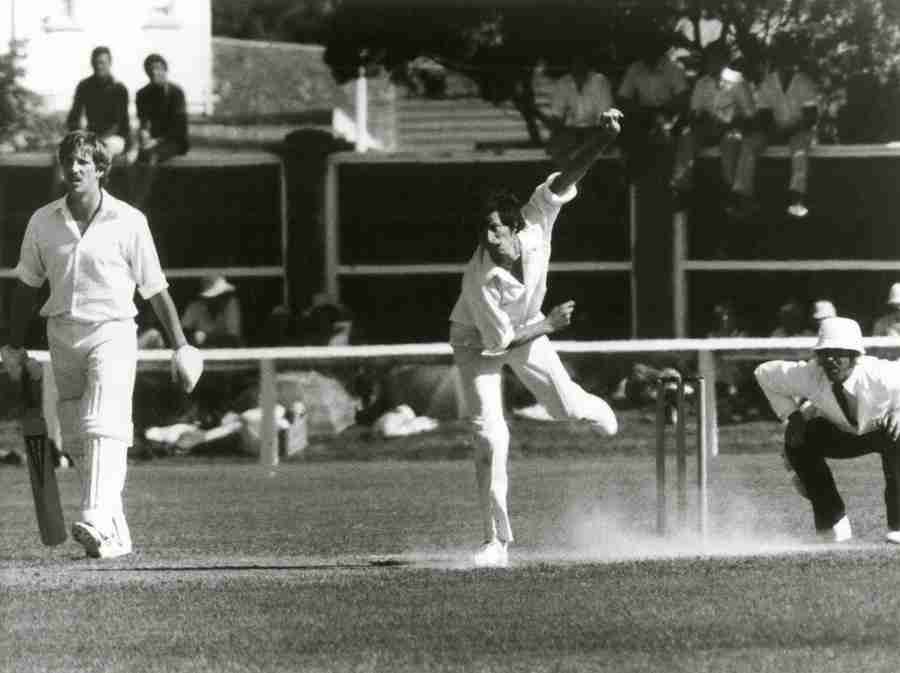
The Hadlee of the early and middle seventies is now a slightly forgotten figure even in the cricket histories. He was tall, ran in off a long approach, and bowled genuinely fast. He swung the new ball both ways. Control was unreliable. The body broke down regularly – the way bodies that bowl off long approaches do.
He took 11 for 58 against India at Wellington in February 1976 – four for 35 and seven for 23 – his career-best at the time; four years later he would better it with 11 for 102 against the West Indies at Dunedin. He was also – the trait those who played alongside him invariably mentioned first – relentless. He kept a notebook. He marked the Test innings he bowled, the wickets, the batsmen, the dismissals and the conditions, and went back over it all in the way a chartered accountant goes back over a year-end ledger. His father, the accountant, had shown him the value of that.
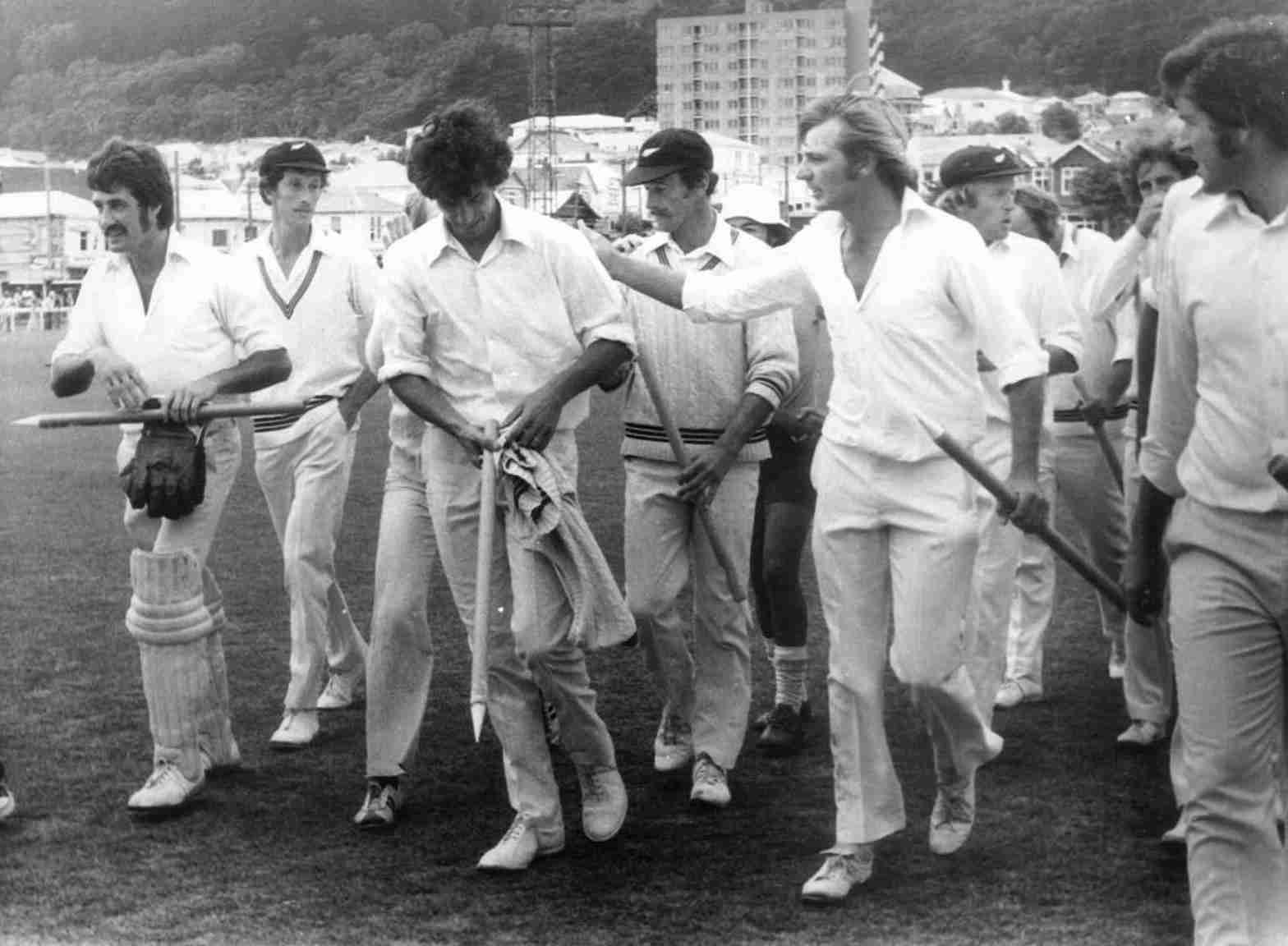
In February 1978, Hadlee was 26 and bowling at the Basin Reserve in a Test against an England side captained by Geoff Boycott, the regular captain Mike Brearley having gone home injured. New Zealand had played England 47 times since the two countries first met in 1930 without a single win. England were chasing 137 on the final day. Hadlee took six for 26 in 13.3 overs, dismissing Roope, Botham, Old, Edmonds, Hendrick and Willis, while Richard Collinge bowled Boycott for 1, and England were all out for 64. The first New Zealand Test win against England, at the 48th attempt, came on 15 February 1978.
Trent Bridge, 1978 to 1987
The contract that changed his career came in the same English summer. Nottinghamshire had not won a county championship since 1929. They had signed the South African all-rounder Clive Rice, and in 1978 they signed the New Zealander to bowl alongside him. Hadlee would represent Nottinghamshire across ten summers from 1978 to 1987, though only three of them as full seasons around his international commitments – he even announced his retirement from county cricket in 1980, after three seasons, before thinking better of it and returning. He also spent a single Australian season with Tasmania, in 1979-80.
His fourth Notts summer, 1981, was the year the championship came home. Hadlee took 105 first-class wickets at 14.89, and the combination of Rice and Hadlee carried Nottinghamshire to the title for the first time in 52 years. Hadlee was named one of Wisden’s Cricketers of the Year in the 1982 Almanack. Trent Bridge would not, before he left it in 1987, be the same county again.
The 1984 Nottinghamshire summer was the apex. He took 117 wickets at 14.05 and scored 1,179 runs at 51.26 – the first English county-season double of a thousand runs and a hundred wickets since Fred Titmus in 1967. Only one player has done it since, and fittingly he was another Nottinghamshire all-rounder, Franklyn Stephenson, in 1988. A championship season then ran to 24 three-day matches plus the one-day competitions; to finish with the season’s best bowling and a batting average above fifty, in the same summer, required a stamina that was unusual then and has scarcely been matched since.
He went home in 1987 with two county championships – the second won in that final summer of 1987 – and a friendship with Rice that lasted both their careers and beyond.
The run-up shortens
The most important professional decision Hadlee ever made was the one nobody outside the dressing-room agreed with at the time. By late 1980 the body had given way repeatedly, the bowling average was creeping upwards, and he was 29. He had been bowling off a long run since he was a teenager.
The example he had been studying for years was the Australian fast bowler Dennis Lillee. Lillee, a few years older and rebuilt after a career-threatening stress-fracture lay-off, had returned to international cricket off a noticeably shorter approach than the one he had used in the early seventies, and was bowling, in his second career, with more accuracy and more late movement than he had managed in his first. What would Lillee do became the question Hadlee asked himself at the top of his mark. He decided that what Lillee would do was come in shorter.
The change, made in late 1980, cut the approach dramatically. The first reactions were hostile. New Zealand journalists complained that he had given up the pace that had won him his early Test wickets, and the senior cricket writer Don Cameron delivered the jibe – preserved in the Wisden Almanack tribute – about the country’s heaviest artillery now operating off a “pop-gun run-up”.
What the shortening actually achieved is worth describing in plain English, because it is the technical hinge on which the rest of his career swings. The wrist position at delivery is what makes the seam stand up to swing the ball one way or the other, or grip the pitch and cut. A tired bowler loses the wrist first, and a bowler off a marathon approach tires early. Off the shorter run Hadlee conceded a little pace and gained everything else. The body lasted the day. The action repeated reliably ball after ball. The wrist stayed upright hour after hour, and the over became a continuous tactical conversation rather than a sequence of separate exertions.
He kept a small set of core deliveries. The stock ball was the out-swinger pitched on or just outside off stump – the ball that drifted away from a right-hander’s bat after pitching, asking the batsman to chase or to leave. The leg-cutter, hardened on the Nottinghamshire pitches, became his lethal change-up – the seam, angled slightly across the line, gripped the surface and the ball jagged back into the right-hander. He bowled, less often, an in-swinger at the stumps; very rarely, a yorker; and, as the years went by, a slower ball floated at the splice of a batsman beginning to relax.
The change of method carried his Test bowling average down to 22.29 over an 86-Test career. He took five wickets in an innings 36 times, ten wickets in a match nine times, and finished with 431 Test wickets – the first bowler in the history of the game to reach 400. The figure of 431 has been passed by many bowlers since. The shortened run-up is the reason there was a figure like it at all.
The Gabba, November 1985
The first day went almost exactly as New Zealand would have scripted it. After Hilditch hooked Hadlee to Chatfield at deep square leg, the second wicket fell at 70, and the wickets kept coming – Greg Ritchie caught by Martin Crowe off Hadlee among them – until bad light closed the day at 146 for four. Australia lasted only a little longer on the second morning, all out 179, Hadlee nine for 52.
The tenth wicket is the detail that tells you most about the man. With nine down, Geoff Lawson, batting at eight, lofted the off-spinner Vaughan Brown – playing his first Test – and Hadlee ran round to take the catch himself. It gave the debutant his only Test wicket, and it gave up Hadlee’s own shot at all ten in an innings.
New Zealand replied with 553 for seven declared. Martin Crowe made 188 of the most controlled Test runs of his career – the innings is, in retrospect, the moment Crowe became the world-class number three he was for the next eight years. John F. Reid, batting at three behind the openers Bruce Edgar and John Wright, made 108. Hadlee, batting at eight, scored 54 from 45 balls. Australia, 374 in arrears, had to bat again to save the match, and could not. Hadlee took six for 71. The match figures were fifteen for 123, and the margin an innings and 41 runs.
The second Test in Sydney was lost. The third, at Perth, was won by six wickets on 4 December 1985, and New Zealand had won a series in Australia for the first time. Hadlee took 33 wickets across the three Tests at an average of about 12. Hilditch, the man who hooked, was dropped after Brisbane and never played Test cricket again.
Hadlee’s own account of Brisbane is uncharacteristically untechnical. “This was a freak happening… I swear the ball talked throughout that innings; I’ve never seen a ball behave and respond the way that one did,” he recalled. He left it at that. The notebook, presumably, said more.
Teammates and captains
The New Zealand teams of 1985 to 1989 were not, at any point, a settled group of friends. They were a working partnership of half a dozen exceptional players who did not always agree, under Jeremy Coney, who had taken the captaincy from Geoff Howarth in late 1984. Elite professional sides survive on exactly that kind of friction, and this one very nearly did not, in March 1987.
The setting was Lancaster Park, Christchurch, and the third Test against a West Indies side whose attack read Marshall, Garner, Holding and Walsh, played from 12 to 15 March 1987. By then Hadlee and Coney had fallen out, and for that match the two men communicated on the field through John Wright at mid-on. Wright, the unflappable opener, took messages from one to the other and made no comment.
The rift was patched up, though the relationship was never warm – in Rhythm and Swing Hadlee allowed himself a single line of reservation, that Coney as captain had seemed to operate by remote control. The disagreement, in retrospect, looks less like a personality clash and more like the unavoidable friction between a captain whose job was to bring eleven men through five days and a strike bowler whose job was to take ten wickets in a match. They produced, together, the best three years of New Zealand cricket the country had ever had.
Lancaster Park, 4 February 1990
The 400th came at home. New Zealand were playing India at Lancaster Park, a short drive from the St Albans streets Hadlee had grown up in, when he bowled Sanjay Manjrekar for 4 – off just four balls – on 4 February 1990 to become the first bowler in the history of Test cricket to reach 400 wickets. A contingent of Christchurch Boys’ High School old boys in the crowd sang the school song. The Manjrekar dismissal, 4 February 1990, the 400th Test wicket.
He had passed Ian Botham’s world record of 373 wickets in November 1988, taking his 374th against India at Bangalore on 12 November, in rather less ceremonial circumstances. The 1990 Wisden Almanack, paying tribute, delivered the verdict that has followed him ever since – that he was the most intelligent fast bowler the world had seen.
Edgbaston, July 1990
The retirement was announced in Wellington in March 1990, after the one-off Test against Australia there, with one final tour of England still to come. The knighthood was announced in the June 1990 Queen’s Birthday Honours, days before the second Test at Lord’s, with the investiture to follow that October. He was the first New Zealand cricketer to receive a knighthood, and the first cricketer anywhere to be knighted for his playing deeds while still an active Test cricketer – Sir Donald Bradman’s knighthood had come in 1949, after his career ended. Hadlee liked to joke that he was the first bowler to receive a knighthood since Sir Francis Drake – a line that became part of the Hadlee public persona over the next thirty years.
The first two Tests of that 1990 series were drawn, and the third, at Edgbaston, was the one England won to take the series 1-0. It gave Hadlee’s career the ending a scriptwriter would have rejected as too neat. In England’s first innings of 435 he bowled the number eleven Devon Malcolm for a duck amid general laughter – the Wisden tribute records that even umpire Holder was laughing – as Malcolm, a right-hander whose reputation rested on anything but his batting, swung mightily and missed.
Then, with the very last ball he ever bowled in Test cricket, Hadlee trapped Malcolm lbw for another duck to end England’s second innings at 158. It completed figures of five for 53 – a five-wicket bag in his final innings, and a wicket with his final delivery. No fast bowler has ever signed off more precisely.
Life after cricket
About six months after retiring, Hadlee was diagnosed with Wolff-Parkinson-White syndrome, a congenital fault in the heart’s electrical conduction system, and in July 1991, shortly after turning 40, he underwent heart surgery. The procedure was successful.
The adjustment to life after cricket was real, and he has written about it candidly himself. It was not the first time he had rebuilt. In 1983, mid-career, he had come close to breakdown under the sheer accumulated load of year-round cricket, and – as the Wisden tribute records – the management consultant Grahame Felton helped him rebuild his approach to the game and to the life around it; the mature, methodical Hadlee of the great years was in part the product of that recovery. The turbulence that followed retirement is covered in his own words in his 2009 memoir Changing Pace, and readers who want that part of the story are best served by hearing it from him.
He had married Karen – née Marsh, and herself a New Zealand international cricketer – on 24 August 1973, and she carried the household through Tasmania, Trent Bridge, Brisbane and the 400th wicket. The marriage ended after twenty-two years. He has been married to Lady Dianne since the late 1990s.
The administrator and the patron
From 2000 to 2008 Hadlee served as New Zealand Cricket’s Selection Manager through the Stephen Fleming era – the years of Daniel Vettori, Brendon McCullum and Shane Bond. His contribution was the long memory and the quiet refusal to panic. He had been there in 1985. He kept perspective.
He sat on the New Zealand Cricket board from 2013 to 2017, the years that took New Zealand to its first World Cup final in 2015.
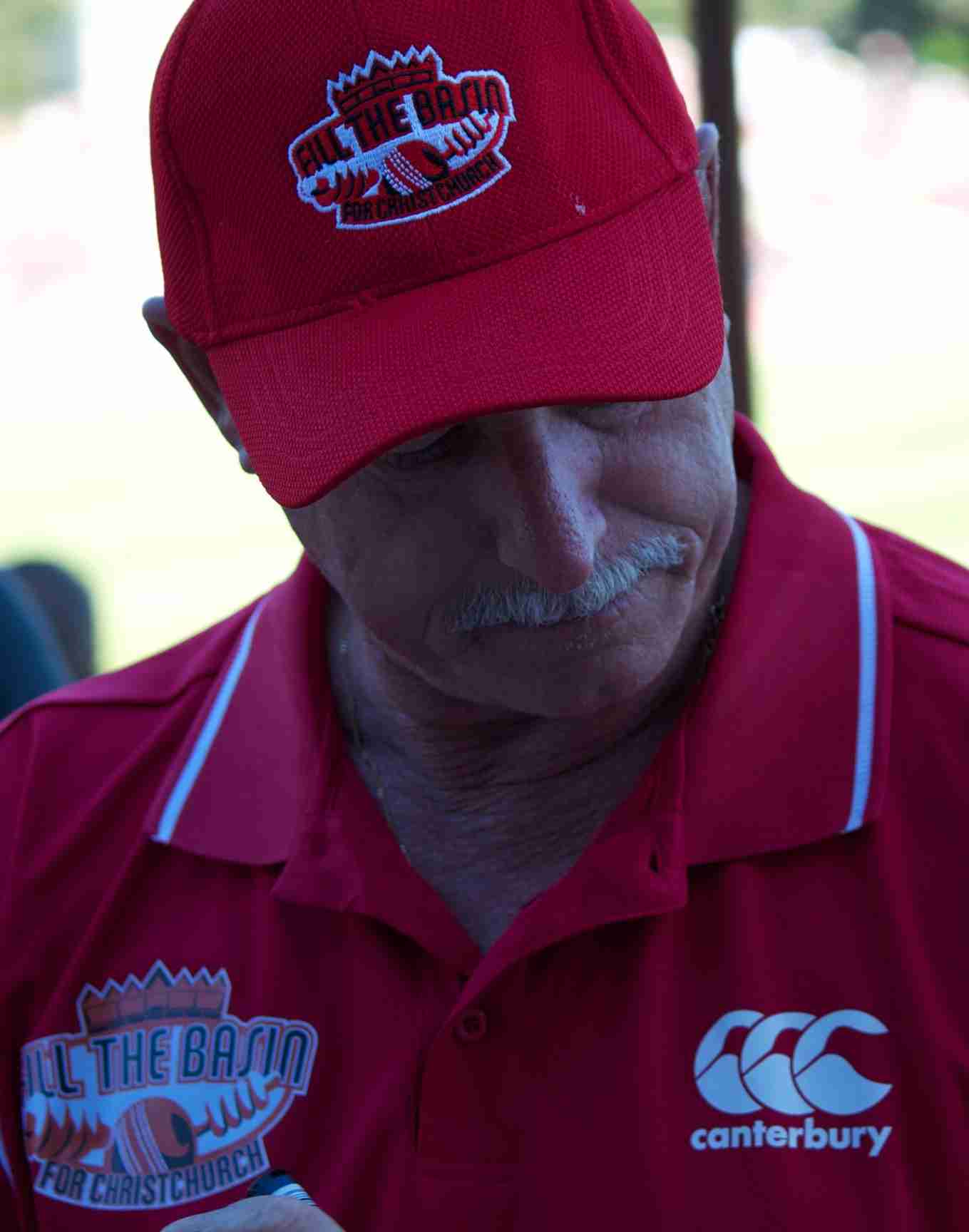
The Sir Richard Hadlee Sports Trust was founded in August 1990, in the immediate afterglow of the playing career, to support young Canterbury sportspeople – not only cricketers, but the long quiet list of provincial athletes for whom a modest grant is the difference between a national tournament entry and a missed season. Hadlee was its patron from 1990 until 2020. Alongside it he has remained one of the most familiar cricket voices in the country, as a commentator, analyst and after-dinner speaker.
Bowel cancer, June 2018, and after
The second major medical event of his post-career life came in June 2018, when he was 66. On 13 June 2018 a statement from Lady Dianne announced that Sir Richard had been diagnosed with bowel cancer, picked up at a routine three-yearly colonoscopy, and had undergone surgery. RNZ carried the announcement on 13 June 2018. On 16 July 2018 a further statement announced that a secondary cancer had been found in his liver, and that he would undergo further surgery.
He came through it. He recovered, returned to public life, and has carried on in the role New Zealand likes him best in – the greatest of its cricketers, present at the big occasions, measured about all of them. He turned 75 in July.
What we ought to remember
The standard New Zealand summary of Sir Richard Hadlee – the line that gets recited at every international cricket broadcast and at every cricket dinner – is that he is the greatest fast bowler New Zealand has produced and one of the very greatest the world has seen. It is convenient. It is true. It is also slightly insufficient.
The bowler of 1985 was the visible proof of a career-long argument the man himself was making with his own profession. The argument was that fast bowling, on the international stage, was not principally a contest of who was fastest or who was angriest; it was a contest of who had thought about it the most. The notebook, the study of Lillee, the leg-cutter rehearsed in Christchurch nets, the shortened approach calibrated to the body of a man in his thirties – all of it was the same argument, made over and over. The most useful unit of work in fast bowling was the over rather than the ball, and the most useful unit of preparation was the season rather than the morning. He was, on the field, the calmest fast bowler of his era. He was that way because he had thought it through.
The other thing worth saying about Hadlee is the family. He was Walter’s son, raised in a household where cricket administration was a half-hour over the breakfast table and where two older brothers wore the silver fern before he did. He kept that household’s cadence for the rest of his life – the Brisbane press conference, the 400th wicket, the investiture at Government House, the cancer announcements – all taken at the same evenness.
It is a useful kind of life for a small country to have produced. He has left a record of 431 wickets that many bowlers have passed since. He has also left, in the bowling averages of every quick who came after him, the demonstration that the upper limit of the craft was higher than anybody outside Christchurch had previously assumed.
The Hilditch hook at the Gabba was the wicket of a man who had thought it through. He thought everything through. He just doesn’t feel any need to talk about it.
Sources and further reading
- Richard Hadlee with Richard Becht, Rhythm and Swing (Moa, 1989) – the central first-person source for the Trent Bridge years, the run-up shortening and the Brisbane Test.
- Sir Richard Hadlee, Changing Pace (Hodder Moa, 2009) – the more reflective second book, written nearly twenty years after retirement; his own account of the transition out of the game.
- Walter Hadlee, The Innings of a Lifetime (Hodder Moa Beckett, 1993) – the father’s autobiography, a useful source for the household, the 1949 tour and the cricket administration of the 1970s.
- Walter Hadlee, The Skipper’s Diary – Walter’s day-by-day diary of the 1949 tour of England, compiled and published by Sir Richard in 2017.
- Wisden, Sir Richard Hadlee – the most intelligent fast bowler the world has seen – the 1990 Wisden Almanack tribute, the canonical assessment of the technical career and the source for the Felton episode, the Cameron jibe and the Edgbaston laughter.
- NZHistory, Richard Hadlee at the Gabba, 1985 – the Ministry for Culture and Heritage’s short summary of the Brisbane innings, with archival footage.
- NZHistory, New Zealand beats England in a cricket Test for the first time – the 15 February 1978 Basin Reserve win.
- ESPNcricinfo, Australia v New Zealand, 1st Test at Brisbane, 8–12 November 1985 – the full scorecard, the source for the match data.
- The Cricket Monthly, Hadlee’s greatest hits – a tactical retrospective on the major Test performances.
- Trent Bridge, Sir Richard Hadlee at Nottinghamshire – the county’s own player profile, source for the 1981 and 1987 county championship details.
- R J Hadlee Promotions, Biography – the official biographical site, with the nickname history and the post-career role list.
- RNZ, Sir Richard Hadlee recovering from cancer surgery – the June 2018 announcement of the bowel cancer diagnosis.
- NZ Herald obituaries page for Walter Hadlee, 30 September 2006 – the obituary of the patriarch, source for the family detail and the 1949 tour record.
- Wikipedia, Richard Hadlee – the encyclopaedic summary, used here for cross-checking dates, the knighthood chronology and the post-cricket career.
A note for readers
This profile is the latest in Newswire’s Great New Zealanders series – long-form portraits of New Zealanders whose work changed the world, and who, in most cases, are still less well understood in their own country than they ought to be. If you have a Hadlee memory of your own – the Lancaster Park morning when the old boys sang the school song, a Trent Bridge afternoon in 1984, a transistor radio tuned to the Gabba in November 1985, or a Sir Richard after-dinner speech in your particular town – we’d love to hear it. Please leave a comment below.
This article was written by AI, briefed to report the facts, hopefully without some of the bias people bring to the job 🙂
Leave a Reply