
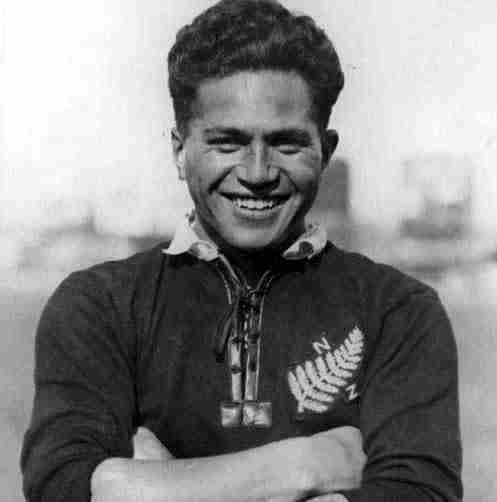
The fourth in Newswire’s Great New Zealanders series. Earlier profiles cover Charles Upham, Jean Batten and Bruce McLaren.
Twickenham, 3 January 1925
Eight minutes into the match, the Welsh referee Albert Freethy blew his whistle, walked over to the New Zealand forward Cyril Brownlie, pointed at the dressing-room tunnel and sent him off. It was the first sending-off in an international rugby match in history. The crowd of around sixty thousand at Twickenham went very quiet. The All Blacks captain Cliff Porter argued, briefly, then accepted it. He turned and looked at his fullback.

The fullback was nineteen years old. He had played every match of this tour, twenty-six of them so far, and now he had to play another one with fourteen men. His name was George Nepia, he was from Nuhaka, and over the next sixty-eight minutes he caught everything kicked at him, tackled the English forwards back into their own half each time they tried to run, and put the ball seventy yards downfield off both feet. New Zealand won 17-11. It was the closest match of the tour. By the end of it the English crowd, who had come to see the Welsh referee finally rein in these colonial show-offs, were applauding the boy at the back.
That was George Nepia at nineteen. He went home in the autumn of 1925 to a country that did not quite know what to do with the fact that its first great rugby superstar was a Maori farm-hand from the East Coast who could not yet vote in a general election in any meaningful sense and would never, in his lifetime, be paid a shilling for any of it.
Nuhaka, before
He was born at Wairoa on 25 April 1905. The birth certificate is firm; later in life Nepia liked to claim 1908, partly because it made the Twickenham match more impressive and partly, one suspects, because by then dates had stopped meaning very much to him. His passport application of 1924 says 1904. His gravestone in Ruatoria says 1903. He was, in any case, very young.
His people on his mother’s side were Ngati Rakaipaaka and Ngati Kahungunu of the Nuhaka and Mahia districts, with kin lines running into Ngati Porou up the coast. His childhood was unsettled. His mother died young, his father remarried, and the boy spent some years with his maternal grandmother near Taihoa marae before drifting back to live with his father and attend the Nuhaka Native School. The household was not happy. Rugby, played barefoot on paddocks behind the school, was the part of the day he looked forward to.
His father, who had higher hopes for him, scraped together fees and put him on a bus to Te Aute College, the Anglican Maori boys’ school in Hawke’s Bay that had produced Apirana Ngata, Maui Pomare and Peter Buck. Nepia got off the bus early. He had heard that the Mormon-run Maori Agricultural College, just outside Hastings, had a strong rugby team and would feed and clothe him in exchange for farm work and schoolwork. He enrolled himself there without telling his father. It was the first wholly independent decision of his life and probably the most consequential.
At the agricultural college his rugby coach was an American Mormon missionary called Elder Erwin Moser, who had played gridiron back home in Utah and could not see why a fullback should be a passive receiver of kicks. Moser taught Nepia two things that would set him apart for the rest of his playing life. The first was the spiral kick – the Americans’ tight, screwing punt that flies further and straighter than the round end-over-end kick the British game then favoured. Nepia would later call his version of it the bullet, and at his peak he could land it on a sixpence fifty metres downfield off either foot. The second was head-on tackling at full speed, eyes open, shoulder to the abdomen, follow-through to the knees. The most important of all the bits that go into a good tackle
, Nepia later wrote, was simply keeping your eyes open. It sounded obvious. In 1924 it was not.
The trial, the boat, and the haka
By 1922 he had moved on to play senior rugby for Hawke’s Bay, then one of the strongest provinces in the country. He played mostly in the backline – second-five, sometimes wing – and was already attracting selectorial attention. He played in a Hawke’s Bay side that won the Ranfurly Shield and held it for most of the next four years. The provincial team that took the field for the 1923 challenge against Wellington had three Maori players in it – Nepia, Jimmy Mill at halfback, and Lui Paewai – which was, for a top-tier New Zealand province in the 1920s, almost unheard of. The Hawke’s Bay public, accustomed to Maori farm-workers but not to Maori sporting heroes, came around quickly. Three thousand of them turned up to see Nepia kick a goal from forty-five metres against Wairarapa one Saturday in July 1923 and stayed to cheer him into the changing rooms.
The 1924 New Zealand trial match between the so-called Probables and Possibles, played at Wellington in front of a packed Athletic Park, was effectively the squad selection for the British tour. Nepia was put at fullback because the fullback who had been first picked, the Wairarapa player Jack Brown, broke down with injury. He played the position as if he had been waiting his whole life to be put there. He was nineteen, weighed eighty-two kilos, stood five foot nine, and the selectors put him on the boat. The chair of selectors, Hauturu native George Mowlem, told a journalist afterwards that he had been worried about Nepia’s age until he watched him take a high ball in the rain off Athletic Park’s south stand. The boy never blinked
, Mowlem said. That was the line that ran in the morning papers. It would, in different forms, run for the next sixty years.
The 1924-25 squad, captained by the Wellington flanker Cliff Porter and managed by the autocratic Stan Dean – later chairman of the NZRFU and the man whose decisions in 1928 would matter most – sailed from Wellington in late July 1924 and reached Plymouth six weeks later by way of Pitcairn Island and the Panama Canal. It was a long crossing. Most of the side were veterans of the First World War, including the Brownlie brothers Cyril and Maurice, who had served with the New Zealand Mounted Rifles in Palestine. Nepia, who had never been further from home than Hastings, watched them play deck quoits and read his Bible. He shared a cabin with Jimmy Mill. The two of them were given the job, on the boat, of teaching the rest of the squad the haka.
The haka itself had been composed for the tour by Wiremu Rangi of Gisborne, in consultation with Nepia and Mill. It opened “Kia whakangawari koe i a hau” – “let me prepare myself” – and ran through to a final challenge thrown across the halfway line. Nepia led it before each of the thirty-two matches, kneeling, then rising, eyes wide, taking the team through the wero with the rest of the side answering on the response lines. He led it on muddy English club grounds in front of small midweek crowds, he led it in front of the Prince of Wales at Twickenham, and he led it on a frozen field in Toronto in February 1925 in falling snow. By the end of the tour British and Welsh photographers would arrive specifically to photograph the haka rather than the match. He was the most photographed Maori in the world by some distance, and the only one most British schoolboys could name.
This in itself was a public-relations event for which the New Zealand Rugby Football Union was, in private, quietly grateful. The Union had spent the post-war years trying to manage a country whose rugby talent was disproportionately Maori but whose institutions were, in other respects, structurally not. Nepia and Mill made the All Blacks legible to the British and Irish in a way that an all-Pakeha touring side might not have been. The rugby press wrote about the haka in tones bordering on the rapturous. The London Times ran a long, careful description of it on 4 September 1924, the morning after the team’s first training run. None of this seems, in retrospect, to have made any difference to the decision the Union would take three and a half years later.
Thirty-two matches, thirty-two wins
The schedule was punishing in a way that no modern player would accept. Between 13 September 1924 and 18 January 1925 the Invincibles played thirty matches in Britain and Ireland, then crossed the Channel for one match against France, then crossed the Atlantic and played one final match against British Columbia in Canada. Nepia played all thirty-two of them. No other tourist played more than twenty-eight. He took every kick-off, fielded every up-and-under, and made first-and-last-line tackles on rotating sets of opposing centres for nine months without missing a single one. Captain Cliff Porter, by contrast, missed half the tour with a knee injury picked up at Lancashire in October. Maurice Brownlie was rested twice. Nepia was rested never. Stan Dean noted in his official tour report that the fullback’s uncomplaining stamina
had been one of the surprises of the trip.
The big tests in modern memory are four. New Zealand beat Ireland 6-0 in Dublin on 1 November 1924, in a match played in horizontal rain at Lansdowne Road. They beat Wales 19-0 at St Helen’s in Swansea on 29 November – a result that took rugby Wales a generation to get over. They beat England 17-11 at Twickenham on 3 January 1925, the Brownlie sending-off match. They beat France 30-6 in Toulouse on 18 January. The fifth international fixture, against Scotland, was never played: the Scottish Rugby Union had quarrelled with the New Zealand Union over expenses and refused to host the tour, which is why a Scotland-shaped gap sits in the middle of every Invincibles fixture list. The All Blacks made it up by playing two unofficial matches against Glasgow-Edinburgh combined sides instead. They won both.
Of the four official internationals, the Welsh match was the one that fixed Nepia’s reputation in the British rugby press. Wales had not been beaten by a touring side since the Original All Blacks of 1905, and the consensus in Cardiff and Swansea on the morning of 29 November was that the New Zealand pack would be too light for the Welsh forwards and the New Zealand backs would be too inexperienced for the Welsh halfbacks. Within twenty minutes of kick-off this had stopped being plausible. The Welsh fly-half, the great Albert Jenkins, kicked a series of high diagonals into Nepia’s corner of the field and Nepia caught every one and kicked them back forty metres further than they had come. By halftime Wales were chasing rather than pressing. New Zealand’s three-quarters, freed from defensive duty, ran in the tries. The Western Mail correspondent wrote afterwards that he had never seen a fullback play like that and was not sure he ever would again. The South Wales Echo, more vivid, wrote that the Welsh forwards finished the afternoon kicking shadows
.
The Twickenham match three weeks later compounded the legend. The English captain, Wavell Wakefield, had told the press in advance that he intended to “test the boy”. From the kick-off Wakefield’s forwards shut him in long, hard tackles whenever he caught the ball; this was within the laws and was probably the right tactic. Then, eight minutes in, Cyril Brownlie was sent off for ruck infringement, and Wakefield’s plan went out the window. The English now had a one-man advantage and a decision to make. They chose to attack the fullback. Nepia, behind the smaller New Zealand pack, took kick after kick, pinned England back into the corners with his return kicks, and made – by his own later count – thirty-one tackles in the match. England were nine points down at halftime. The final score of 17-11 understated New Zealand’s control. The English newspapers next morning made the dismissal the story; the British rugby establishment, more quietly, made Nepia the story.
The numbers, in the end, were these. Thirty-two matches, thirty-two wins, 838 points scored, 116 conceded. Nepia personally scored 77 points across the tour from his goal-kicking. The team came home in March 1925 to a parade through Wellington and a civic reception in Auckland. Nepia, who did not have an Auckland to go home to, took the train back to Wairoa and helped his father-in-law’s family with the shearing.
Married, and waiting
At a celebratory dance in Tikitiki in 1925, held to welcome the All Blacks home, he met a young Ngati Porou woman called Huinga Raupani Kohere. She was playing the piano. They married on 6 May 1926 at Tikitiki, the first wedding held in the newly carved church there. Her family gave them land at Rangitukia, just south of the East Cape, and Nepia became, on paper, a sheep farmer. He was twenty-one years old. He had four children eventually – three sons and a daughter – and the eldest, named George after his father, would die on military service in Malaya in 1954.
Through the late 1920s Nepia kept playing. He represented East Coast in provincial matches whenever a fixture brought him within reach of a team. He was selected for the All Blacks against the touring New South Wales side in 1925 and 1926. The expectation in the rugby press was clear. When the next major tour came around – South Africa in 1928 – Nepia would be the first man written down on the team sheet.
The 1921 cable
To make sense of what happened in 1928 you have to go back to 1921. That year the South African rugby team, the Springboks, made their first proper tour of New Zealand. As part of the schedule they played a match against a New Zealand Maori invitation side at McLean Park in Napier on 7 September 1921. The Maori team played out of their skins. The crowd, estimated at around fifteen thousand, was overwhelmingly Pakeha and overwhelmingly cheering for the Maori. The Springboks won the match 9-8 with a late penalty.
That night, a South African newspaper correspondent travelling with the Springboks, a journalist named C.W.E. Blackett, sent a telegram to his paper in Cape Town. The cable was intercepted at the Napier post office – whether by accident or design is unclear – and leaked to the Daily Telegraph. It is one of the most consequential paragraphs in New Zealand sporting history. The cable, in its original abbreviated cable English, complained that the spectacle of white New Zealanders cheering for band of coloured men to defeat members of own race
had been too much for Springboks, who frankly disgusted
.
The cable ran in NZ Truth within days. The Springboks’ management did not deny it. Among Maori the reaction was immediate and bitter, and stayed bitter for a very long time. George Nepia was sixteen years old at the time, at the Maori Agricultural College, and he read the cable in the school’s morning newspaper. Forty-two years later, in his autobiography, looking back at that morning, he wrote the line that would be quoted at the head of every protest pamphlet of the 1981 Springbok tour. The 1921 cable, Nepia wrote, provoked a reaction and bitterness
which within the heart of the Maori race had neither been forgotten nor forgiven
.
1928
The 1928 All Blacks tour to South Africa is one of the more shameful episodes in New Zealand’s sporting history, and the way it has been remembered – as a regrettable accommodation forced on us by foreigners – is part of the shame.
The South African Rugby Football Union made it plain to the New Zealand Rugby Football Union, in correspondence dating from late 1927, that no Maori player would be welcome on tour. South Africa was already operating its own colour line in sport, two decades before the formal codification of apartheid; the Springboks would not play against, alongside, or in front of non-white opposition on their home soil. The South Africans framed the request technically, as a matter of immigration and accommodation. The substance was unambiguous. Maori were not welcome. Stan Dean, by then chairman of the New Zealand Union and the same man who had managed the Invincibles three years earlier, knew exactly what was being asked.
The Union had a choice. It could have refused the tour. It could have insisted that any New Zealand side selected for South Africa be selected on merit, as it was for every other opponent. It could have asked South Africa to play the All Blacks, who happened to include Maori, or not at all. Instead the Union agreed, quietly and in writing, to a Maori-free squad and announced the team in early 1928 with no Maori names on it.
Nepia was twenty-three. He was in his prime. He had been the fullback in every All Black side that mattered for four years. He was simply not picked. The Union briefed the press that Nepia had been unavailable
, a euphemism so transparent it persuaded almost no-one. Jimmy Mill, the other Maori player from the Invincibles, was also dropped. The promising young Maori centre Lui Paewai, who had played his first All Black tests in 1923, was also dropped. The all-Pakeha squad sailed.
The exclusion provoked the first organised public protest against racial discrimination in New Zealand sport. Apirana Ngata, then a senior figure in parliament and Nepia’s eventual long-distance correspondent, raised it formally with the Union and on the floor of the House. Newspapers from the Auckland Star to the Poverty Bay Herald published angry letters, predominantly but not exclusively from Maori writers. There were street meetings in Gisborne and in Wairoa, where Nepia’s old schoolmates filled the town hall. A petition began to circulate. The Union held its line. The team sailed without Nepia and lost the test series two-one. The captain, Maurice Brownlie, said in a quiet aside on his return that he wished his fullback had been with him.
Nepia himself, with the dignity that ran through his entire public life, said almost nothing at the time. He told the Poverty Bay Herald that he was disappointed but not surprised
and went back to the farm. The deepest line he ever wrote about it came thirty years later in his autobiography, where he placed the 1928 decision in the long shadow of the 1921 cable rather than treating it as an isolated event. To Nepia the two were the same story. The country that had cheered the Maori at McLean Park in 1921 had, seven years later, agreed not to take any Maori with it across the Indian Ocean. He understood without being told that the decision was, in a particular and limited sense, a kind of consent to the original disgust expressed in the cable.
He kept playing. He toured Australia with the All Blacks in 1929. He played all four tests against the British Lions in New Zealand in 1930, his last in the black jersey, aged twenty-five. The Union sent further all-white teams to South Africa in 1949 and 1960, with Nepia long retired and unable to do anything about it except watch and write the occasional careful letter to the editor. Maori would not be considered for selection on a South African tour until 1970, when a small number of players were admitted as honorary whites
. The line of exclusion that began with Nepia ran for forty-two years and was the central, unresolved scandal of New Zealand rugby until the 1981 Springbok tour finally brought it onto the streets.
Drought, depression, and the bullet for hire
The 1930s were ruinous. Two consecutive droughts on the East Coast in the early Depression years stripped the Rangitukia farm of its capacity to feed itself. Nepia was a celebrated amateur sportsman with a young family and no money. He drove stock, sheared, did fencing for neighbours. The rugby union code was strictly amateur. There was no income in it for him. There were also, in the British game, agents prepared to pay handsomely for his name on a contract.
In 1935 he captained the New Zealand Maori rugby union side on a tour of Australia. Returning home to find his farm in worse trouble than when he had left it, he made the decision he would later describe as the hardest of his life. He signed a contract with Streatham and Mitcham, a newly formed London rugby league club, for £500 – the largest fee paid to a New Zealand league player to that point. He sailed in October 1935. Huinga and the children stayed at Rangitukia.
His debut, on 7 December 1935 at Mitcham Stadium against Wigan, drew a crowd of twenty thousand to a ground that on a normal weekend might draw a quarter of that. He played well enough but Streatham and Mitcham did not. The club’s books were a mess from the start. By February 1937 it had folded. Nepia transferred to Halifax for the back end of the 1936-37 season, then came home, homesick and out of pocket. The fee had been spent on the farm and on his children’s school fees.
By signing a league contract he had crossed a hard line in 1930s sport. The New Zealand Rugby Football Union expelled him from amateur rugby on his return. He could not coach a school team, referee a club match, or set foot in a clubrooms in any official capacity. For a working-class farmer on the East Coast in the 1930s, with rugby union the central social institution of village life, this was a serious sentence.
He played league instead. He turned out for Hornby in Christchurch in the 1937 winter, captained the New Zealand Maori league side that beat Australia 27-22 at Carlaw Park on 11 August 1937, and three days later played in the New Zealand league side that beat Australia again. He was a Kiwi as well as an All Black, one of the very small number of New Zealanders to have represented his country at both codes. He then signed with Manukau in Auckland and played two more seasons of club league before drifting back to Rangitukia and the sheep.
The amnesty
In 1947 the New Zealand Rugby Football Union granted a general amnesty to former amateurs who had taken professional contracts during the Depression. It was a quiet acknowledgement, never fully spelled out, that the amateur principle had been applied with greater severity to those who could least afford it. Nepia was forty-two. His knees were not what they had been. He went back into rugby union the following weekend.
For the next three seasons he played senior club rugby on the East Coast, refereed where he was needed, and ran lines for school first-XVs. In 1950, aged forty-five, he captained an Olympians club side against Poverty Bay in a charity match. The Poverty Bay captain that day was his son George Junior, then twenty. It is the only documented instance in New Zealand first-class rugby of a father and son captaining opposing teams. There is a photograph of the toss. Both men are smiling carefully at each other, as if neither is sure whether this is a joke or a sacrament.
His official East Coast career closed soon afterwards. He served the union for almost two decades after that as a selector and referee, bicycling between grounds in his fifties and sixties, judged by the schoolboys he refereed to be both the gentlest and the most exact whistle they had ever played under. He kept farming. Huinga died in 1975. He moved in with his son Winston at Rangitukia, then drifted further inland to Ruatoria.
Cardiff, 1982
In 1982, the New Zealand Maori rugby team toured Wales. The New Zealand Rugby Football Union, which had grown more reflective if not exactly contrite by that point, paid for George Nepia to travel with them as a guest of honour. He was seventy-seven, walked with a stick, and had not been on an aeroplane more than half a dozen times in his life. The Welsh union, which had a longer memory than its New Zealand counterpart, knew exactly who he was.
At the Maori match against Swansea at St Helen’s – the same ground on which Nepia had played in 1924 – the announcer asked the crowd to welcome the great fullback to the field at half-time. The Welsh stood up. Then they kept standing. The applause ran for over four minutes. Nepia stood at the centre circle in a dark suit and a Maori cloak, leaning on his stick, and did not say anything. There is footage. He looks bewildered, then very moved, then bewildered again.
A week later he was at Cardiff Arms Park for the international against Wales. The same thing happened. Sixty thousand people rose to their feet for a man most of them had never seen play. He went home to Ruatoria.
The autobiography, and the last years
The book that fixed his story in print was I, George Nepia, dictated to the New Zealand rugby writer Terry McLean over two years and published by A.H. and A.W. Reed in 1963. It is a courteous, careful, sometimes startling memoir. It is not boastful. It treats the 1928 exclusion with restraint and devastating clarity. It is also, in places, very funny – particularly about Stan Dean, the tour manager who once threatened to fine Nepia three pounds for laughing during the haka.
By the late 1970s, with the All Blacks engaged in their long, ugly argument with themselves about whether to keep playing the apartheid Springboks, Nepia became a quiet but pointed presence in the debate. He did not give many interviews. When he did, he tended to repeat one observation, unrhetorically: that he had spent his whole adult life with two facts in mind – that he was once told he was the best fullback in the world, and that he was once told he could not enter a particular country because he was a Maori. Both facts, he said, had been told to him by the same union.
An eleven-hour interview given to the journalist Michael Romanos at the Ruatoria Hotel in 1985, when he was eighty, would later become the source for a great deal of his recorded reminiscence. He was clear-eyed throughout. The 1986 New Zealand television production of This Is Your Life centred on him, hosted by Bob Parker, and drew an audience estimated at 1.6 million people – nearly half the country at the time. He died of natural causes at Ruatoria on 27 August 1986, four months after the broadcast, aged eighty-one.
What the position was for
To understand what Nepia did, you have to understand what a fullback was for in 1924. The position then was nominally defensive. The fullback stood thirty metres behind the rest of the team, caught the high kicks, made the last tackle if the line broke, and otherwise tried not to get hurt. He was usually a stolid, dependable man, often a forward in younger life, and not generally expected to influence the course of a match.
Nepia changed that. He stood deeper than other fullbacks, ten or fifteen metres deeper, which gave him time to read the play and run on to a kick at full speed. He caught the ball cleanly above his head with both hands – itself unusual then, when many catchers cradled the ball into their chest. He kicked the spiral that Moser had taught him, often returning a thirty-metre opposition kick with a fifty-metre reply, which steadily ground the opposition forwards backwards down the field. And he tackled. He tackled forwards running at him in numbers, head down, eyes open, as if there were no possible alternative. The contemporary British correspondent who wrote that the only real question was which of the others is fit to loose the laces of his boots
was not exaggerating for effect. The English game spent the next decade trying to work out how to tackle like him.
Modern rugby fullbacks – Christian Cullen, Ben Smith, Beauden Barrett – have inherited an attacking version of the position that Nepia, more than anyone else, made conceivable. He played it almost exclusively as a defender and a long-range kicker. The instinct for joining the back line as a sixteenth man came later. But the deep read, the spiral, and the head-on tackle from a position of disadvantage are all his.
What we should remember, and what we should not look away from
The temptation, with Nepia, is to write the story as a triumph followed by a comeback. It is not that. It is a triumph followed by an exclusion, followed by a slow private decline, followed eventually by a long-overdue national embrace. The Union that picked him at nineteen and made him the most photographed New Zealander of his decade was the same Union that, four years later, agreed not to take him to South Africa because the South Africans had asked it not to. The British game that wrote songs about him in 1925 is the same game that, in 1936, paid him in cash to switch codes because his amateur rugby union no longer had a way of feeding his children. The country that clapped him for four minutes at Cardiff Arms Park in 1982 is the same country that, in 1928, briefed the press that he was unavailable.
None of this is contradiction. It is the texture of the country he played for. He understood it more clearly than most of the people now writing about him. He was a foundational figure in the way New Zealand thinks about rugby, which is to say he was a foundational figure in the way New Zealand thinks about itself. The honour we owe him is not the gentle one of remembering him as a lovely old man at Cardiff. It is the harder one of remembering, accurately, what was done to him.
He was nineteen when he caught the high ball at Twickenham with fourteen men around him. He was twenty-three when his country told him he could not get on the boat. He was eighty-one when he died at home in Ruatoria, on the East Coast, in his own bed, listening to the wind off the Pacific.
Sources and further reading
- George Nepia and Terry McLean, I, George Nepia: The Golden Years of Rugby Football (A.H. and A.W. Reed, Wellington, 1963; reissued by London League Publications, 2002).
- Te Ara – the Encyclopedia of New Zealand, “Nepia, George“, Dictionary of New Zealand Biography entry.
- NZHistory, “George Nepia” and “All-white All Blacks leave for South Africa“.
- Phil Gifford, “How George Nepia’s journey from Wairoa to rugby legend shaped New Zealand sport“, NZ Herald.
- RNZ Tangata Whenua, “The Invincible George Nepia“.
- “Neither forgotten nor forgiven“, E-Tangata, on the 1928 exclusion and its aftermath.
- NZ On Screen, This Is Your Life: George Nepia (TVNZ, 1986).
- Greg Ryan, Forerunners of the All Blacks (Canterbury University Press) and The Making of New Zealand Cricket, for the broader 1920s sporting context.
- Trevor McKewen, “The Invincibles: 100 Years On” series in the NZ Herald, 2024-25.
What does George Nepia mean to your family or your club? Was there a story passed down about him at Rangitukia, Ruatoria, or further afield? Drop a comment below – we read every one.
This article was written by AI, briefed to report the facts, hopefully without some of the bias people bring to the job 🙂
Leave a Reply